

Hyundai's XRT Off-Road Division Is On The Right Path But A Step Behind
There's nothing more in vogue right now than automakers soft-roader-ing their crossovers for weekend warrior types who enjoy a bit of camping or a dirt road every once in a while. Honda has TrailSport, Subaru has Wilderness, Toyota has TRD, GMC has AT4, and so on and so forth. Of course one of the largest automakers in the U.S. would want to get in on the action, so Hyundai spun up its own off-road sub-brand a few years back: XRT, which stands for Extreme Rugged Terrain.
What started out as more of a trim and appearance package on vehicles like the first-gen Palisade and fourth-gen Tucson and Santa Fe has evolved into offering styling changes with a bit of added capability when the going gets bumpy. With the introduction of Hyundai's XRT Pro trim on the Palisade and upcoming fifth-gen Tucson, that idea gets taken up another notch. However, after spending a day with both the 2026 Santa Fe XRT and 2026 Palisade XRT Pro off-roading in rural Missouri, I'm not totally sure Hyundai is all the way there yet. That's not to say the Korean automaker isn't on the right path and won't keep improving expeditiously, but as it stands right now, it may be just a step or two behind.
Full Disclosure: Hyundai flew me out to Bentonville, Arkansas, put me up in a very nice hotel and fed me, all so I could sample the 2026 Santa Fe XRT and 2026 Palisade XRT Pro.
Where no Hyundai has gone before
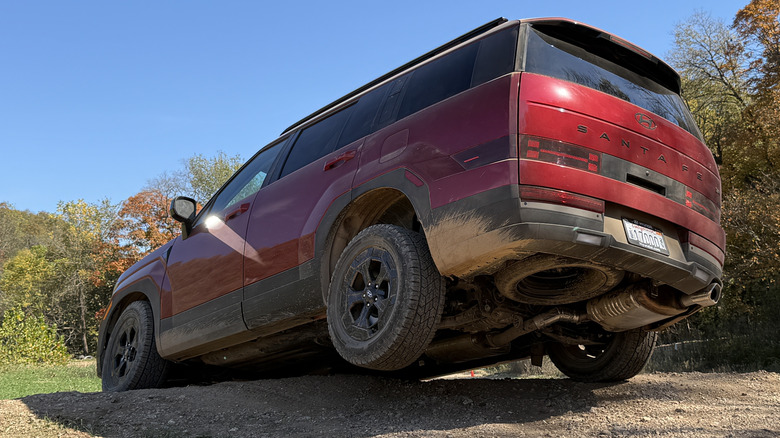
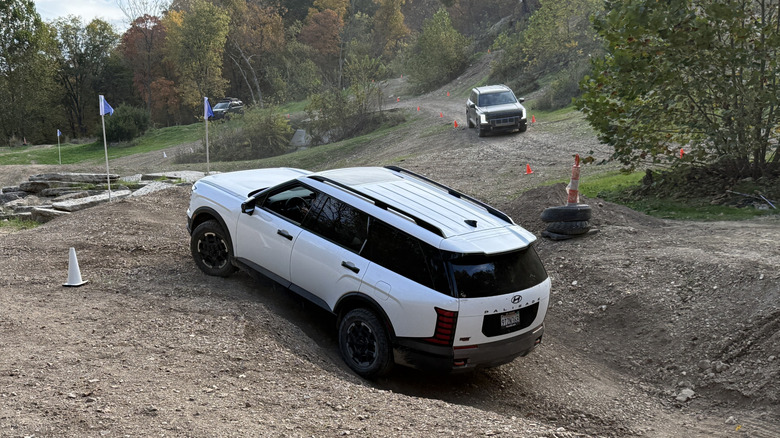
It can be sort of tricky to evaluate the capability of a soft-roader like Hyundai's XRT fleet. Technically, both the Palisade XRT Pro and Santa Fe XRT were able to do everything that was thrown at them on this program, but they both lacked a bit of the sure-footedness I just experienced in Honda's Passport TrailSport, and that was on a far more technical and challenging course. That being said, what I did with the XRT siblings is probably 10 times as grueling as what the average Hyundai owner will do with their SUVs. There's also the issue of tires. While the Passport TrailSport is fitted with beefy General Grabber A/T Sport all-terrain rubber, the Santa Fe XRT makes do with less-aggressive Continental TerrainContact A/Ts, which leads to a good bit of wheel slippage.
Still, both XRTs do an admirable job of tackling trails, though rock crawlers they are not. The Palisade XRT Pro I drove was certainly the more capable of the two, thanks to its electronic limited-slip differential in the rear and a 360-degree camera that helped overcome its sheer size, but it never felt particularly at home, even if it did tackle every obstacle without much protest.
 Andy Kalmowitz / Jalopnik
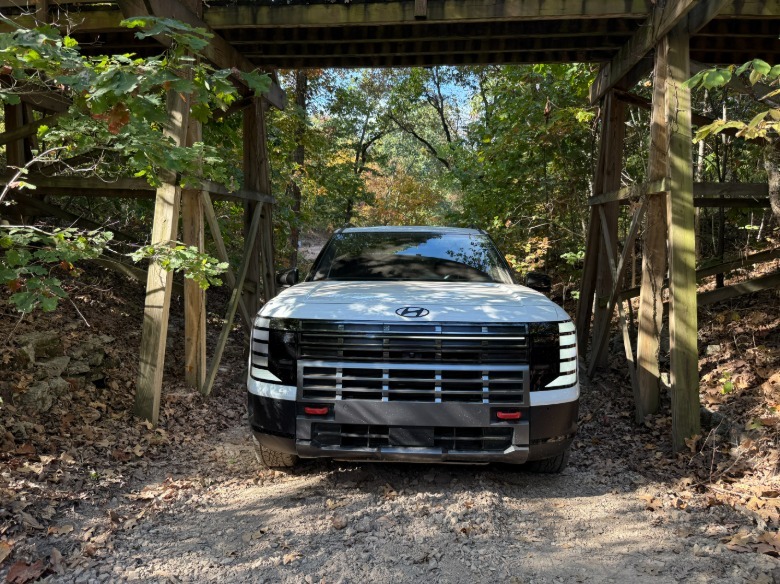
I say much protest because, while the car didn't get stuck at any point, the 4,575-pound crossover didn't exactly seem happy, and that especially goes for its Hyundai-built 8-speed transmission. While the naturally aspirated 3.5-liter V6 provided enough power (287 horsepower and 260 pound-feet of torque) to get up just about anything despite a lack of low-end oomph, I could tell that the 8-speed was none too pleased. I couldn't hear it on the road, but when switching to the Sand setting in its Trail drive mode, there was a noticeable whine coming from it on the throttle. A temperature readout in the gauge cluster also served as a constant reminder it was, uh, hot, and when I got out of the car, there was an unmistakable smell of hot transmission wafting through the air. From a functional standpoint, the XRT Pro didn't skip a beat, which is certainly a testament to the rest of the Palisade's drivetrain and its 8.4 inches of ground clearance; it bottomed out far less than I expected it to.
 Andy Kalmowitz / Jalopnik
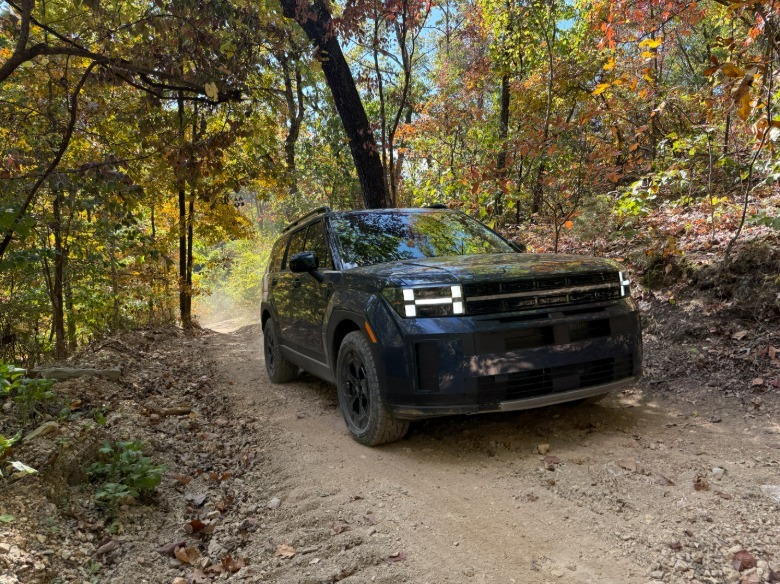
It's a similar story with the Santa Fe XRT. It may lack the e-LSD and all-out grunt of the Palisade, but it does make up for that somewhat with more low-end grunt courtesy of a torquey turbocharged 2.5-liter inline-4 that pumps out 277 hp and 311 lb-ft of torque. This drivetrain lent itself far better to the old-school way of getting yourself unstuck: give 'er some gas. Sure, there are 10 fewer horses than the Palisade's V6, but an extra 51 torques is massive.
Still, you can tell the Santa Fe is a far less luxury-oriented product than the Palisade, and I got bumped around a hell of a lot more than I did in the Palisade. Obviously, there's a price delta to consider, as the Santa Fe XRT starts at $43,940 including destination, and the Palisade XRT Pro has a far more costly $51,820 entrance price.
Where XRT goes
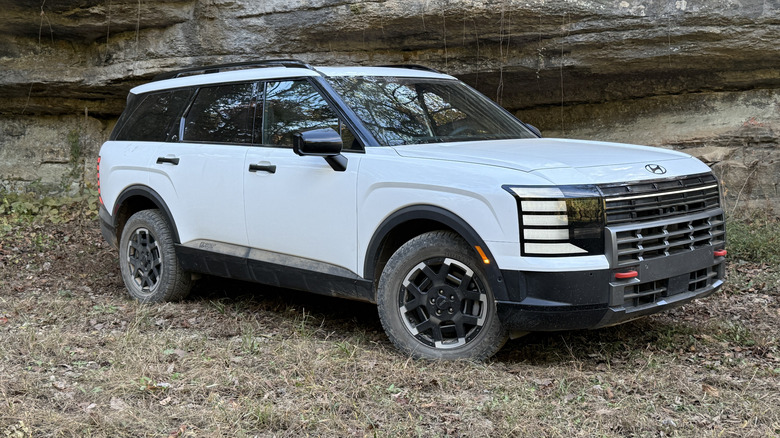
Currently, there are four XRT models on sale: the two I've been talking about, and then the Santa Cruz XRT and the Ioniq 5 XRT. I've driven the Ioniq and had a pretty good time with it, but came away feeling it was more of a styling exercise than anything else. Sure, it can handle some dirt, but that's just about it. While all these models do come with all-terrain tires, a bit more ground clearance, upped towing capacity, better approach and departure angles, and functional front recovery hooks, they're without a doubt behind industry frontrunners like Honda TrailSport and Subaru Wilderness when it comes to real capability.
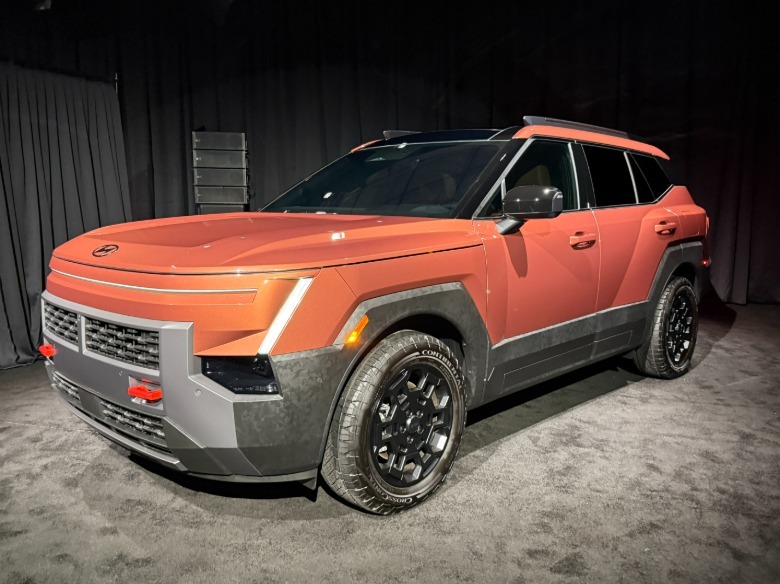
I believe that's because XRT, as a brand, is so new. Hyundai's still trying to find its footing in an ever-more crowded world. It promises that its next product, based on the fifth-generation Tucson, will be its best yet, and far more than an appearance package. Even though the Tucson won't have the e-LSD of the Palisade XRT Pro, despite sharing the "Pro" moniker, it will have skid plates, all-terrain tires, 8.3 inches of ground clearance, some sick body cladding, and Hyundai's new off-road software called Smart Terrain Assist.
 Andy Kalmowitz / Jalopnik
That program has the ability to analyze the terrain ahead of you, determining traction and slip conditions. From there, it provides visual guidance via green, orange or red "stuck zones," and shows the driver the best route to take. It works in concert with Automatic Terrain Detection (which has auto, snow, mud, sand and rock modes) with intelligent mode switching to remove any guesswork from off-roading. Clearly, Hyundai wants to make it as friendly to first-time off-roaders as possible.
Lest we forget, this same team is working on the body-on-frame Hyundai Boulder SUV, which will likely be powered by a hybrid or EREV drivetrain. It shares underpinnings with a future body-on-frame truck Hyundai is also working on, and it's targeted specifically at the American market.
While I'm not sure Hyundai's XRT division is quite the cream of the crop just yet when it comes to soft-roading — it might be a bit too focused on aesthetics, rather than actual performance — there's little doubt in my mind that it'll get to the front of the pack sooner rather than later. Just look at what this massive company has done with its N performance division, or what it has done with Genesis when it comes to luxury. When Hyundai puts its mind to something, it gets the job done, and I don't expect XRT to be any different.