

Desperate For Cheaper Alternatives, Bolivian Farmer Turns Plastic Waste Into Fuel For Tractors

As the entirety of the world continues to be crippled by a dwindling oil supply thanks to the great decision making happening in Washington, D.C., desperate times are calling for desperate and innovative measures. Already the state of Texas called a "statewide disaster" over diesel prices, which allowed truckers to fill up with dyed fuels and home heating oil. In Bolivia, Reuters reports that one farmer has turned a plentiful oil-made product into fuel to run his tractors for the upcoming growth season in the southern hemisphere.
Prices for diesel in the South American country of Bolivia, which currently imports about 95% of its diesel product, now sits at 18 bolivianos, or $1.54 per liter (roughly $6.00 a gallon). The inflationary "wartime" price, a byproduct of the Iran war, is making farming extremely expensive in both the northern and southern hemispheres as one wraps up the harvest season while the other is preparing for its growth season.
Eston Machaca, a Bolivian farmer in the Bolivian Altiplano found a way to help make it more affordable, for now. He's used a plant in Ancocala, about 22 miles from La Paz, to transform materials into more affordable fuel via pyrolysis. Pyrolysis heats materials to high temperatures in an oxygen-starved environment, which then decomposes them into combustible gases. From there, the product can be further distilled and refined into usable fuel for vehicles. For the more visually inclined, YouTuber Garage 54 has two interesting videos making his own quite rudimentary pyrolysis distilling machine, with another video that shows his team creating a final distilling process that made a usable fuel they tested on an old Lada. He made fuel from tires and it worked, quite well.
A suitable fuel substitute
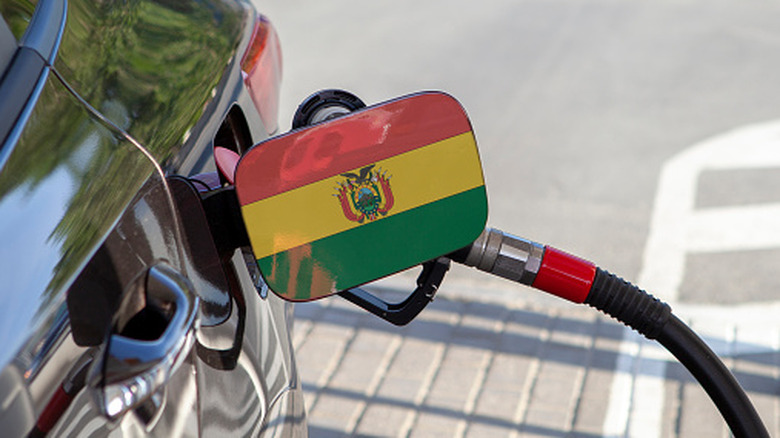
The process and the resulting product are not a perfect substitute for the real thing, but it has been getting the job done, and much more cheaply at that. Machaca told Reuters he's been using plastics — plastic bags, rubber tires and used oil — to produce about 80 to 150 liters, or about 21 to 40 gallons of usable fuel daily. He hasn't sold any of it, solely using it to fuel his tractors. And the cost of that fuel has run at nearly half of that of market diesel, between 7 and 10 bolivianos, or $0.60 to $0.86 per liter (about $2.31 to $3.31 a gallon). You would have a hard time finding anyone who wouldn't want to pay those kinds of gas prices right now.
Machaca is just one of many trying to find ways to survive the fuel shortages and prices affecting the world. Russia, in dealing with its own created mess, has resorted to modding cars to run on LPG, otherwise known as liquified petroleum gas. In Cuba, cars have been getting converted to electric to weather out the storm as long lines and the country's fuel lottery remain hopeless. Meanwhile, over in Europe, adoption rates of EVs continue to soar in response to the wildly expensive fuel prices. It seems the U.S. is the only country sort of going about things as usual, aside from the dyed diesel plight. Though it could be only a matter of time before Americans may need to start getting equally as crafty.