

The Reason Why Cars In Europe Are Smaller Isn't Just About The Price Of Fuel
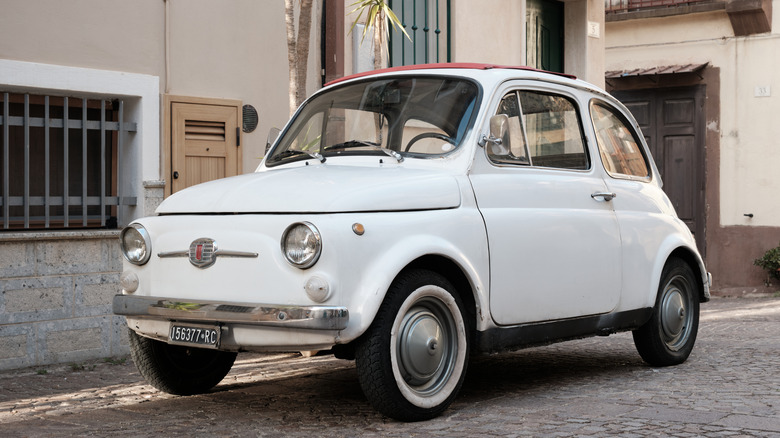
It's not a blanket rule, but generally speaking, cars in Europe are smaller than those that find success in America. Not just recently, but historically, too. While the best-selling cars in the U.S. during the '60s were predominantly far larger models like the Lincoln Continental and Chevrolet Impala, Europe had the hugely successful Fiat 500, Volkswagen Beetle, and classic Mini – all huge triumphs with tiny footprints.
The reasoning behind Europe's continued preference for smaller cars can partly be attributed to fuel costs, but not wholly. In many European towns and cities, the streets were developed long before mass vehicle ownership, and it's these narrow roads and limited parking space that make ownership of large SUVs look far less desirable. Instead, a compact hatchback can far more easily navigate the same streets and sneak into many a space that U.S.-centric SUVs and trucks would have to drive past.
There are also financial incentives which affect car-buying decisions in Europe. For example, European Union emissions rules place strict limits on the average CO2 emissions of manufacturers' new-car fleet. While one of these factors independently explains the difference in vehicle sizes between Europe and the U.S., together, they do paint a picture of why European buyers typically enjoy different vehicle preferences.
European cities were not originally built with cars in mind

Historic urban centers in Europe make large SUVs and trucks, the types of which are typically very popular in the U.S., look seriously impractical. The famous trio of Clarkson, Hammond and May made this point quite comedically in the "Grand Tour's" special episode "Lochdown," where they attempted to navigate Edinburgh's steep city center in classic American land yachts.
Such cities and their streets were designed decades and centuries before widespread car ownership was even considered. Adapting historic centers to work for modern motorists, while also taking into account pedestrians and preserving the historical character, is certainly more challenging than starting from a car-centric angle in the first place. And so a vehicle's external dimensions directly affect just how easily it can navigate urban centers throughout Europe. The fact that these cities were often designed before mass car ownership also explains why parking is scarce; parking spaces simply weren't originally designed into the cities.
Looking at standard parking sizes in both Europe and the U.S. highlights these differences clearly. In the U.S., a standard parking space measures 9 feet wide by 18 feet long, whereas in the UK, a standard space sits at 15.7 feet long by 7.9 feet wide. Not a huge difference, but consider that a 2026 Chevy Silverado sits at 81.2 inches wide without the mirrors, or 6.77 feet, which would leave UK citizens with only around half a foot on each side. The RAC already documents how the increase in vehicle size is applying pressure on the UK's parking spaces, and that's even without motorists taking a liking to the full-size creations that populate a significant portion of the U.S.'s annual best-selling lists.
Fuel costs and emission-related taxes are heavy influencers

While not the sole factor behind European car buying decisions, fuel prices do remain an important part of the picture. While costs obviously do vary from one country to the next, as a general rule, fuel prices — and specifically, the taxes applied to fuel prices – are currently significantly higher in Europe than they are in the U.S. As of writing, the average price of gas in all of Europe revolves around $2.24 per liter, or roughly $8.84 per gallon.
Naturally, higher prices make vehicles with higher consumption look less desirable. So while a feature-laden full-size certainly has its benefits, a more fuel-efficient choice, like the subcompact Volkswagen T-Roc – Europe's best-selling SUV – often makes more sense to European buyers. Interestingly, the T-Roc even made it as Europe's most popular mainstream convertible model.
Taxation influences vehicle choice beyond the fuel pump, too. Throughout most of Europe, taxes related to registration, annual road usage, and company car schemes are directly related to CO2 emissions. The EU also sets CO2 targets for new-car fleets, with the fleet-wide target for new cars currently sitting at 93.6 grams of CO2 per kilometer for 2025–2029, with an even lower CO2 target scheduled for 2030–2034. Such rules encourage automakers to drop average emissions across their range, and smaller vehicles with smaller, more efficient engines are an effective way of achieving this.
So, while fuel and vehicle taxation do not distinctly require European drivers to buy small cars, they do create an environment in which it is financially most sensible to do so. Couple that with narrow streets and restrictive parking spaces, and it becomes clear why buying behaviors differ so much from one side of the pond to the next.