

These Are The 12 Quickest Porsche EVs
Before Porsche launched its first EV, the Taycan, in 2019, the list of the quickest Porsches was mainly populated by 911 Turbos, GT2s, and the 918 Spyder hybrid hypercar. Today, however, the Stuttgart-based automaker has six different models in its portfolio that are quicker than the latest 911 Turbo S.
That's mightily impressive, because the 2026 911 Turbo S packs Porsche's T-Hybrid powertrain and is good for 701 horsepower and a 0-to-60 sprint of 2.4 seconds. Yet, you can match that acceleration figure with a Porsche-badged family SUV that accommodates five people and their cargo without coughing CO2 or other pollutants into the atmosphere (at least not directly).
Heck, the 911 Turbo S won't even earn a spot on the podium in this list of the quickest Porsche EVs. Nor will it seat more people or carry more cargo. Electric cars have already set a new 0-to-60 benchmark, and Porsche's EVs are some of the fastest around. And we aren't talking hypercars here, but family SUVs (Macan and Cayenne Turbo Electric) and all-terrain wagons (Taycan Turbo S Cross Turismo). So, get ready for some relentless acceleration figures, often in the sub-3-second range.
Before we jump into the matter, it's important to note that we ranked these cars using Porsche's official acceleration figures. In one case, we had to source a 0-to-62 mph (0-to-100 km/h) acceleration figure because that model was never sold in the U.S. The 0-to-60 mph time for this car should be lower, but we won't delve into calculating the exact figure because it involves many variables. Also, all acceleration times are with launch control enabled.
2025 to 2026 Porsche Taycan GTS Sport Turismo (0 to 60: 3.1 seconds)
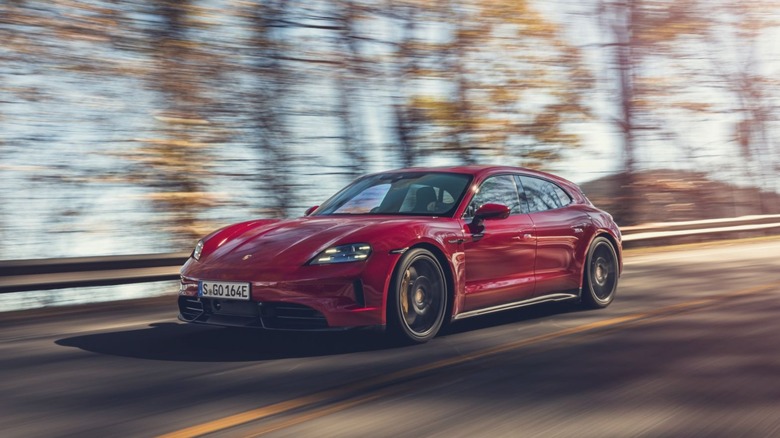
The Porsche Taycan GTS Sport Turismo, aka, the wagon variant of Porsche's four-door EV, wasn't built for record 0-to-60 times, but as a driver's car. Yes, with an official 0-to-60 figure of only 3.1 seconds, it's still amazingly quick but nowhere near as ballistic as the Turbo or Turbo S variants. It packs "only" 690 horsepower and 582 pound-feet of torque, spread across two electric motors — surely not a number Porsche's marketing team can brag about in an era when performance EVs have four-digit horsepower figures.
And that's only when you press the overboost button on the steering wheel — as standard, the GTS Sport Turismo produces 596 hp. Even so, the Taycan GTS Sport Turismo seems to be more effective than what Porsche's acceleration figure suggests. Car and Driver brought this performance wagon to 60 in only 2.8 seconds and dispatched the quarter mile in 10.8 seconds. Motor Trend achieved the exact same times in its review.
But the GTS Sport Turismo wasn't built to steal headlines. It's the sort of car engineers build for themselves — one that pairs the right amount of power with a balanced chassis. See, like higher-end Taycans, the GTS Sport Turismo comes standard with the Torque Vectoring Plus system with a locking rear differential, which helps it stay planted and engaging in the corners. Add the rear-steering option, and the GTS Sport Turismo will feel even more agile and responsive. It's a car that weighs over 5,200 pounds, but you'll hardly ever feel that in the twisties. Besides, that weight was necessary to accommodate the larger 105-kWh battery, EPA-rated for 279 miles on a charge.
2025 to Present Porsche Taycan GTS (0 to 60: 3.1 seconds)
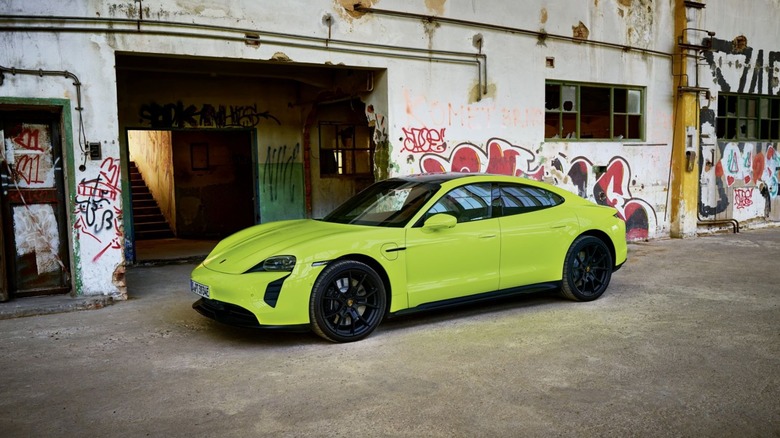
The Taycan GTS is basically the same car as the GTS Sport Turismo but in sedan form. As a result, at 5,057 pounds, it's a bit lighter than its wagon counterpart, which would lead you to believe it should be quicker. Still, Porsche's official acceleration figure suggests the same 0-to-60 time of 3.1 seconds. Both models also have a governed 155-mph top speed.
Even so, the lower weight brings some range advantages, with the Taycan GTS able to travel an additional 14 miles (293 miles) on a charge, per EPA estimates. Still, the Taycan GTS has a smaller 15.9-cubic-foot cargo capacity compared to GTS Sport Turismo's 17.2-cubic-foot utility space (frunk plus trunk). Wagons also have larger rear openings that can swallow bigger items, making Porsche's discontinuation of the Taycan wagon variants for 2027 a bitter pill to swallow.
Naturally, the regular Taycan GTS also comes with the same standard chassis tech as its wagon counterpart. Rear-wheel steering and Porsche's Active Ride are optional, as they are on the GTS Sport Turismo. In other words, both models should be equally fun to drive on a winding road.
However, there is one addition that should make the 2027 Taycan GTS more engaging than the discontinued wagon variants: the E-Shift system with eight simulated gear changes. The tech works similarly to Hyundai's N e-Shift and employs a special Electric Sport Sound to make the shifts more believable.
2025 to Present Porsche Macan Turbo Electric (0 to 60: 3.1 seconds)
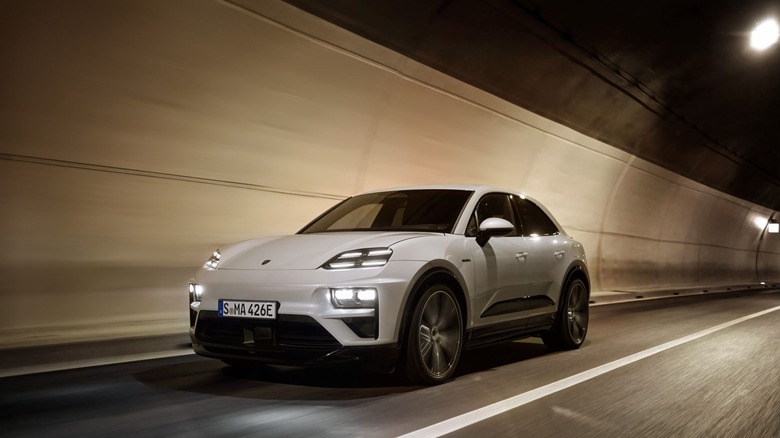
Porsche completely revamped the Macan formula for 2025, turning its best-selling model into an EV. The internal-combustion Macan is still on sale, but if you want Porsche's latest and greatest, the Macan Electric is the clear winner
Currently, there are five distinct models in the range: the Macan Electric, 4, 4S, GTS, and Turbo Electric. Even the base 355-horsepower model is relatively quick, reaching 60 mph in 5.4 seconds, but the dual-motor 402-hp Macan 4 and 509-hp Macan 4S are quicker at 4.9 and 3.9 seconds, respectively. The Macan GTS variant we tested this year is even spicier, packing a 563-hp drivetrain for a 3.6-second 0-to-60 time.
Still, it's the Macan Turbo Electric that offers true supercar pace, courtesy of a 630-hp (with overboost) dual-motor drivetrain. It reaches 60 in 3.1 seconds, as quickly as the Taycan GTS, which may be due to the higher 833 pound-feet of torque. Curiously, the Macan Turbo Electric's top speed is also higher at 162 mph. But the Turbo wouldn't be worthy of its badge if it was only fast in a straight line. So, it comes as standard with adaptive air suspension and Porsche Torque Vectoring Plus, which turn it into a very capable corner carver.
Still, the Macan Turbo Electric isn't as practical as you'd expect from an SUV. The 20-cubic-foot overall cargo capacity is fine, but the rear seats are a bit tight for adults. Conversely, the 293-mile range is good for a performance EV, and the 270-kW charging juices the 100-kWh battery from 10% to 80% in just 21 minutes.
2025 to 2026 Porsche Taycan Turbo Cross Turismo (0 to 60: 2.6 seconds)
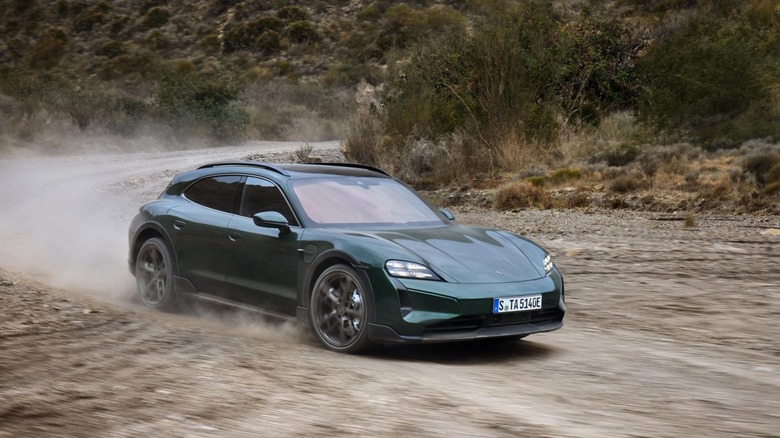
The Turbo Cross Turismo is the off-roady, lifted variant of the Taycan Sport Turismo. As such, it has a slightly raised ground clearance (0.4 inches) and some body cladding, though it still runs on high-performance summer tires. So, in essence, you probably wouldn't want to off-road this thing, at least not over challenging terrains.
On the other hand, those tires allowed Porsche to offer the Taycan Cross Turismo in the bonkers Turbo trim, which produces 697 horsepower and 626 pound-feet of torque or a whopping 871 hp and 656 pound-feet of torque once you engage launch control. That's enough for an astonishing 0-to-60 time of 2.6 seconds, making the Turbo Cross Turismo quicker than the T-Hybrid equipped 911 Carrera GTS.
Although the Turbo Cross Turismo sits higher off the ground, it's still as good in the corners as the other Taycan variants. Buyers could make it even better by choosing the optional Porsche Active Ride and rear-wheel steering. Emphasis on "could," because the Taycan Cross Turismo was also recently discontinued.
As far as practicality goes, the Taycan Turbo Cross Turismo offers a similar 17.2-cubic-foot overall cargo volume as the GTS Sport Turismo. Still, it takes an even steeper range hit compared to the regular wagon, managing only 265 miles per charge.
2025 to Present Porsche Taycan Turbo (0 to 60: 2.5 seconds)
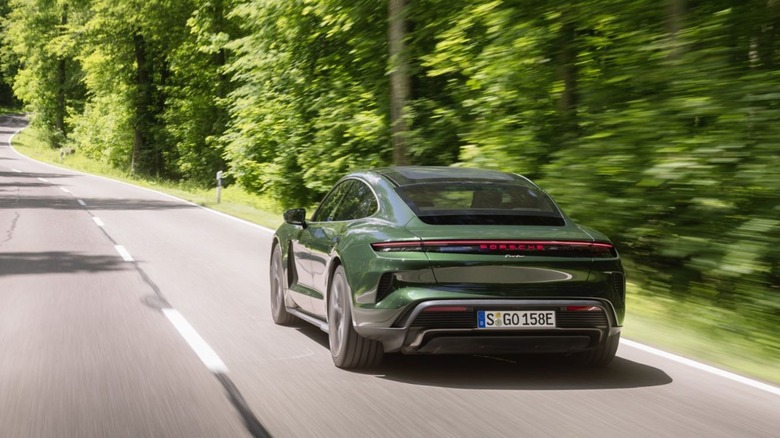
What happens when you put the Turbo Cross Turismo's drivetrain into a lighter sedan body that sits closer to the ground? Of course, you get a quicker 0-to-60 time of 2.5 seconds, but also a slightly higher top speed of 162 mph. Not a huge difference, sure, especially since you lose some cargo capacity by choosing the Taycan Turbo, which, like the GTS variant, offers a 15.8-cubic-foot combined storage across its frunk and trunk.
As far as driving engagement goes, the latest 2027 Taycan Turbo can be optioned with the E-Shift feature, which simulates gear changes via the steering wheel paddles. As standard, the Taycan Turbo rides on adaptive air suspension, with the advanced Porsche Active Ride and rear-wheel steering features available as options.
The Turbo uses the same 105-kWh battery as other performance Taycan variants, which, in this case, is good for 292 miles. Crucially, the 800-volt battery supports charging up to 320 kW, which replenishes the battery from 10% to 80% is just 18 minutes.
2025 to 2026 Porsche Taycan Turbo S Cross Turismo (0 to 60: 2.4 seconds)
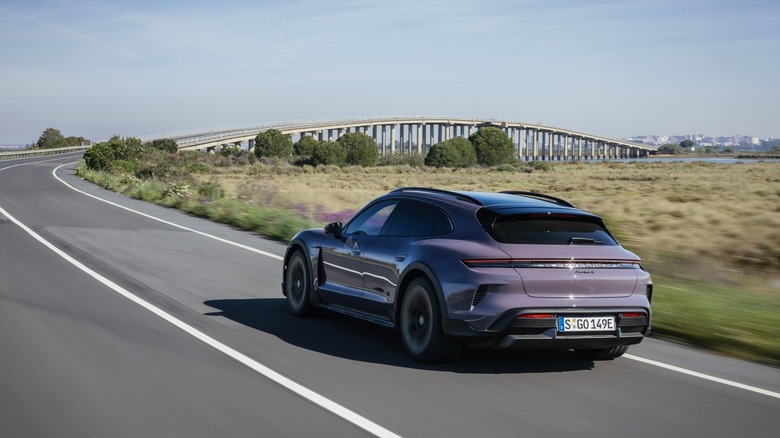
The Cross Turismo might've been the active lifestyle variant of the Taycan, but that didn't stop Porsche from equipping it with the highly potent Turbo S powertrain. Pumping out a massive 938 horsepower, the Taycan Turbo S Cross Turismo blitzes to 60 in only 2.4 seconds and reaches a top speed of 155 mph. However, Car and Driver claims an even quicker time of 2.2 seconds. The publication's quarter-mile time of only 9.8 seconds is equally impressive. In fact, Car and Driver argues that the Taycan Turbo S Cross Turismo could be even quicker with stickier tires!
Like any other high-performance Taycan model, the Turbo S Cross Turismo could (it's also dead in the U.S. now) also be optioned with Porsche's Active Ride suspension system. Meanwhile, ceramic brakes on both ends were standard, as was the Porsche Torque Vectoring Plus system with a locking rear differential. The Taycan Turbo S Cross Turismo has the same 17.2 cubic-feet of cargo volume as the Turbo variant, but also a slightly lower 261-mile range.
2026 to Present Porsche Cayenne Turbo Electric (0 to 60: 2.4 seconds)
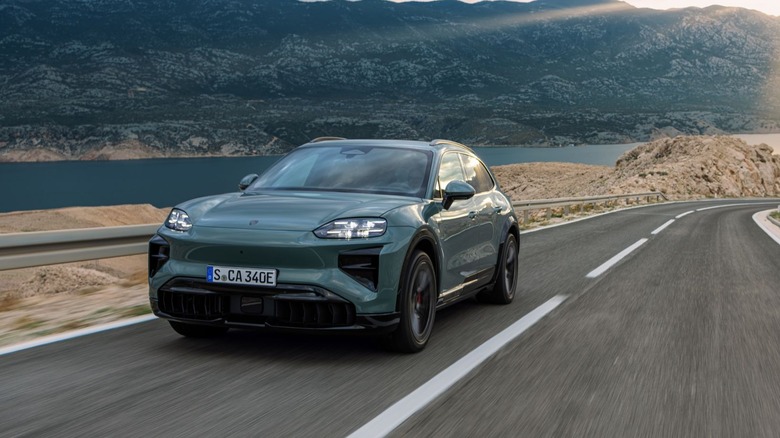
Like the Macan Electric, the Cayenne Electric will sell alongside the regular gas model as a more modern, all-electric variant. It brings some real advances in battery technology that allow charging speeds up to 400 kW, enough to juice the 113-kWh pack from 10% to 80% in only 16 minutes.
Currently, you can choose between three AWD variants and two body styles: a regular "hatchback" SUV and a coupe. The 435-horsepower base model reaches 60 in 4.5 seconds, while the 657-hp S trim cuts it down to 3.6 seconds. Then, there is a sizeable gap to the Cayenne Turbo Electric, which, with 1,139 hp and 1,106 pound-feet of torque on tap, is the most powerful Porsche production car to date. This mightily impressive figure allows a dizzying 0-to-60 time of 2.4 seconds and a top speed of 162 mph. That would make the Cayenne Turbo Electric quicker than the 918 Spyder with the Weissach package (2.5 seconds), Porsche's last hypercar. Heck, in Car and Driver's tests, it sprinted to 60 in only 2.1 seconds and to the quarter mile in 9.5 seconds!
However, it's not just the speed that makes the Cayenne Turbo Electric feel like a bargain at nearly $200,000. It comes as standard with air suspension, but you can option the Porsche Active Ride to combine a velvety ride with excellent body control. The limited-slip diff on the rear axle and Porsche Torque Vectoring Plus are also standard, while a rear-wheel steering is optional. Every Cayenne Turbo Electric is equipped with active aero to reduce drag (0.25 Cd), helping push range to 303 miles with all-season tires and 298 miles with summer tires.
2026 to Present Porsche Cayenne Turbo Coupe Electric (0 to 60: 2.4 seconds)
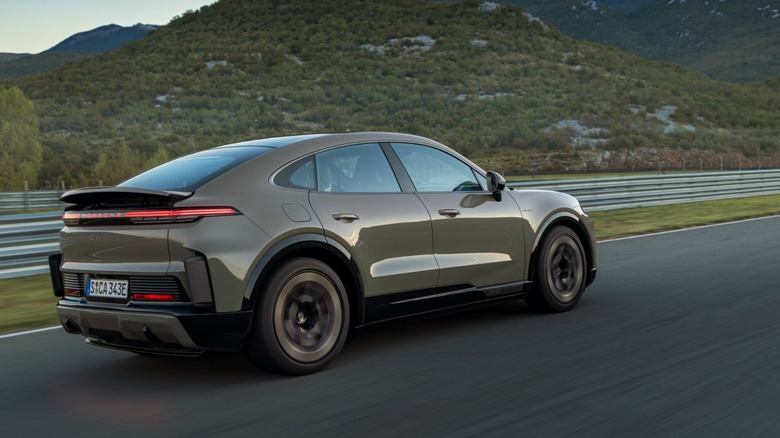
Porsche introduced the coupe variant of the Cayenne Turbo Electric quickly after the launch of the regular model. Both EVs share the same powertrain options, with the top-end Turbo Coupe Electric producing 1,139 horsepower and 1,106 pound-feet of torque. As a result, both dispatch the 0-to-60 sprint in 2.4 seconds and have a top speed of 162 mph.
However, the coupe variant has a completely redesigned rear end that mimics 911's and gives the Cayenne a less of a soap bar look. Crucially, it gives the SUV an even lower drag coefficient of 0.23 Cd, which stretches the range to 307 miles with all-season tires and 302 miles with summer tires.
Conversely, the sloping roof makes the Cayenne Turbo Coupe Electric a bit less practical than the regular variant. Both models share the same 3.2-cubic-foot frunk, but the Cayenne Turbo Electric has a much larger 26.4-cubic-foot trunk, compared to the coupe's 17.7-cubic-foot trunk. The overall capacity of the standard model is also higher at 54.9 cubic-feet versus 46.4 cubic-feet, with the Cayenne Turbo Coupe Electric also offering less rear headroom. Apart from that, the coupe should offer the same driving experience, as it also shares the standard and optional chassis tech.
2025 to Present Porsche Taycan Turbo S Sport Turismo (0 to 62: 2.4 seconds)
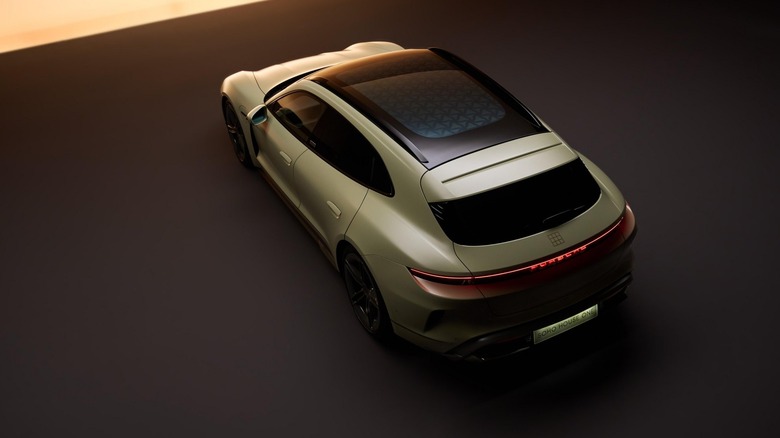
Porsche never offered the Taycan Sport Turismo in Turbo S guise in the U.S., but that model is still available in international markets, where Porsche hasn't discontinued any of the wagon models. Still, it's largely the same car as the Turbo S Cross Turismo, minus the higher road clearance. The Turbo S Sport Turismo is rated at 939 horsepower and 819 pound-feet of torque for international markets, and, according to Porsche, reaches 62 mph (100 km/h) in 2.4 seconds. This should make it a tad quicker than the Turbo S Cross Turismo, which reaches 60 mph in the same amount of time. Top speed is 162 mph.
Like the latest Taycan sedan for the North American market, the Turbo S Sport Turismo can now be optioned with the E-Shift simulated gearbox internationally. Still, the international Turbo S trim comes as standard with air suspension and rear-wheel steering, with Porsche's Active Ride offered as an optional extra. As such, it's still an excellent car to whip around a backroad. Porsche says the Taycan Turbo S Sport Turismo charges from 10% to 80% in 18 minutes and will travel 339 to 377 miles on a charge (depending on specifications).
2025 to Present Porsche Taycan Turbo S (0 to 60: 2.3 seconds)
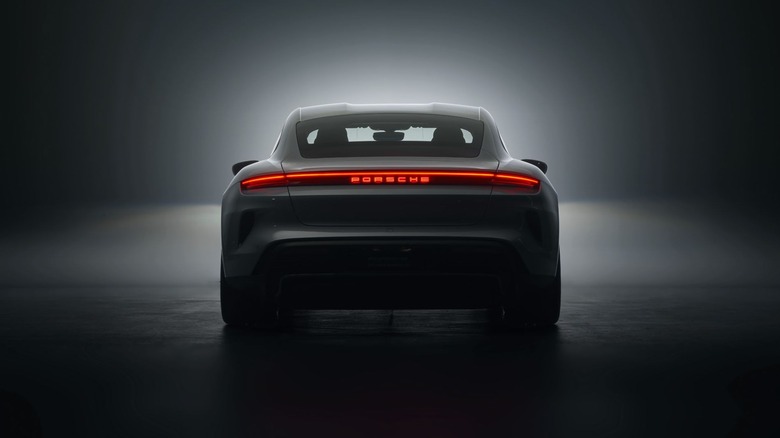
The Taycan Turbo S continues to be sold in the U.S. for the 2027 MY as one of Porsche's quickest cars. It packs an identical dose of dual-motor punch as the Turbo S variant of the Cross Turismo and Sport Turismo, which translates to 938 horsepower and 818 pound-feet of torque with launch control enabled. As a result, it blitzes to 60 in a neck-snapping 2.3 seconds and has a top speed of 162 mph.
Perhaps the most significant feature the Taycan Turbo S received for 2027 is the optional E-Shift system, designed to simulate Porche's PDK dual-clutch gearbox. The system adjusts powertrain torque to mimic gear changes and also simulates powertrain noises. The driver can quasi-shift gears using paddles behind the steering wheel.
The latest Taycan Turbo S also includes rear-wheel steering, Porsche Torque Vectoring Plus, ceramic brakes with yellow calipers, and adjustable air suspension right out of the box, with Porsche Active Ride offered as an option. The Taycan Turbo S' range is rated at 266 miles combined, which is on the low side.
Porsche Taycan Turbo GT (0 to 60: 2.2 seconds)
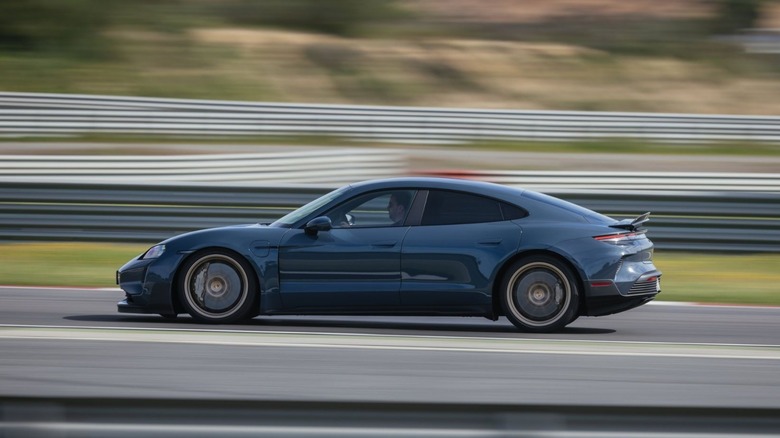
The Turbo S badge has adorned Porsche's fastest and most powerful cars ever since it appeared on the 1992 964-generation 911 Turbo S. Yes, Porsche also launched more potent limited-edition machines like the Carrera GT and 918 Spyder, but as far as the core range was concerned, Turbo S models were top dogs.
That is, until the Taycan Turbo GT arrived for the 2025 MY, which now sits above the Taycan Turbo S in the pecking order. Perhaps it's an EV-only thing, as neither model has a turbocharger. Still, with a colossal dual-motor electric drivetrain that produces 1,019 horsepower and 914 pound-feet of torque, the Turbo GT reaches 60 mph in an even quicker 2.2 seconds. Top speed is also higher at 180 mph.
But the Taycan Turbo GT doesn't only include motor tuning. It also comes as standard with the Porsche Active Ride system with unique GT tuning, and, thanks to extensive use of carbon fiber, weighs 165 pounds less than the Taycan Turbo S. To keep it stable at speed, Porsche also equipped it with an aggressive aero package that includes front end aeroblades and a rear "Gurney flap" spoiler. All things considered, the Taycan Turbo GT is the logical next step for track-day fans. The only option left to tick is the simulated E-Shift gearbox, which should add even more drama to the absurdity of this car.
Interestingly, perhaps thanks to the lower weight, at 276 miles, the Taycan Turbo GT has a higher EPA-estimated range than the Taycan Turbo S. Because it uses the same battery, though, it charges from 10% to 80% in identical 18 minutes.
Porsche Taycan Turbo GT w/ Weissach Package (0 to 60: 2.1 seconds)
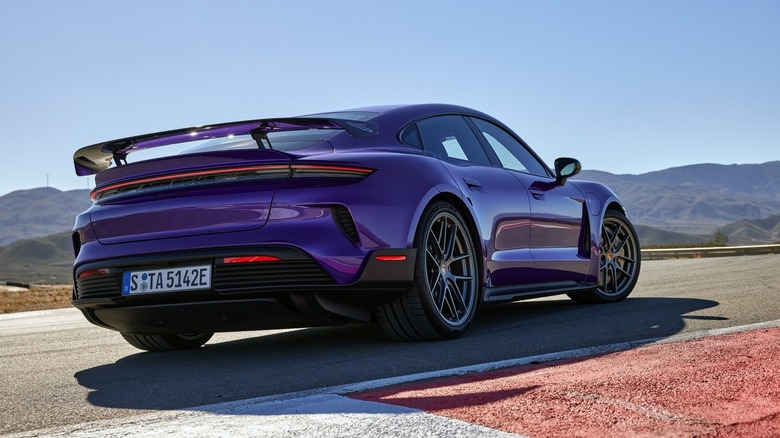
Is the Taycan Turbo GT not crazy enough for you? You can turn its outrageousness up to 11 with the Weissach Package. It doesn't bring any powertrain improvements and is still rated at 1,019 horsepower and 914 pound-feet of torque, but it cuts 165 pounds from the Turbo GT's weight, thanks to extensive use of aluminum and carbon fiber and the deletion of the rear seats.
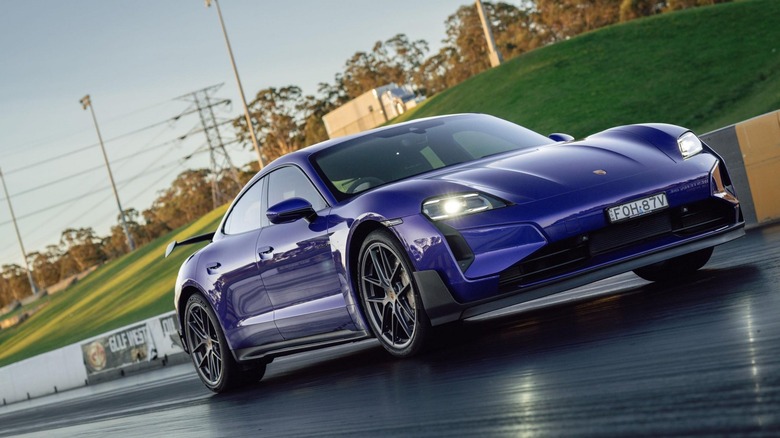
Cashing in on that diet, the two-seater Taycan Turbo GT storms to 60 in only 2.1 seconds. On a prepped surface at the Sidney Dragway in Australia, Porsche even measured an unbelievable quarter-mile time of 9.083 seconds, a new record for an unmodified production car at the strip.
The Weissach Package also brings improved cornering stability courtesy of a carbon rear wing, more aggressive front splitter, carbon side skirts, and underbody air control elements. Track-day enthusiasts can go even more hardcore with the Manthey Kit, which has a racecar-like aero and further optimized chassis. The Porsche Active Ride system and E-Shift feature are optional with the Weissach Package.