

Here's How My 15-Year-Old Porsche Cayenne Held Up To 10,000 Miles Of Driving In 16 Days
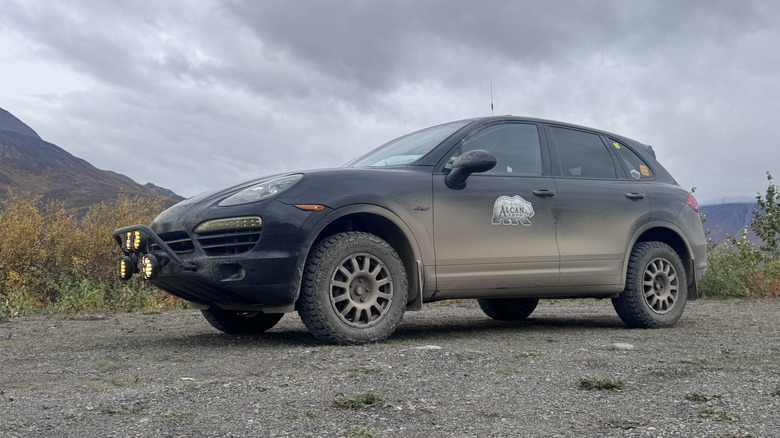
I love a good road trip, and I'm not going to shy away from long miles (kilometers?) in the driver's seat. When a friend asked if I'd like to accompany him on the 2026 running of the famed Alcan 5000 rally across Canada and Alaska, it was the work of mere moments to agree to the trip and offer my old Porsche Cayenne Diesel as our shared steed for the event. It's comfortable, offers plenty of ground clearance and visibility, and it positively sips fuel compared to its gasoline-powered counterparts. When I signed up for the event in November of 2025 I had no way of knowing the world's oil supplies would be completely buggered by the President's idiotic war in Iran, and the national average price for a gallon of diesel would explode from $3.82 then to $6.50 now. So it goes, press on regardless.
In addition of the wear and tear on a human body sitting in a car for 10,000 miles over 16 days, and the damage done to our collective wallets, that many miles in that short of time is bound to wreak havoc on a car. Especially a 15-year-old German luxury car with an odometer that just crossed into the six figures. I told my co-driver that the contingency plan for the car, depending on how deep into the wilderness we were when we broke down, would be to light a torch and walk away. I was only half kidding.
I brought enough supplies on this trip to ameliorate minor failures, punctured tires, and the odd leaky hose. There was very little chance that any repair shops along the route would be properly set up to fix a modern Porsche, despite its heart being a simple Volkswagen/Audi 3.0 TDI V6.
Thankfully we didn't need a pricey tow, and I made it back home again without lighting the torch. That sizzling sound you might hear is my wallet burning through roughly 10% of my annual income in a two week adventure. I figured now is as good a time as any to discuss what broke, how much it cost to fix, and what I would have done differently.
What broke?
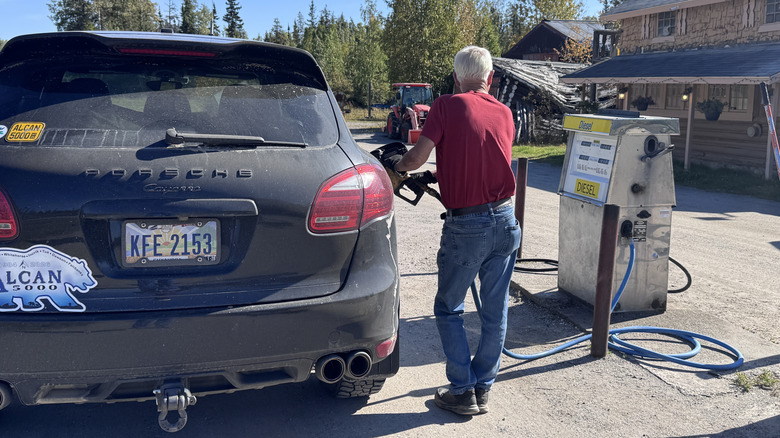
Before I left for this trip I dropped the Cayenne off to a friend of mine who is a Porsche Certified mechanic who used to work at a dealer but has put out his own shingle as an indie. I trust his work, and have no qualms with his rates to boot. When I dropped the car off it had a light coolant leak, and I asked him to give it a once over in advance of a big cross-country road trip. My mechanic also used to live in Alaska, so he knows the rigors to which the Cayenne needed to withstand. Once he'd given the car a clean bill of health, I was reasonably confident we'd be in the clear.
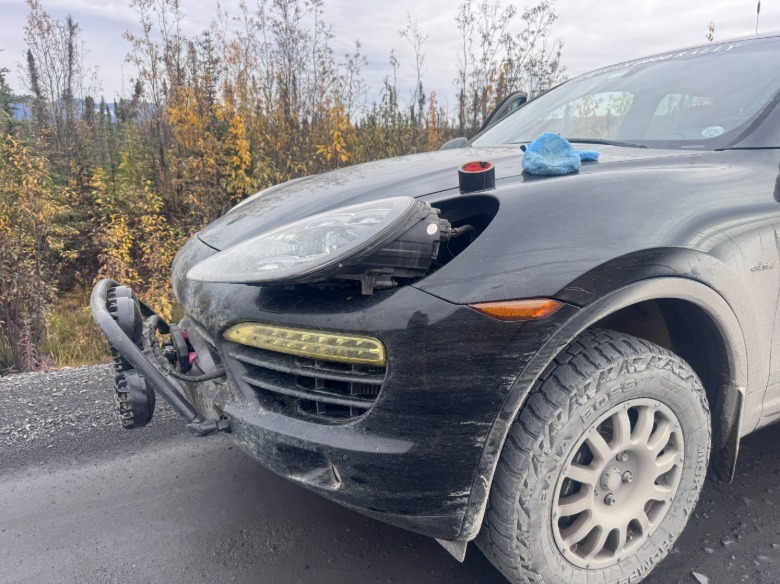
What actually went wrong with the Cayenne on this lengthy trip? Nothing that completely sidelined us, and nothing long-term painful, but many annoying little things. In actuality, the car made it 10,000 miles from my house in Reno, Nevada to the farthest reaches of Canada's road system, and returned without any permanent problems. Here are the problems that did occur; the bumpy roads shook both plastic headlight brackets until they cracked and the headlights popped out, the mud from wet dirt roads caked inside the rear wheels like concrete wore through the brake pad wear sensors (which threw a brake warning light on the dash), and the windshield received four fresh rock chips. The worst of the issues involved a ridiculously huge pothole in the middle of the night that bent both right-side wheels.
 Bradley Brownell/Jalopnik
The windshield is covered by insurance, so I'll have to pay a few bucks out of pocket, but it's not a big deal. The headlight brackets are available aftermarket for about $40 per side. The pad wear sensors are under $10 each, but I have a full set of rear rotors, pads, and sensors sitting on the shelf at my shop, so I'll just swap everything out at once when I get back to Cleveland, Ohio for the winter. Earlier this week I dropped off the Cayenne to a wheel shop to get them trued up for a reasonable $515. Throw in a nice detail and I'm still under $1,000 in repairs for this trip, which is about what I had budgeted.
How much did it cost?
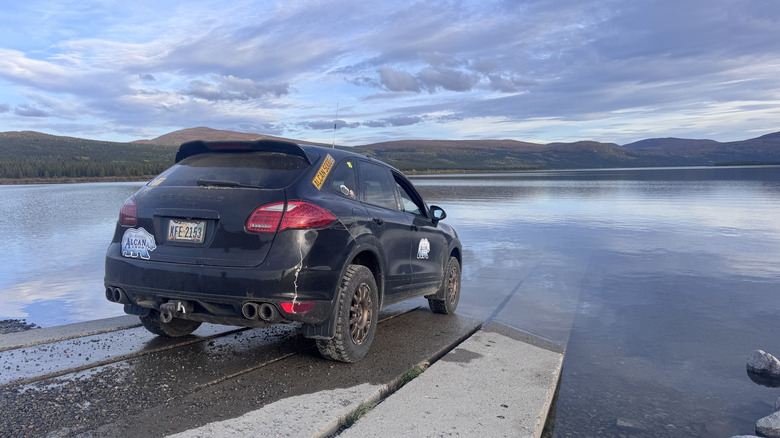
If you were to go on this huge two-week adventure to the arctic, what kind of dosh would you have to shell out to make it happen? I'm very thankful that I went on this trip with a friend, not only for the camaraderie, but to help split the cost and the driving burden. I'm going to go kind of broad here, because there are certainly more expensive and less expensive ways to make this trip happen, we went kind of down the middle of the road. I brought snacks to avoid expensive and unhealthy gas station fare. We drove through the night twice, sleeping in the passenger's seat to avoid extra hotel bills. We kept our trinket and souvenir buying to a minimum. It was still a pretty expensive trip.
Being part of the Alcan 5000 rally made the trip significantly easier, as the route was pre-planned and hotels for 11 nights were included in our $4,200 registration fee. By being part of the rally we didn't have to go it alone. There was always someone in our group willing to stop and help out if needs arose, and an event-specific sweep truck to help haul a broken car to the next nearest town. Even if you aren't interested in the TSD competition aspect of the rally, it was worth it to have that peace of mind and ease of navigation handled for us.
Outside of the cost of the rally and hotels, diesel was easily our biggest expense. The Cayenne got slightly worse mileage on the Canadian winter mix diesel, averaging 28ish miles per gallon across the 10,000 mile event, while I usually achieve numbers into the low 30s. A full tank is going to last around 650 miles at that usage rate, which was plenty of range for us to make almost every day without stopping. With an average per-gallon cost running around $7 for the full extent of the trip, we spent around $2,500 on fuel. Throw in another $400 for a pair of oil changes, around $100 in diesel exhaust fluid, and a few bucks for a couple quarts worth of top-up oil, and the truck consumed over three grand in petrochemicals.
I would guess that between the two of us, we ate and drank another $1,000 worth of miscellaneous snacks, meals, beers, early morning Tim Hortons coffees, and other. We were trying to be frugal, but a dollar doesn't buy as much food as it used to, especially in Canada. Throw in the $3,600 worth of upgrades I made to the Cayenne before leaving, the mileage wear on those incredible Mickey Thompson off-road tires, and buying an off-road jack for the trip, and it adds up quickly. Let's say all-in we're looking at more or less $12,000 to do this trip, not including the cost of the vehicle or its mileage depreciation.
If I were to do this all over again, I probably would forego some of the preparation I did in advance of the rally. I don't think this truck really needed a two-inch lift, a brush bar, a winch, etc. Though the auxiliary lights did help quite a lot on the overnight drives back home with crepuscular wildlife darting back and forth across the roads. Then again, the Cayenne looks way more bitchin' with that stuff installed, so maybe it was worth it after all.