

Trump's Idea For A West Point-Style Space Academy For NASA Begins To Take Shape
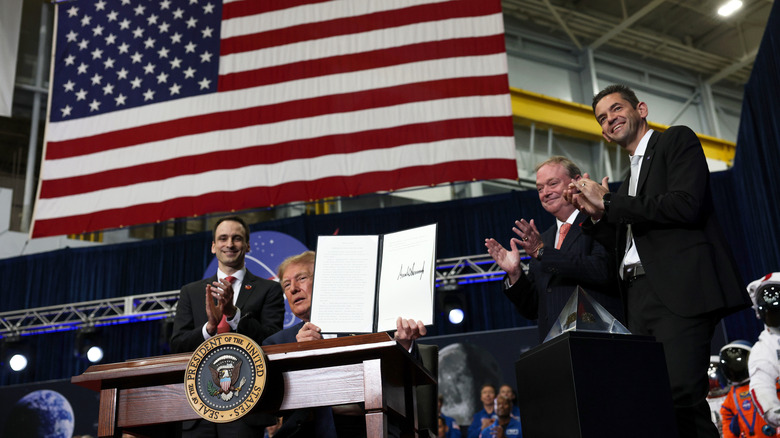
When President Donald Trump signed an executive order on August 28 to establish a United States Space Academy (USSA), details were a little sparse. Now, NASA has put out a Request for Information (RFI) that's bringing the distant object into clearer focus. The USSA will be a federally funded and managed academic institution with a physical campus run by NASA, similar to how the Army runs West Point. The idea is to build science, engineering, and research facilities to train the next generation of talent that the space sector will require, taught by expert faculty. As with West Point, students would be required to work in the field for a few years after graduation. According to the RFI, this won't be fully built out until 2031, but an interim program will take an initial cohort of students in 2028.
There's a number of things happening in this RFI. First, the need is real: The booming space sector is facing a shortage of qualified workers, which is hindering America's modern-era push into space. In an age where space companies are worth $2 trillion and militaries around the world are investing more heavily in orbital capabilities, it's good for both the economy and national security to have a steady pipeline of working talent.
An unusual process for building a school

That said, the way the Trump administration is going about this is a bit unorthodox. First off, government academies like West Point require Congressional authorization to exist. Trump's executive order is a kick-off for the USSA project, but is nothing more than an idea without the legislative branch on board. Second, the goal of a first cohort by 2028, before the campus is even (proposedly) finished by 2031, is unusual. There are some other space-based goals slated for 2028 as well, chief among them landing astronauts back on the Moon. Why is 2028, specifically, the year for such ambitious targets? Nothing official. In unrelated news, 2028 will be the final year of the Trump presidency.
The RFI has some other oddities as you dig into it. The core purpose of the document is to allow states to petition to be the location for the USSA. There are a number of features that NASA is looking for, such as proximity to aerospace hubs, research centers, or NASA facilities. Makes sense. More perplexing is the page limit: States have to make their pitch in no more than 47 pages. That's a strange number, isn't it? Why not just round up to 50 pages? Well, Trump is the 47th president of the United States, and the in-development F-47 fighter jet was given that number in part as a reference to Trump.
For what it's worth, the RFI also mandates that the proposals from states "shall be Times New Roman, size 12... Text shall be single-spaced with double-spacing between paragraphs." Yes, your college papers really did prepare you for the real world.
Precedent and unprecedent
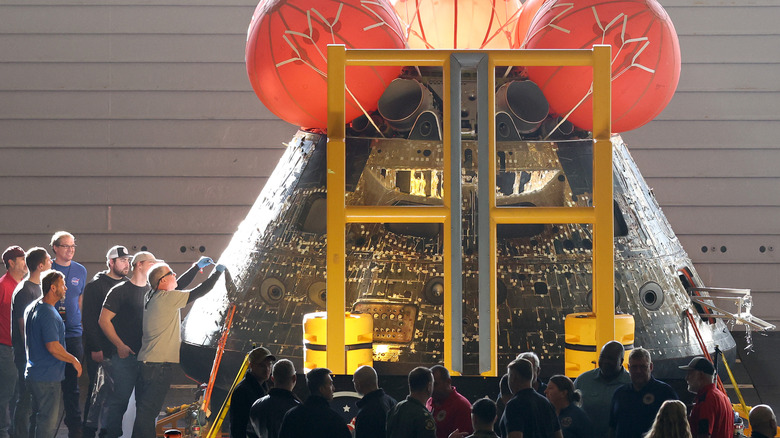
The RFI stipulates that the USSA campus must have appropriate engineering facilities, at least 300 acres, and capacity for up to 4,000 students. It must also have sports arenas, so apparently space cadets may crash the next big Army-Navy football game. But for the 2028 cohort (and all the rest until the campus is built), the cohort will have to attend another, pre-existing college near the future actual site.
While this all has precedent in service academies like West Point, it's also novel in the sense that it has no direct ties to the military. The closest parallel, as NASA Administrator Jared Isaacman himself points out, is the United States Merchant Marine Academy, run by the Department of Transportation. Even there, however, students are part of the Navy Reserve. The USSA will be the first entirely civilian service academy. What does that mean for the students' working obligations post-graduation? What will formally define a "space job"? TBD.
There is potentially another way to do all this. In an opinion piece for SpaceNews, Todd Harrison argued for re-thinking the USSA program as closer to the military's ROTC system. This way, instead of building a whole new expensive campus somewhere (which Congress hasn't approved yet), students would just receive federal support to go to pre-existing universities to take specific classes. Upon graduation, students would have a work obligation in the field for a few years.
Either way, states have until October 26 to apply to host the campus. Just keep it to 47 pages.