

Art Deco On Wheels: These 1930s Automobile Designs Helped Define An Era
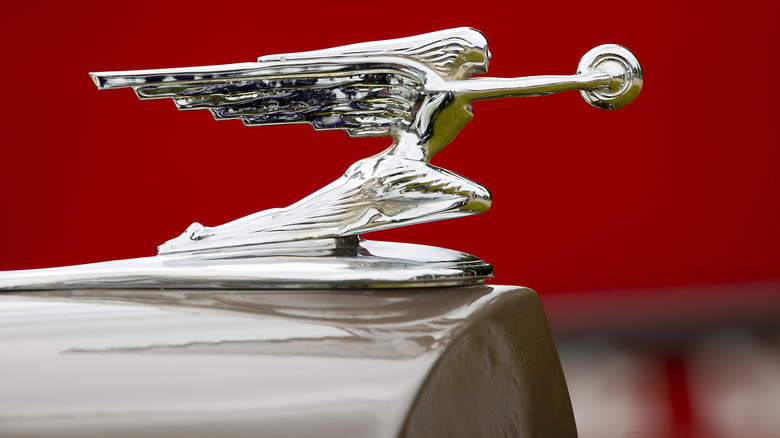
If Art Deco makes you think about the Chrysler Building more than a Chrysler Airflow, that's understandable. We tend to associate the style with skyscrapers, furniture, jewelry, and the sort of aggressively ornate elevator doors that make you reflexively reach up to adjust your necktie before remembering you're wearing cargo shorts and a fun run participation tee.
And yet, automobiles were another natural canvas for the motif, and we found some good ones. For our purposes today, "Art Deco" covers both the ornamental style most closely associated with the 1920s and early 1930s and the increasingly streamlined direction it took as the decade progressed. The Art Deco Society of New York (which ought to know) describes automotive Art Deco as "making excellent use of beautifully rounded forms, mixing baroque elements like the stylized rays of the sun, and artfully melding gentle, flowing curves with razor-sharp edges." So, that. Or, just check out the Mercedes-Benz Vision concept, and then look at the dope pictures that follow. That works, too.
We found designs that captured that interwar fascination with geometry, ornament, machinery, speed, and aerodynamics. We'll tour through some of these models, from the outrageous Pierce-Arrow Silver Arrow and Cord 810 to the Chrysler Airflow, Tatra T97, and even a humble Plymouth P8 Deluxe Coupe. Some did deco with subtle details. Others looked like they had arrived from 20 years ahead of schedule.
1933 Pierce-Arrow Silver Arrow
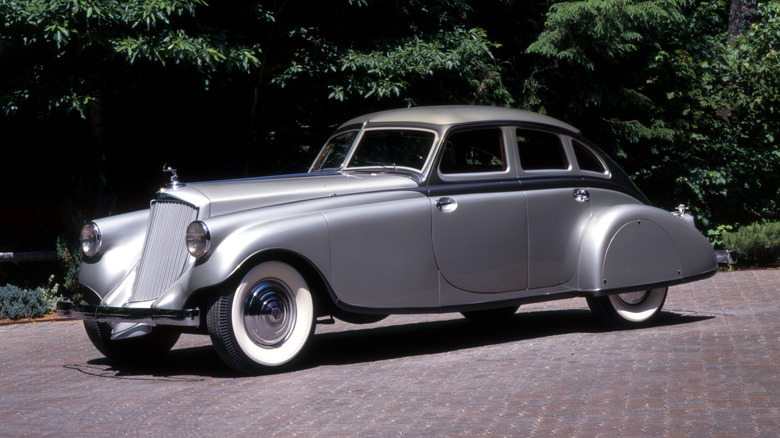
There are subtle ways to introduce a new design language, and then there is rolling into the 1933 Chicago World's Fair and parking one of these on display with a $10,000 price tag. Adjusted for inflation, that'd be something like a quarter-million dollars during a time when that was heavy-hitter money for a vehicle, before you could drop twice that amount on a base-model Rolls-Royce SUV destined for a carpool pickup line. True luxury was always grotesque, but boy have we gone deep now.
Anyway, the Silver Arrow came from designer Phillip O. Wright, who began developing the vehicle on Pierce-Arrow's V12 chassis in 1932. What emerged was dramatically removed from the boxy sedans around it: a low roof, fastback tail, skirted rear fenders, and headlights goggled out of the bodywork instead of hanging off it like a pair of lanterns. Pierce-Arrow built just five Silver Arrows, exhibiting them at that Chicago World's Fair and then all around the national auto-show circuit.
This isn't a case where we have to squint and argue that something vaguely feels Art Deco, either. The Art Deco Society of New York, our earlier go-to source for explaining what the hell Art Deco is in the first place, calls out the Silver Arrow explicitly, pointing to details including its sweeping flush fenders, hidden side-mounted spare tires, and peculiar split rear-window treatment. More broadly, the whole body embodies what it's all about: a machine that looks modern, fast, and futuristic, all while standing still. Pierce-Arrow sold all five cars at their $10,000 asking price and lost money on each one. Apparently, the future has terrible margins.
1934 Cadillac V-16 Fleetwood Aerodynamic Coupe
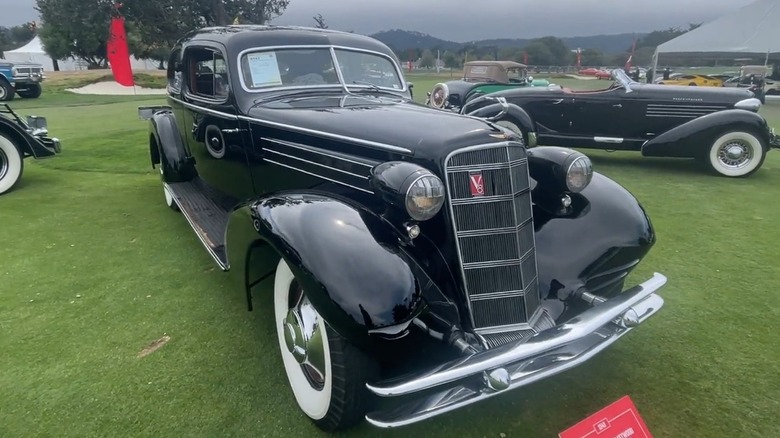
Cadillac was apparently watching Pierce-Arrow hog the futuristic-car attention at the Chicago World's Fair and decided it also knew how to make something that looked like it belonged in Tomorrowland. In fact, GM's Art and Colour Section developed its own Aerodynamic Coupe for the same 1933 Century of Progress exposition under Harley Earl, pairing a dramatically streamlined body with Cadillac's V-16.
The fair car wasn't just an attention grabber. Cadillac turned the idea into an extremely limited Fleetwood body style for 1934, and the production version stretched the shape over an enormous 154-inch wheelbase. The details were doing a lot of work: a sharply raked windshield, teardrop fenders, a fastback roof, and a spare tire hidden beneath the rear deck rather than bolted conspicuously onto the side. Cadillac's own 1934 technical literature described its new bodies as "aerodynamic in styling," specifically noting the sloping windshields and tapered rear decks intended to reduce wind resistance.
It's the kind of signature design element that hurt to see go away, especially as modern wind tunnel algorithms continue to insist that what we all really want to drive is a squished egg. Only three V16 Aerodynamic Coupes were built for 1934, with eight produced across 1934, 1936, and 1937. Sometimes, the future arrives slowly. Other times, it arrives eight times without losing effect.
1934 Packard Twelve Model 1106 Sport Coupe by LeBaron
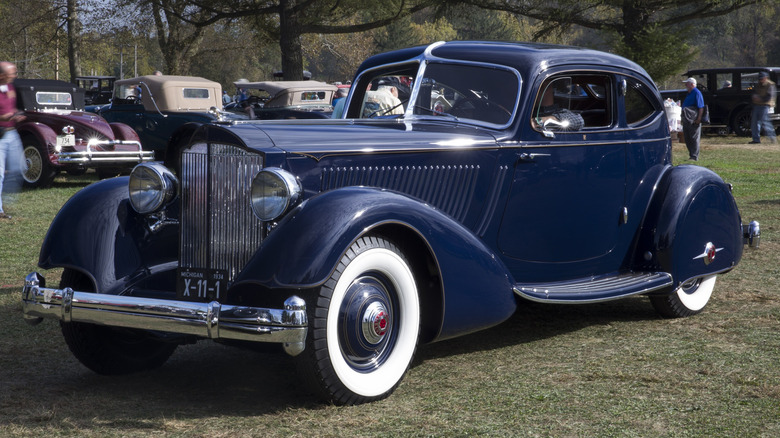
Packard generally wasn't known for wild styling. Its cars were expensive, powerful, and beautifully made, but often fairly conservative in appearance. Then this happened. The 1934 Twelve Model 1106 Sport Coupe looked almost nothing like the Packards around it, aside from that tall, unmistakably Packard grille still standing upright out front.
The body came from LeBaron, an American coachbuilder who was neither a baron nor French. The fastback roof swept down into a nearly circular trunk opening, while the pontoon fenders, full rear skirts, and repeating curves made the whole car feel like one composed object instead of a collection of separate body parts. And then you start noticing the smaller stuff. The roofline falls sharply toward the rear, while the rear bodywork and fenders visually wrap around the wheels instead of reading as separate pieces. The car also sat on Packard's shortened 1106 Twelve chassis, and its running boards curved inward toward the body as the tail narrowed behind them. Smaller details carried the same theme through the car.
It's a Packard, but somebody clearly told Packard it was allowed to have fun. That begs the question: Who owns the Packard brand now, and could we revive it?
1934 Chrysler Airflow
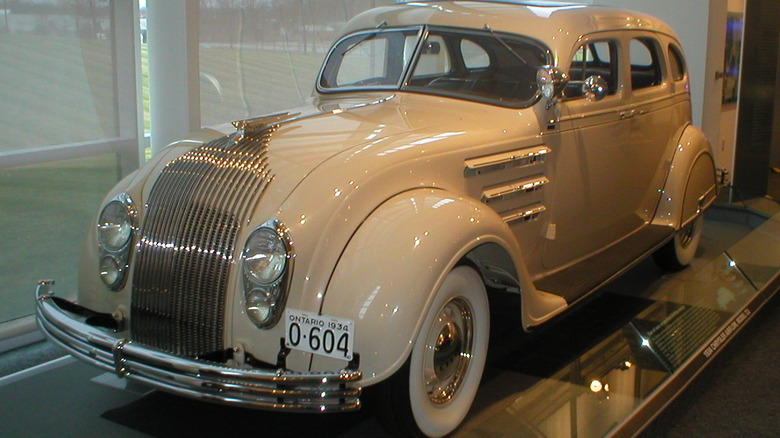
The Chrysler Airflow is what happens when somebody stops treating "streamlined" as a decorative adjective and starts trying to make the whole damn car behave that way. Chrysler spent years experimenting with wind-tunnel testing and aerodynamic models, eventually learning, among other things, that a conventional car of the era moved through the air more efficiently backward than forward.
When the Airflow debuted at the National Automobile Show in January 1934, it looked genuinely alien next to the upright cars around it. The grille leaned back into the hood, the headlights were incorporated into the front bodywork, the windshield was steeply raked, the rear wheels were skirted, and the roof flowed toward the tail instead of ending in the familiar boxy bustle. Chrysler also moved the passenger compartment entirely between the axles, and it became the first car on the market with room for three across the front seat, So, now you have the historical context for that time you were 12 and had the most uncomfortable road trip of all time stuffed between your parents.
But alas, the Chrysler Airflow was a flop in the '30s despite its innovative design. Chrysler sold 10,838 Airflows in 1934, 7,751 in 1935, and then moved toward more conventional offerings before ending Airflow production after 1937. Sometimes, defining an era comes at a steep cost.
1935 Peugeot 402
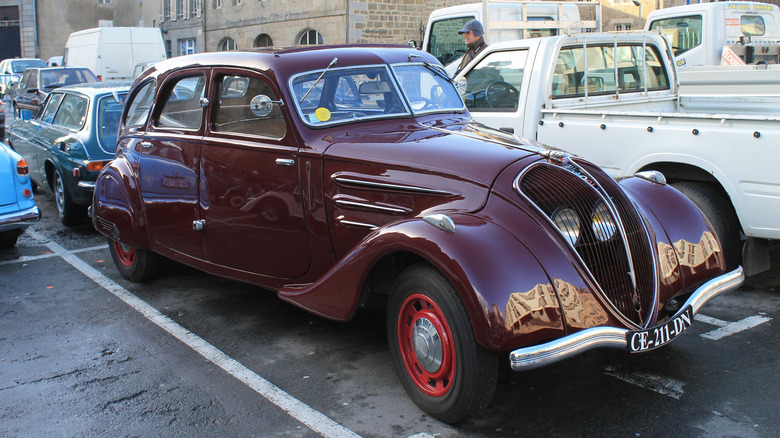
The Chrysler Airflow might have gotten there first, but Peugeot demonstrated that one of the weirdest, most beautiful French cars can prove that Art Deco styling doesn't have to be commercially cursed. The Peugeot 402 debuted with a body that was a radical departure from what came before.
The look came from Peugeot designer Henri Thomas and centered on what became known as the "Sochaux spindle:" a long, flowing front end, headlights tucked behind the grille, a split and sharply raked windshield, rear wheel skirts, and a body that ditched the running boards still common at the time. The 402 introduced a new aerodynamic design language for the brand, and the V&A later singled it out as one of the major examples of streamlining taking hold in automobile design during the 1930s. This is less about chrome filigree or decorative geometry and more about the Streamline Moderne half of Art Deco, where speed itself became a styling theme. The car looks like somebody grabbed a conventional sedan at both ends and gently stretched it toward the horizon.
It also mattered beyond one weird styling experiment. The 402 remained in production from 1935 to 1942, and its aerodynamic approach established a new visual direction for Peugeot. The Airflow looked like the future and scared buyers away. The 402 looked like the future and somehow convinced a decent chunk of France to come along for the ride.
1936 Lincoln-Zephyr
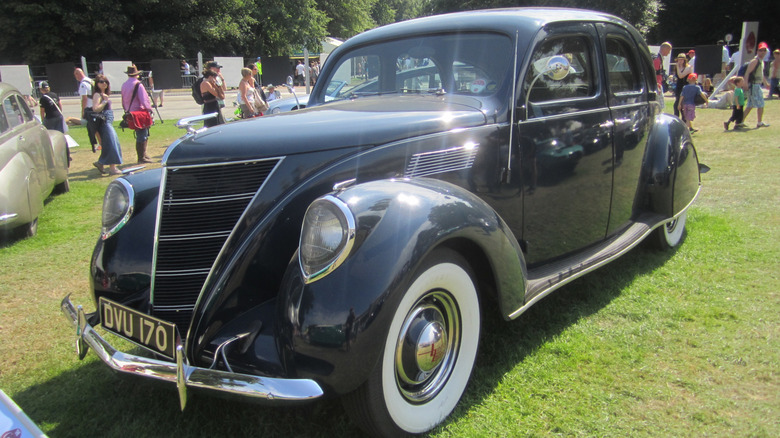
The Lincoln-Zephyr wasn't trying to out Pierce-Arrow the Pierce-Arrow. Lincoln had a more practical problem: Its pricey flagship Model K wasn't selling great during the Great Depression. The solution was a new companion car priced around $1,300 instead of the Model K's $4,000-plus, bringing Lincoln luxury considerably closer to the economic realities of the day. In modern car terms, we're talking roughly as if modern Mercedes-Benz only sold the $134,600 S 580 and then came out with the CLA at $43,900 – you know, instead of moving upmarket to a Mercedes G-Class EV that does tank turns.
Its design had appropriately futuristic roots. John Tjaarda headed design engineering at Briggs Manufacturing, and Ford displayed one of his rear-engine mockups at the Chicago World's Fair. That frame became the basis for the 1936 Lincoln-Zephyr, although the production car ultimately used a front-engine layout. The visual drama survived: a pointed V-shaped grille, headlights worked into the front fenders, skirted rear wheels, and a roofline that tapered cleanly toward the tail.
That combination is where the Art Deco connection really lands. It's not overloaded with ornament, but the pointed nose, repeated horizontal lines, integrated lighting, and tightly controlled proportions all make the car feel deliberately modern rather than merely luxurious. The Zephyr also used unitized body-and-frame construction, so some of that modernity carried into the structure underneath the bodywork. Better yet for Lincoln, people actually bought the thing. The Zephyr accounted for more than 90% of Lincoln production in its first model year, with roughly 15,000 sold. Turns out, you can sell people the future. You just have to knock about ⅔ off the sticker first.
1936 Cord 810
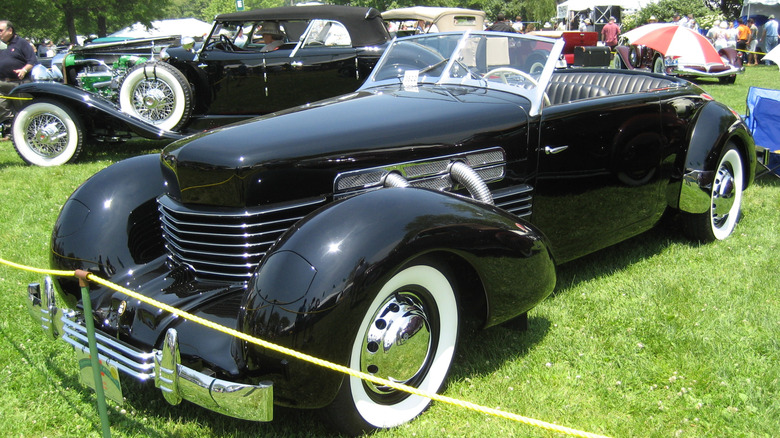
If Art Deco was never really on your mind and you've just been kind of following along, the Cord 810 is probably where you can draw the clearest line of lineage between a 1930s-era piece of automotive art and that Mercedes-Benz Vision Iconic Concept we talked about at the beginning. Gordon Buehrig's 1936 Cord arrived with front-wheel drive, independent front suspension, a unitized body, and a four-speed preselector transmission, but you could ignore every mechanical innovation and still understand why people crowded around it. After the 1935 New York Auto Show, old-timey newspapers reported that spectators stood on other cars' running boards just to get a look.
The front end is the obvious star of the show. There's no conventional upright radiator grille. Instead, seven horizontal louvers wrap around the nose, and it had pop-up headlights that'd make a '90s kid warm inside and were, in fact, the very first example of such a thing. Nothing looks accidental. Horizontal lines repeat across the nose, hardware disappears when it would interrupt the shape, and the curving fenders clash beautifully with the hard-edged hood. Even decades later, the design still reads as something exceptional: The Museum of Modern Art included the closely related Cord 812 in its 1951 "8 Automobiles" exhibition.
1936 Stout Scarab
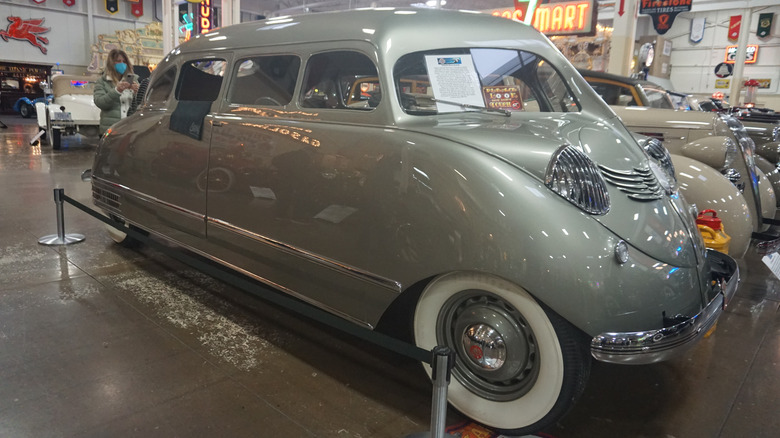
We stand by our assertion that every minivan is cool, and the Stout Scarab was a cool minivan before minivans were a thing. Aviation engineer William Bushnell Stout designed the Scarab around a Ford flathead V8 that was placed in the back, pushing the passenger compartment forward and opening up an unusually large amount of usable interior space. Passengers entered through a single large door on the right side (sound familiar?), and the layout opened up the cabin enough for movable passenger seating and a folding table, turning the Scarab into something like a decadent Machine-Age ancestor of the Toyota Previa.
All that said, the styling makes the thing more glamorous than the description so far may suggest. The nose carries a scarab-beetle emblem between the headlights, while some examples featured chrome accents extending over the rear of the car. That Egyptian connection wasn't accidental: scarab imagery was common in Art Deco design during the 1920s and 1930s and drew on an ancient Egyptian symbol with deep cultural significance.
It was also spectacularly expensive. The Scarab carried a starting price of $5,000. Nobody is entirely sure how many were actually built, but it's almost certainly in the single digits, with at least a few buyers coming from Stout's own investors, including William Wrigley (the gum guy) and Willard Dow (the chemical guy). Harvey Firestone (of tire fame) also grabbed one. So, yes, the 1930s might have invented the minivan. They just had the good sense to make it look like a status symbol instead of a dustbuster.
1937 LaSalle Coupe
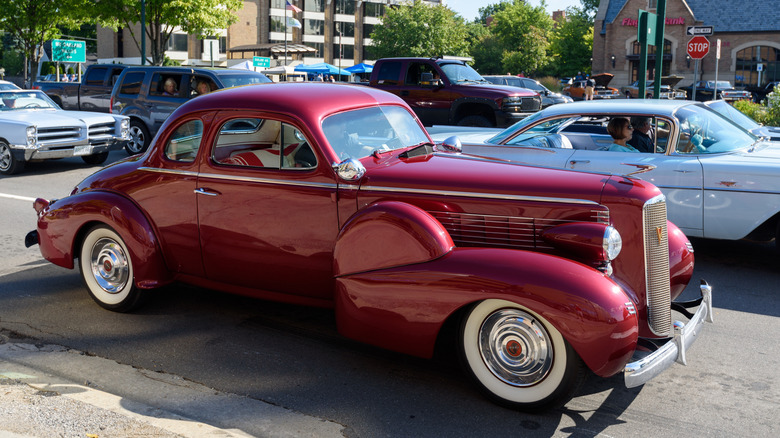
In an alternate universe where Cadillac greenlit all of its concepts, it'd be the coolest automaker on the planet. And since General Motors clearly didn't do that, vehicles like the 1937 LaSalle Coupe remained few and far between. LaSalle existed because General Motors saw an annoying hole between Buick and Cadillac and decided the answer was apparently another entire car brand. Introduced in 1927 to fill that pricing gap, LaSalle was positioned as a lower-priced companion to Cadillac. By 1937, though, it had evolved into something much more interesting.
That year's Series 50 moved back toward Cadillac mechanically and visually. The 1937 LaSalle shared its body shell and 322-cubic-inch V8 with Cadillac's Series 60, while the headlights moved farther back, their housings became more elongated, and the hood sides picked up a much cleaner horizontal design. It's a much quieter Art Deco statement than the Cord, but the geometry is still doing plenty of work.
The formula landed. LaSalle sold roughly 32,000 cars in 1937, the strongest year in the marque's history, and a LaSalle Series 50 served as the pace car for the 1937 Indianapolis 500. For once, looking like the future didn't require hiding the headlights, moving the engine to the back, or selling half your inventory to chewing-gum magnates.
1938 Tatra T97
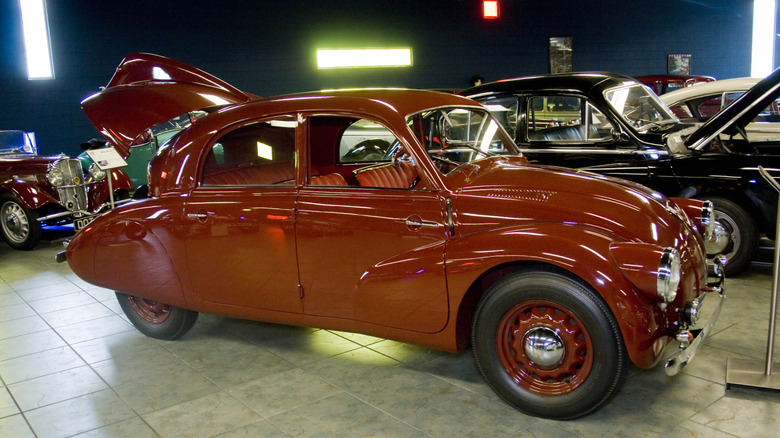
It may be fashionable among enthusiasts to refer to Tatras as commie cars, but there's some historical whiplash here. Tatra would indeed later become a state-owned automaker in postwar Czechoslovakia, and its later passenger cars became closely associated with the communist establishment. The T97 predates all of that. This was still a prewar Czech design, not a product of the Eastern Bloc.
Its engineering lineage is much more interesting anyway. Hans Ledwinka was the engineer most responsible for Tatra's early backbone-chassis and independent-suspension thinking, while the company was also pursuing air-cooled engines and radical aerodynamic bodies. The result was the vehicle in the picture. That fin is the bit that really sells the whole thing. It looks decorative enough to belong on a piece of Art Deco furniture, but it was there to help with high-speed stability, allegedly. The T97 is basically where ornament, machinery, and function all start bleeding together. Tatra built four T97s in 1937, 237 in 1938, and 269 in 1939.
And if the silhouette is giving you Beetle déjà vu, you're not imagining it. Several features seen on the T97 would later turn up in Volkswagen's design, and Tatra eventually pursued Porsche over patent infringement. Meanwhile, the Nazis were actively pushing Ferdinand Porsche to develop a cheap "people's car."
1938 Talbot-Lago T-150C-SS Teardrop Coupe
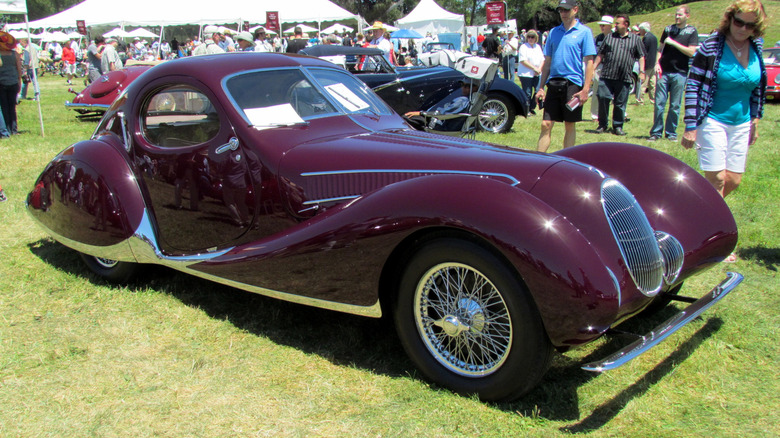
If you're doing the kind of high-falutin carspotting that can only happen in a place like the Monterey Auction, you may spot a Talbot-Lago T-150C-SS Teardrop Coupe. It gave Figoni & Falaschi, the Paris coachbuilding firm, one of the era's most dramatic canvases: a short, high-performance Talbot-Lago chassis wrapped in the coachbuilders' famous Goutte d'Eau, or "Teardrop," body. The New York-style Teardrop coupes were built between 1937 and 1939, and each body reportedly required about 2,100 hours of labor.
The shape is almost offensively pretty. Huge flowing fenders swallow the wheels, the roof melts into the tail, and the whole car looks like somebody sketched it without lifting the pencil. It wasn't merely sculpture. The T-150C-SS sat on a competition-derived chassis, and one Figoni-bodied Teardrop competed at Le Mans in 1939. That's a useful reminder that Art Deco could be decorative, dramatic, and still attached to something meant to move very fast, for the 1930s anyway.
1939 Plymouth P8 Deluxe Coupe
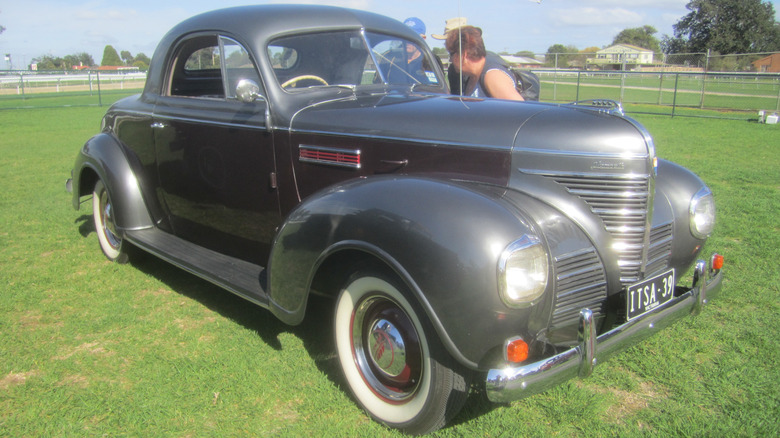
There's something fitting about ending here, with a Plymouth. After a list full of hand-built exotica, aviation engineers, failed luxury marques, and cars that cost more than houses, Art Deco had filtered all the way down to a brand that was first conceived as a cheaper alternative to American rivals. By 1936, Plymouth was already building about half a million cars a year, so this wasn't some design exercise for people with chauffeurs and inherited railroad money.
The 1939 P8 Deluxe Coupe still got the good stuff. The hood and fenders flow together more cleanly than on cars from just a few years earlier, horizontal brightwork stretches the body visually, and the grille has enough repetition and geometry to look like it belongs on a particularly expensive radio. This isn't us forcing the theme onto an ordinary old Plymouth, either. The 1939 model has been singled out as one of the strongest examples of automotive Art Deco of its time. The P8 was also among the early cars to move the gear selector from the floor to the steering column, so welcome to a piece of history, you proud few enthusiasts of three-on-the-tree.
And that feels like a good place to leave the 1930s. Art Deco didn't stay trapped in world's-fair showpieces and coach-built masterpieces. It worked its way into regular cars, changed what a modern car was supposed to look like, and left us with an era where even a Plymouth could show up dressed for an occasion that didn't quite exist.