

7 Of GM's Legendary LS V8s Ranked By Horsepower
It's not often that a family of engines achieves cult-like status, but General Motors' LS V8 certainly has. These mills are compact, relatively simple, and remarkably versatile. They have underpinned everything from hard-working pickup trucks to luxurious SUVs and fearsome muscle cars. For this list, we're putting the seven most iconic engines of GM's modern small-block LS family under the spotlight, so historic units — such as the mighty 454 LS6 big block of the early '70s — won't be making an appearance. In addition, GM's all-new LS6 also won't feature, as it falls outside of the Gen III/Gen IV architecture. Instead, every LS engine produced since the C5 Corvette's original LS1 debuted in 1997 and before the arrival of Gen V LT engines has been considered.
Among the entries, which we ranked by their total output from lowest to highest, are greats such as the LS7, which squeezes 505 horses from a naturally aspirated 7.0-liter lump alongside the 580-hp LSA and 638-hp LS9, both of which were given forced induction in GM's search for dizzying performance.
LS1: 350 horsepower
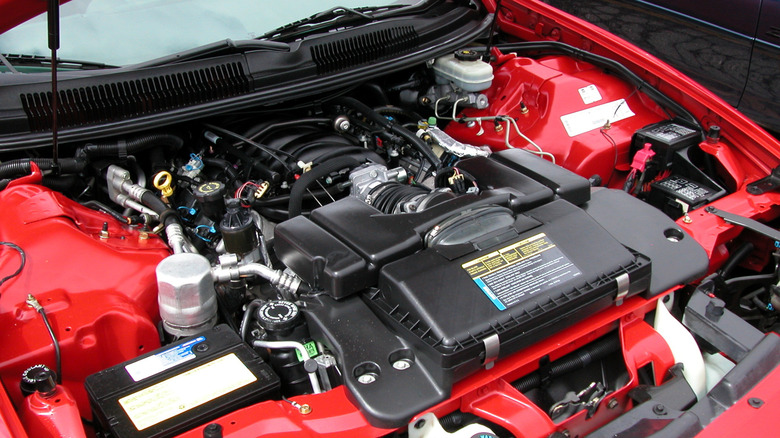
No list of legendary LS engines is complete without the mill that started it all — the LS1. This first of the Gen III engines sported an all-aluminum block, completely redesigned cylinder heads, and individual coil packs for each cylinder, that were placed closer to the spark plugs for better ignition. When it debuted for the 1997 model year, the LS1's output was certainly impressive, and a notable jump up from what was available in the entry-level C4 cars that preceded it. Initially, the LS1 produced 345 horsepower at 5,600 rpm under the hood of the C5 Corvette, alongside 350 lb-ft of torque, which arrived at 4,400 rpm. In contrast, a '96 Corvette in base guise produced 300 hp and 335 lb-ft of torque from the same 5.7-liter displacement, so the fruits of GM's engineering department's labor were immediately visible.
Improvements to the intake and exhaust manifolds were implemented from the 2001 model year onward, which saw outputs rise further, to 350 horsepower and 365 lb-ft of torque. It was at this point that Chevrolet also introduced the more powerful LS6 engine for the C5's Z06 variant, but more on that later. The LS1 remained as the C5's base offering until production ceased, and the new C6 generation was ushered in with its own LS of choice.
LS2: 400 horsepower
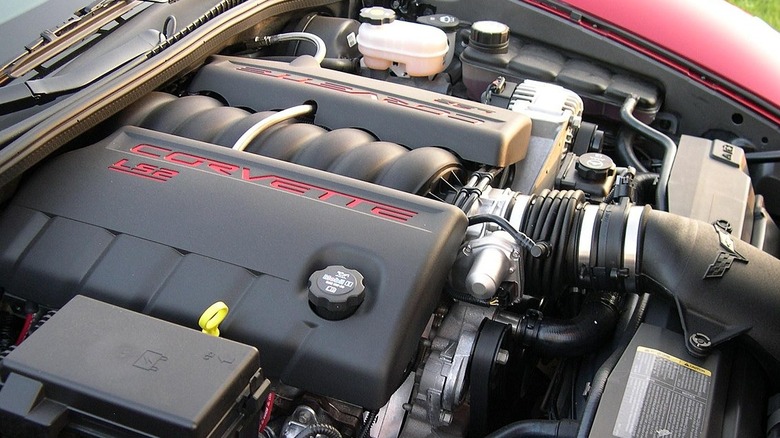
Enter the LS2. The longing for continual improvement saw GM engineers introduce a number of upgrades to the C6 Corvette's base engine, such as a completely new block casting, a lighter exhaust manifold with improved flow rate, and an increase in displacement to 6.0 liters. The compression ratios had also risen in the jump from LS1 to LS2, from 10.1:1 to 10.9:1. As a result, output immediately went up. The LS2 provided Chevrolet's C6 Corvette with 400 horsepower and 400 lb-ft of torque, which peaked at 6,000 and 4,400 rpm, respectively.
In spite of the clear performance advantages, Chevrolet didn't employ the LS2 engine under the Corvette's hood for very long, and the engine only enjoyed three years of production through the 2005, 2006, and 2007 model years. While the only Corvette to use the LS2 was the base C6 generation model, plenty of other GM products also made use of the engine, so it wasn't quite the flash in the pan it may first appear. The Pontiac GTO also featured the lump, as did the Chevrolet SSR, Trailblazer SS, and Cadillac's effortlessly cool first-generation CTS-V.
LS6: 405 horsepower
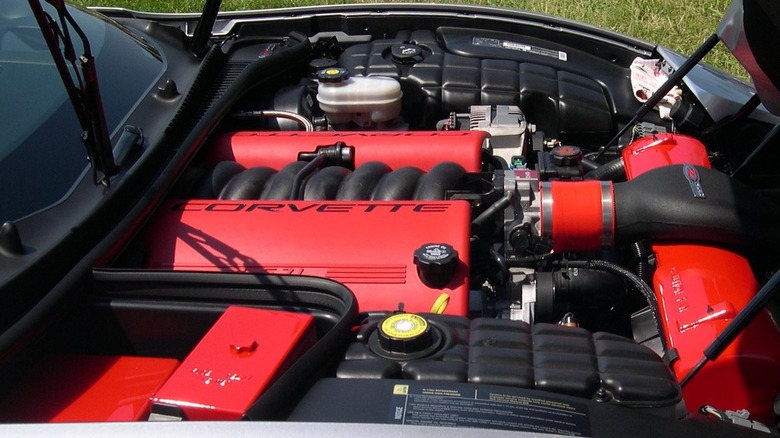
The LS2 was succeeded by the more powerful LS3, but before we jump ahead and continue the chronological walk down LS memory lane, let's jump back a few years and cover the C5 Corvette Z06's LS6 V8, which was slightly more powerful than the LS2 that followed. The LS6's introduction in 2001 saw the revival of a historic nameplate, as GM already made use of this designation with its 450-horsepower big-block powerhouse from the early 1970s. So yes, GM reused engine codes, but that doesn't mean these engines are remotely similar; one's a classic big-block, the other is a modern small-block.
Like the LS1, the LS6 remained in production through the 2004 model year, prior to the C6-generation Corvette taking over the following year. The LS6 shared much in common with the LS1, such as its 5.7-liter displacement and nodular crankshaft, but a more aggressive camshaft profile plus reworked cylinder heads enabled it to reach the altogether more impressive output of 385 hp and 385 lb-ft of torque. Updates along the way saw peak power nudge to 405 horses, while torque received a handy bump to 400 lb-ft.
LS3: 436 horsepower
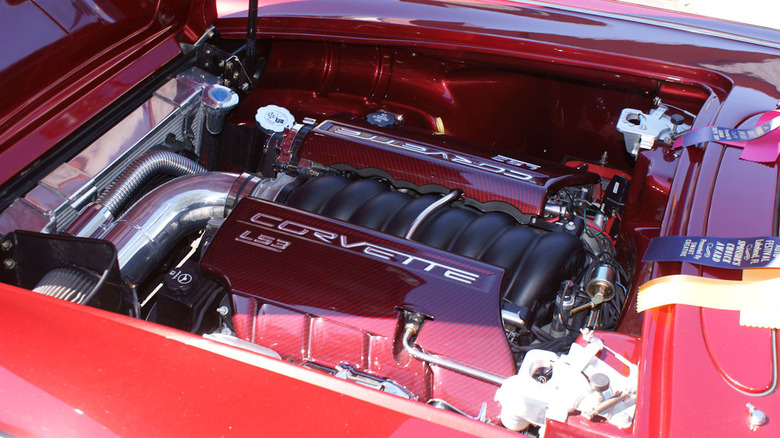
There are quite a few notable differences between LS2 and LS3 engines, one of which being when they were produced. While the LS2 enjoyed a relatively short production run, the LS3 has motivated the Corvette from 2007 through to 2013. And in addition to providing grunt to post-2007 C6 Corvettes, the engine could also be found powering the Camaro SS, Pontiac G8 GXP, and Chevrolet SS Sedan.
The LS3 had been designed as a cleaner evolution of the LS2, no doubt to help work alongside the introduction of ever-stricter emissions rules, but GM engineers didn't want to compromise performance in this pursuit. So, displacement was enlarged once again, this time to 6.2 liters, and other tweaks were introduced, such as a more aggressive camshaft profile, rectangular-port cylinder heads, and larger Z06-like fuel injectors. As a result of these tweaks, GM's LS3 engine churned out 430 horsepower and 424 lb-ft of torque. Exhaust tweaks would see small increases, resulting in a peak output of 436 horses and 428 lb-ft. Interestingly, compression was actually down in comparison to the LS2 at 10.7:1.
LS7: 505 horsepower
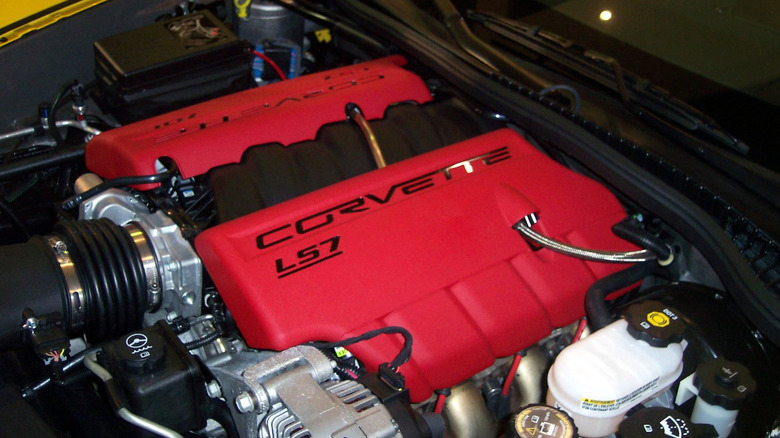
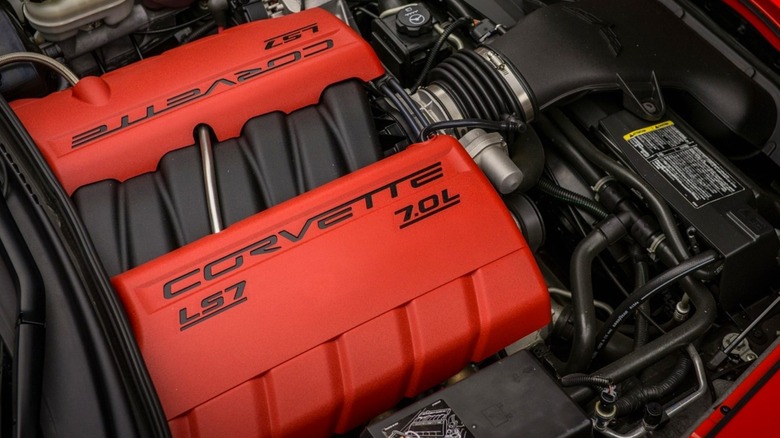
This is where LS performance goes from ample to genuinely impressive, as the LS7 is the first member of this family to see output jump north of 500 horses. It's really quite a special engine, the largest in terms of displacement, packing exactly 7 liters or 427 cubic-inches. Of course, 427-ci engines have played a big part in Chevy muscle car culture over the years, so the LS7 had big boots to fill. GM developed the engine with a C6 Corvette Z06 in mind, and indeed that's where it did find a home, propelling the all-American sports car to 60 mph from a standstill in just 3.6 seconds, and onto an official top speed of 198 mph. The LS7 was hand-built with all-aluminum construction and was designed with inlet air delivery as an absolute priority. It also came with a dry-sump oiling system from the factory.
Aside from the Corvette C6 Z06, the LS7 also found its way under the hood of the revived Camaro Z/28 and the limited-edition C6 427 Convertible. The precise output from this gargantuan small-block is 505 horsepower and 475 lb-ft, and it enjoyed a lengthy production run of almost a decade between the 2006 and 2015 model years, despite powering a relatively small number of models.
LSA: 580 horsepower
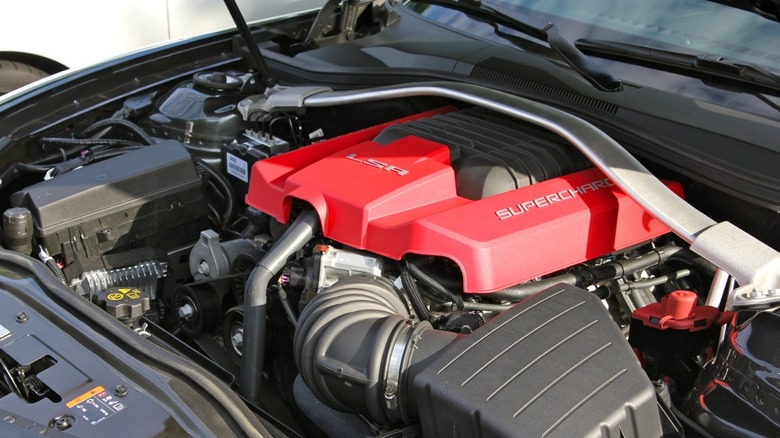
The 6.2-liter LSA V8 is unlike the other engines featured in this list for a number of reasons. First up, it doesn't sport a numerical designation. Secondly, the LSA was never fitted from the factory to a Corvette. The only GM products to house this particular small block were the second-generation Cadillac CTS-V and fifth-generation Camaro ZL1, plus a couple of Holden products, too. Thirdly — and while this doesn't make it unique for a modern LS engine — the LSA is supercharged. Under the hood of the fifth-generation Camaro ZL1, it produces a very healthy 580 horsepower at 6,000 rpm, in addition to 556 lb-ft of torque at 4,200 rpm. The second-generation CTS-V comes close, with 556 horses and 551 lb-ft.
The engineering that went into the LSA was seriously impressive. It features high-flow rotocast cylinder heads for added strength and performance, plus a lightweight rotating assembly featuring a forged crank and powder-metal connecting rods. Keeping everything cool is a dual-brick liquid-to-air intercooling system, mounted within the supercharger's casing. It's a mean combination of performance-oriented elements that allows the LSA to develop a properly supercar-worrying turn of pace. As a result, Chevy's Camaro ZL1 is capable of cracking the 60 mph sprint in around 4.1 seconds, and it will keep going until it's knocking on the door of 180 mph.
LS9: 638 horsepower
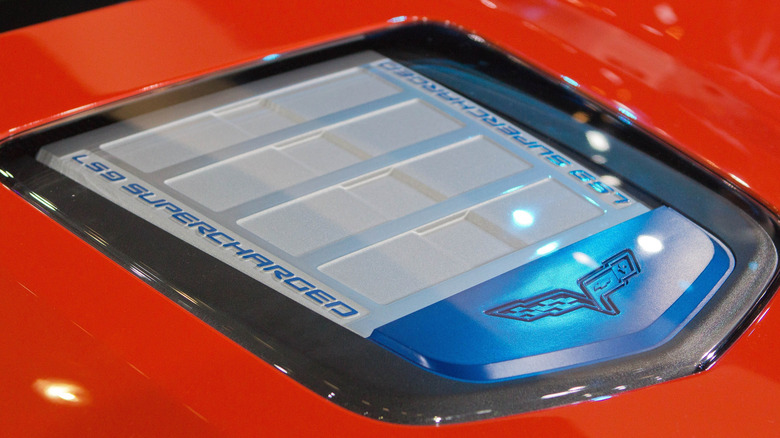
As mighty as the other efforts are, the LS9 is the most powerful LS engine here — and by a considerable margin too – with 638 horsepower at its disposal. Much like the LSA, the LS9 is also a 6.2-liter unit that uses a supercharger to boost its output. But in order to deliver more punch than the LSA, GM fitted the LS9 with a larger 2.3-liter supercharger, and it also sports a dry sump oiling system and upgraded internals. Whereas the other engines featured here were available in multiple GM models, the LS9 was only ever factory fitted to a single model: the C6-generation Corvette ZR1.
Naturally, the performance specs associated with a 638-horse Corvette are outstanding; the ZR1 will tear to 60 mph in a scarcely believable 3.4 seconds, and for those brave enough to keep their right foot planted, it won't stop accelerating until it hits 205 mph. Impressively, the ZR1 debuted with a sticker only slightly higher than $100,000 – a six-figure Corvette was probably a tough pill to swallow for some, but it certainly delivered enough bang for the buck, with that LS9 deserving much of the credit.