

These Are 7 Of The Largest Hemi Engines Ever Made
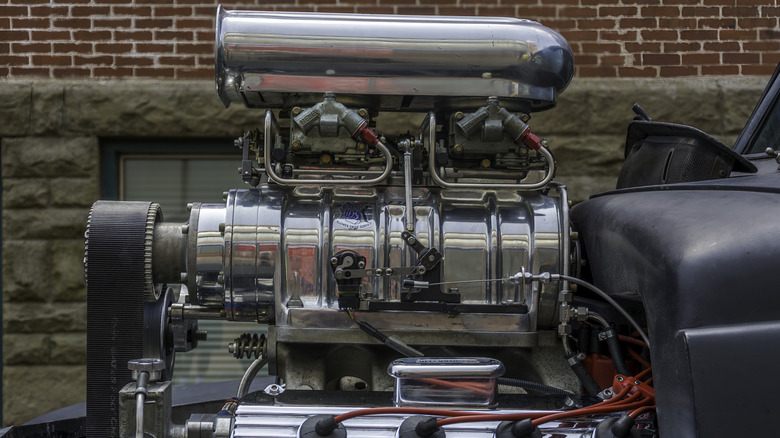
The invention of the Hemi engine dates back to the turn of the 20th century (roughly 25 years before Chrysler was founded) when aviation pioneer Augustus Herring was developing hemispherical combustion chambers inside a plant owned by the Truscott Boat Manufacturing Company – whose foundry coincidentally cast engines for Allie Ray Welch. By 1905, versions of these engines made it into cars via the Welch Motor Car Company, whose factory was taken over by General Motors in 1910. Then, in 1951, the iconic Chrysler FirePower engine brought Hemi power to the masses, and the Chrysler name became inseparable from these unique engines.
The Hemi owes its many benefits to its unique shape. Hemispherical combustion chambers put intake and exhaust valves opposite each other, creating a straight path through the engine head and allowing cylinders to fill more completely on the intake stroke. The dome also clears the middle of the chamber for the spark plug, allowing the flame to quickly and evenly reach the entire charge. Finally, domes wrap their volume in less wall area than other chambers (such as wedges) – meaning less of the burning charge's heat escapes into the cooling system, and more of it stays inside the cylinder, where it can create torque for the crankshaft.
Chrysler initially learned most of this on the government's dime: Its first Hemi engine wasn't for a car at all, but a WWII fighter aircraft, paid for by the Army Air Corps. That laid the foundations for the Hemi cars motors that followed. Below, we rank the largest Hemis of all time by displacement alone, climbing from Chrysler's 392 and 426 V8s to a 909-cubic-inch drag racing engine, a 1,792-cubic-inch tank V12, and a 2,220-cubic-inch wartime V16 — yes, that means the list contains some non-Chrysler Hemi engines.
Chrysler 392 FirePower
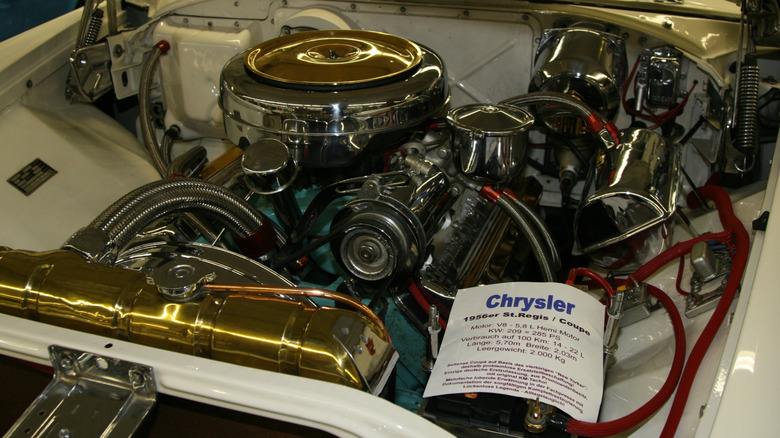
Chrysler's FirePower V8 was the first Hemi the company mass produced for passenger cars, the most powerful American engine of 1951, and is still one of the largest Hemis ever built. Its first iteration was the 331 cubic-inch (5.4-liters) with a 3.8125-inch bore, a 3.625-inch stroke, and 180 horsepower. From 1951 to 1955, it was optional on Chrysler Saratogas and standard on Imperials and the New Yorker – once America's longest-running nameplate.
The height of Chrysler's first-generation Hemis, however, is the FirePower 392, which paired a 4.000-inch bore with a 3.906-inch stroke atop a slightly raised deck. In the New Yorker, a single Carter four-barrel carburetor and a 9.25:1 compression ratio yielded 325 hp at 4,600 rpm and 430 pound-feet of torque at 2,800 rpm. The 1957 300C offered two engine options: a 375-hp 392 with twin Carter four-barrels or a 390-hp high-output version with four-bolt cast iron headers and a 2.5-inch low back-pressure exhaust.
In 1958, Chrysler offered its 300D with a 392 engine and a Bendix Electrojector — an analog electronic fuel injection system. AMC had advertised the same system on its 1957 Rambler Rebel but pulled it before a single injected car reached a customer. That left the 300Ds built at Chrysler's DeSoto plant between January and July 1958 among the first electronically fuel-injected cars sold in America. Unfortunately, the system didn't last, due to failing capacitors and AM radio interference. While 1959 saw the end of Chrysler's first-gen Hemis, the displacement badge lives on: you'll find modern 392 Hemis come standard in the 2026 Dodge Durango R/T 392, offering 475 hp and 470 pound-feet of torque.
1964 Chrysler 426 Elephant
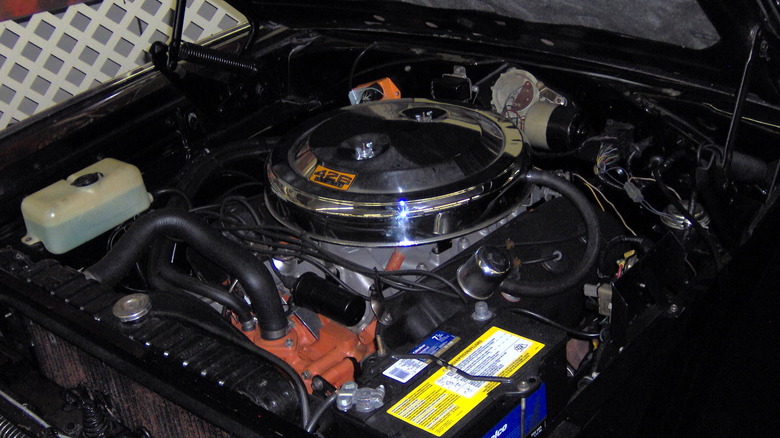
Chrysler spent the early '60s watching Pontiac dominate the track and muscle car culture. In December 1962, president Lynn Townsend decided to fight back, ordering his engineering team to come up with an engine and vehicle combo built to dominate stock car track races as well as the drag strip. In doing so, he kicked off the development of Chrysler's Gen-II Hemi: an engine that debuted at the 1964 Daytona 500 and did exactly what Townsend ordered.
The 426 (nicknamed "Elephant," due to its size and power) was essentially a modified 426 Max Wedge – an idea proposed by Chrysler's racing program coordinator of the time, Tom Hoover. It featured a 4.25-inch bore with a 3.75-inch stroke, displacing exactly 425.6 cubic inches (7.0 liters). Racing-spec cars featured a 12.5:1 compression ratio, aluminum cylinder heads, a 312-degree camshaft, Holley carburetors, I-beam connecting rods, cross-bolted main bearing caps, and a forged steel crankshaft. Richard Petty, Jimmy Pardue, and Paul Goldsmith took first, second, and third at the 426's debut race, and NASCAR quickly banned the engine from 1965, announcing new homologation rules that required all competition cars to feature street engines.
In turn, the Street Hemi arrived in 1966 as a $907.60 option (equivalent to $9,354 in 2026) on Dodge Coronets and Chargers, as well as Plymouth Belvederes and Satellites. Detuned for pump gas, it featured lower compression (10.25:1), dual Carter AFB four-barrel carburetors, cast iron cylinder heads, and a much milder 276-degree camshaft. Even so, it delivered 425 bhp at 5,000 rpm and 490 pound-feet of torque at 4,000 rpm. While the original 426 went out of production in 1971, the displacement remains iconic: Mopar currently sells a supercharged "Hellephant" A30 426 HEMI Crate Engine — good for 1,000 hp — for nearly $30,000.
1998 Mopar Performance 472
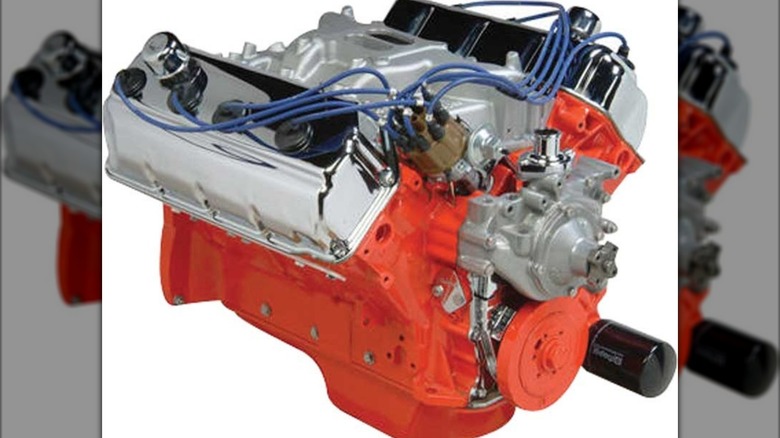
In 1998, Mopar Performance reintroduced fully assembled, brand-new Gen-II 426 Hemi crate engines to its catalogue. And for those needing extra power that the Elephant engine could deliver, there was the 472 – built on the same raised-block architecture and old-school hardware, but featuring more stroke for plenty of extra torque.
Pairing the 426's 4.25-inch bore with a 4.150-inch stroke, the Elephant's big brother displaced exactly 471 cubic inches (7.7 liters). And a 2009 Mopar Performance catalog shows that the engine's design, even 10 years after it debuted, stayed deliberately old school, featuring cross-bolted mains, cast iron heads, chrome valve covers, stainless steel intake and exhaust valves, a 301-degree hydraulic camshaft, a forged steel crankshaft, and an aluminum dual-plane M1 intake manifold waiting for a four-barrel carburetor. Its compression ratio, however, is arguably the detail that matters most. By dropping the 472's compression to 9.0:1, Mopar let the classic RB architecture live on the premium 91 octane available at any corner gas station. Mopar rated its new engine at 525 horsepower and 540 pound-feet of torque.
Granted, dropping a 472 into a classic B or E body takes more than a hoist: Tin Man Fabrication sells bolt-in conversion mounts built to fit an original Gen-II 426 or a crate Hemi into stock B, E, and C bodies from the 1960s and 1970s. And while retailers now list the 472 as discontinued, parts specialists such as Bouchillon Performance and Mancini Racing list 426, 472, 528, and 572 cast-iron Hemis as available to order, using the Gen-II blocks put back into production by casters such as Callies Performance.
Prestige Motorsports 572
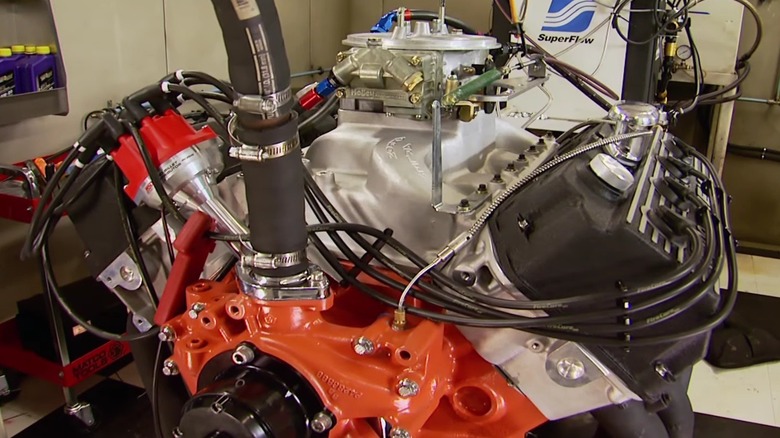
Not every Hemi on this list is a vintage Chrysler built in Detroit. This 572 Mopar big block stroker comes from Prestige Motorsports, a shop in Concord, North Carolina that has hand-built more than 300 custom engines since 2008. Its Hemi is built to the same Gen-II architecture Chrysler introduced in 1964 – just pushed well past anything the original engineers likely had in mind.
The displacement — 572 cubic inches – comes from a square bore and stroke measuring 4.5 inches. Rotating components such as the crankshaft and H-beam rods are forged in 4340 steel, and the engine also features custom-forged pistons. Intake is handled by aluminum Edelbrock or Indy heads, complete with stainless steel valves and a solid roller camshaft with mounted rockers, while a pair of Edelbrock carburetors pump fuel. Though the 426 iron block is standard, it is also available in aluminum for those wanting to reduce the front-end weight of their vehicle. The engine produces over 700 brake horsepower while running on 91 octane fuel and comes backed with a three-year unlimited-mileage warranty.
Since not everyone needs an almost-10-liter V8 sitting in their car, these engines are built-to-order. One was ordered by Massanutten Technical Center in Harrisonburg, Virginia and installed in a 1969 Dodge Charger R/T by students – a project that instructor Terry Taylor planned as an introduction to old-school Hemis. Check out our breakdown if you want to learn more about this 9.4-liter big block Hemi and how much it costs.
For Hemis Only 909
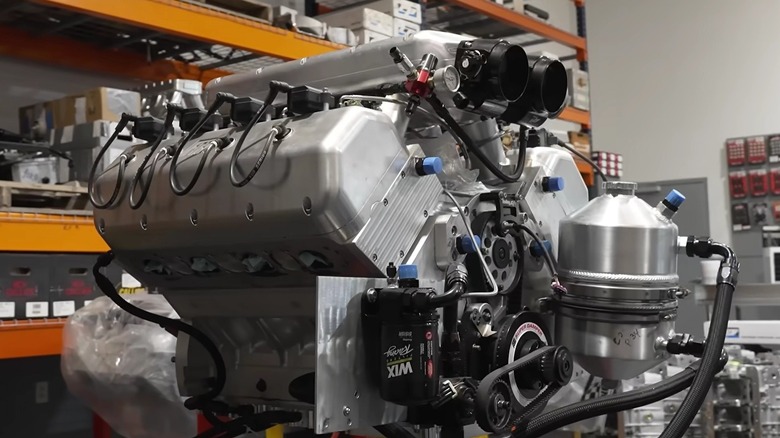
A production 426 Hemi spaces its cylinder bores 4.80 inches apart. In 2026, Tim Banning, from For Hemis Only in Florida, unveiled a massive 909-cubic-inch Hemi engine that spaces them 0.70 inches further apart, at 5.500. Built on a custom aluminum billet block, it accommodates a 5.225-inch bore and a 5.300-inch stroke. Its intake valves measure 2.90 inches across – "the size of a small plate," said Banning in an interview with Engine Builder – and the engine uses a dry-deck design, meaning coolant flows between the block and the heads via external plumbing.
900 cubic inches move enough air that the camshaft doesn't need to be aggressive, and Banning's isn't: He went with mild configuration combining a 75mm roller street grind, a 268/272-degree intake-exhaust duration, and lift in the mid-0.800-inch range. And the decision paid off: "When we fired it up, it was probably the smoothest engine we've had on the dyno in two years," Banning said. At roughly 12.5:1 compression, the engine makes more than 1,400 horsepower on pump gas – well beyond the original 1,200 target.
The customer ordering this motor told Banning he wanted a "one-of-one engine," and while his current engine seems to have hit the mark, Banning plans to continue ironing out some details: A newer version is already in store and will feature 15:1 compression, a higher camshaft duration, as well as a completely redesigned induction system — though he plans to keep the engine naturally aspirated.
1946 Continental AV-1790
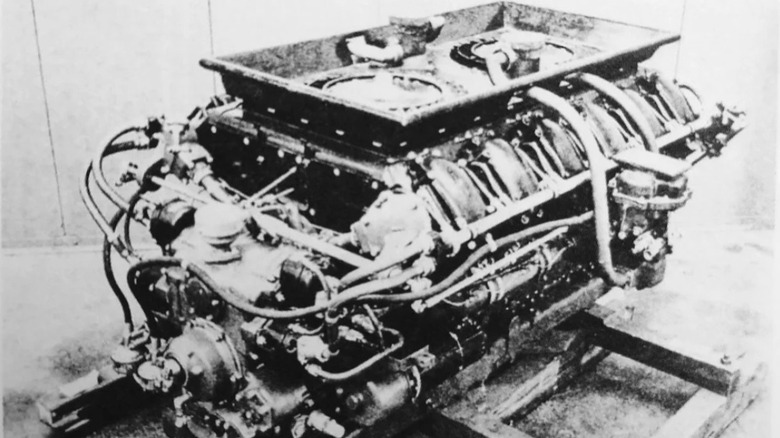
A Continental AV-1790 sits in Jay Leno's Tank Car roadster. But this engine wasn't built just to please motor enthusiasts: namely, it propelled M46, M47, and early M48 Patton medium-sized tanks across Cold War battlefields. The mighty, air-cooled, 90-degree V12 was designed because the U.S. Army's heavier M26 Pershing lacked power, with its liquid-cooled Ford GAF engine making only 500 horsepower. The Continental's V12 and beefy Allison cross-drive transmission solved that problem.
The engine's layout is essentially inside out compared to that of a car: Its intake ports sit on the outside of the cylinder, while its exhaust ports sit in the valley, and two enormous fans pull air from around the cylinders past the manifolds. Its cylinder banks are over 50 inches long and 42 inches wide, displacing 1,792 cubic inches and giving the engine a weight of approximately 2,000 pounds. Regarding performance, M47 Pattons equipped with the Continental AV-1790 made 810 hp and 1,560 pound-feet of torque. Fueling the engine were dual two-barrel Stromberg carburetors made to run 80 octane gasoline.
The M46 – the first Patton tank to feature the Continental engine – was deployed during the Korean War and proved especially efficient in rugged terrains. The M47 and M48 were accepted by the Army in 1952 and 1953, respectively, featuring improved firepower and armor (though late M48s also used diesel engines). As you'd expect, the Continental AV sitting in Jay Leno's famous "tank car" isn't stock: It got a twin turbo in 2006, along with 75mm Ford Mustang throttle bodies and fuel-injection, pushing its max hp to 1,600. And Leno isn't the only person to have a tank engine in his car: Another Continental AV-1790 sits in a 1998 International 4700 truck frame equipped with little more than bucket seats and a windshield.
1941 Chrysler XI-2220
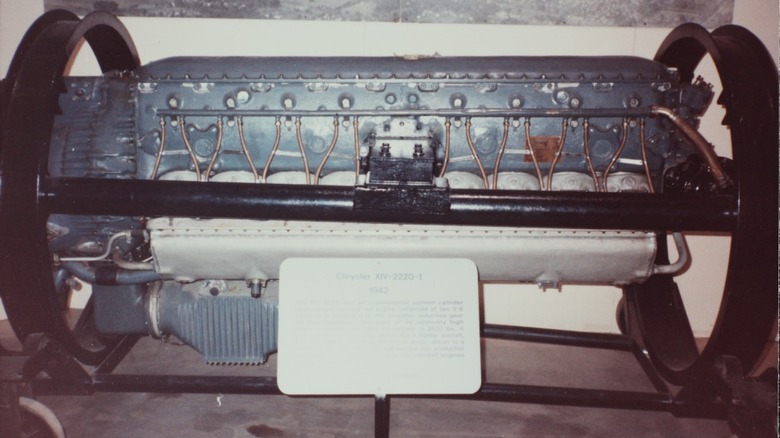
The largest Hemi engine of all time is probably one of Chrysler's most ambitious and experimental builds, yet it's one that never really fulfilled its purpose. In 1939, the U.S. Army declared that it wanted a high-performance V-type engine to power its aircraft. Chrysler proposed a design in 1940 and, in 1941, got the job. So, the beastly XI-2220 came to be. It even flew successfully in 1945, but not in time to get any use in the war it was built for.
While it laid down many foundations later adapted for Chrysler's emblematic FirePower V8, the XI-2220 borrows little else from car engines — though its inverted V-shape was similar to German Mercedes-Benz V12s. It featured 16 liquid-cooled cylinders spread over two banks with a 60-degree inclination that helped keep the engine's overall width down to just 33.5 inches (though it measured 10.5 feet in length). Each cylinder bank had its own magneto, and each cylinder carried its own spark plug. The bore and stroke measured 5.8 inches and 5.25 inches, respectively, displacing 2,219 cubic inches (36.4 liters). With a single-stage GE CH-5 radial turbo-supercharger, the engine produced 2,500 horsepower at 3,400 rpm and 25,000 feet, 2,150 hp at 3,200 rpm, and 1,450 hp at a 2,800-rpm cruise.
Engine testing began in 1942, and Chrysler's creation was later fitted inside two Republic P-47 Thunderbolt fighters. Originally equipped with Pratt & Whitney air-cooled R-2800 radial engines (which were just 53 inches wide and 81 inches long), the planes needed to be heavily modified. While they flew successfully in July of 1945, the war in Europe had ended by then, and the XI-2220 never saw any wartime action. Still, it's a marvel of wartime engineering and holds a critical place in the history of the Hemi engine.