

Here's How Much A Chevy Corvette Would Have Set You Back In The '70s
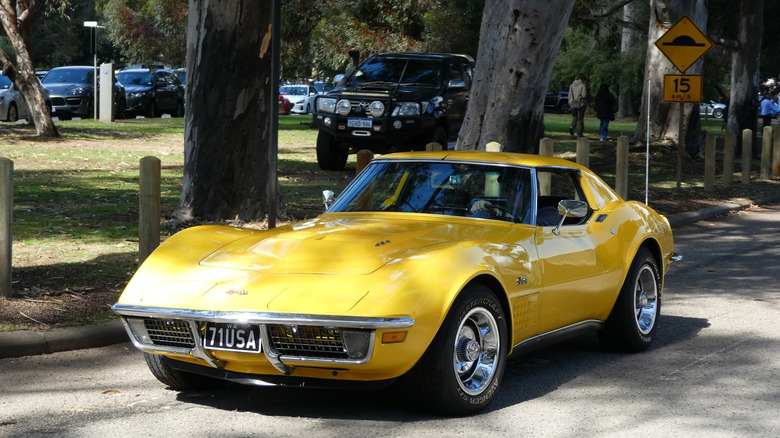
The 1970s was a tumultuous time for American automakers, and the nation's favorite sports car wasn't excluded from the fallout. While the start of the decade saw the release of thunderous big-block-powered luxury machines along with some of the greatest 'coke-bottle' muscle cars from the golden era, the rest of the '70s was very different. The Environmental Protection Agency's formation in 1970 introduced strict new emissions regulations, while the oil crisis saw gas prices rise to previously unprecedented levels. Naturally, that made filling up V8-powered sports cars like the Corvette a little more uncomfortable, but it also meant the production costs of such cars went through the roof, too, which was ostensibly reflected in the Corvette's MSRP.
While it was possible to pick up a shiny Corvette from the dealer with that new-car smell for under $5,000 at the start of the 1970s, by the end of the decade, that price had more than doubled, and Corvette prices rocketed even further as the early '80s dawned. Other changes affected the Corvette-purchasing process during the decade too, such as the pricing of desirable extras — power windows went from $63.20 to $141 during the '70s — and even the availability of the convertible option.
Here's what Corvette buyers were paying throughout the early 1970s
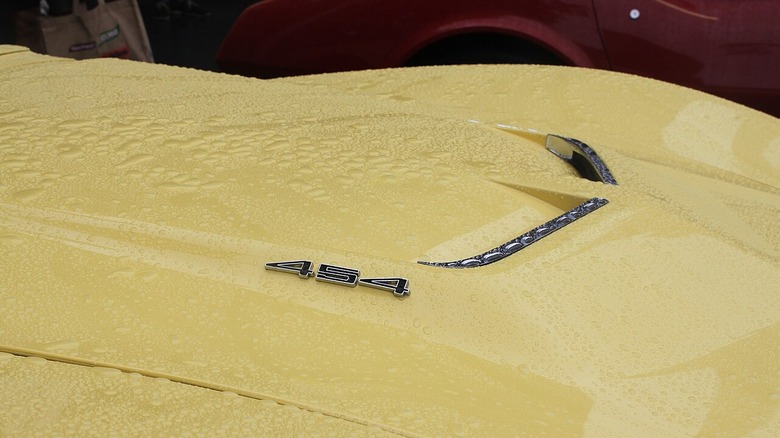
Starting with happier times, a Corvette buyer in 1970 was presented with a plethora of options at tantalizing prices. They could drive away in a shiny new Sport Coupe for just $5,192, or feel the wind in their hair for even less, at $4,849 in a convertible. For an extra $289.65, they could opt for a 390-horsepower 454-cubic-inch LS5 V8, while comfort-oriented options like power windows and air conditioning would set them back $63.20 and $447.65 respectively.
For the first few years of the '70s, Corvette prices would grow only gradually. From '71 and through '73, the price for a base Sport Coupe would swell to $5,496, to $5,533, to $5,561 for each respective model year, before landing at $6,001.50 in '74. The Convertible was slightly cheaper but tracked a similar path. A long list of options continued to tempt buyers into spending more, with perhaps the most tantalizing box to tick being the 454-cubic-inch LS6 option in '71. For $1,221 extra, this would net you the most powerful 'Vette of the '70s, although at $926 more expensive than the 390-hp LS5, it's no wonder it remained a remarkably rare configuration. Back to base prices, though, once the Corvette cracked $6,000 in 1974, its pricing trajectory slowly started to explode.
The late '70s had Corvette buyers reaching ever-deeper into their pockets
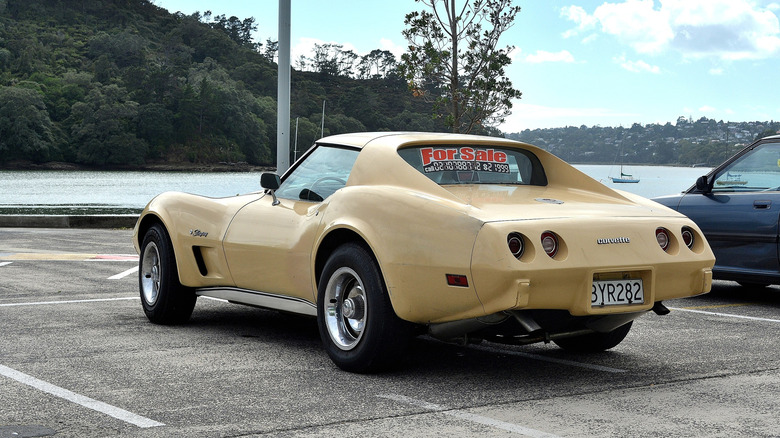
The year 1975 saw base Corvette prices swell to $6,810.10, before they hit $7,604.85 in 1976. As for convertible models, a '75 example commanded $6,550.10, and if you wanted a convertible Corvette in the latter years of the decade, tough luck, as Chevy discontinued the model. Meanwhile, new federal mandates forced cars in the '70s to wear giant 5-mph bumpers, and so the once sleek C3 Corvette was soon adorned with a questionable plastic nose and tail end in '73 and '74, respectively.
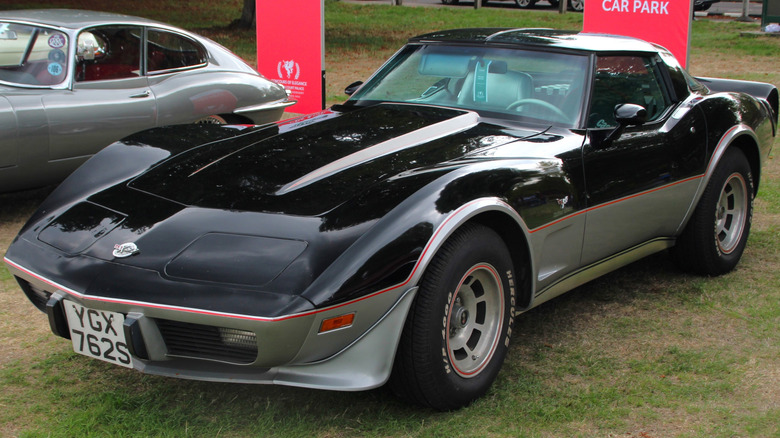
By this point the stylish chrome bumpers, more powerful engines, and now the drop-top options were no longer available. Even though buyers were paying more than ever, they were actually receiving less 'Vette for their money. By 1976, the Sport Coupe's base price had already swollen by around 50% compared to 1970, but things were about to get a whole lot more expensive. Base Corvette pricing in '77, '78, and '79 tracked as follows: $8,647.65, $9,351, and $10,220.23. Special and limited editions commanded far more, like the '78 Pace Car Edition, which set buyers back $13,653.21. To close the decade out, prices of base models jumped by almost as much as $3,000 in a single model year, with the base '80 Sport Coupe models commanding $13,140.24.
What '70s Corvette buyers were getting for their money
Throughout the 1970s, prices appreciated massively across the entire Corvette range, but all while this was happening, the power outputs and overall performance of the models actually kept decreasing at a similarly alarming rate. We've already covered the heady outputs of early models, with optional LS5 and LS6 big-block engines producing 390 and 425 hp, respectively, but it's the base engines that best tell this story. In 1970, a zero-option 'Vette left showroom floors with 300 hp and 380 lb-ft. Immediately in '71, that base output dropped by 30 horses, and figures changed across the board from here on out thanks to a change over to SAE net calculations. Official outputs for base 350ci engines in '72 and '73 were 200 hp and 190 hp respectively.
Interestingly, the base 350 received a 5-hp increase for '74 models, although the good news ended here. Despite jumping over $800 in price, the '75 model actually lost 30 horsepower, in turn becoming the second-least-powerful Corvette ever sold, with a dismal 165 hp. The Corvette's recovery was a slow and painful one, with the '76 model bringing output up to 180 hp, and while figures bounced around a little over the coming years, the base '79 Corvette's 195-hp rating and 225 hp for the range-topping L82 are proof the decade ended in a miserable place when compared to its starting point. Of course, ever-tightening emission regulations and the change from gross to net horsepower ratings were to blame for the Corvette's pitiful outputs, while a shift in American buying patterns also turned many consumers away from performance-oriented machines, and into economical commuters or luxury-lined models instead.
How much '70s Corvettes cost today
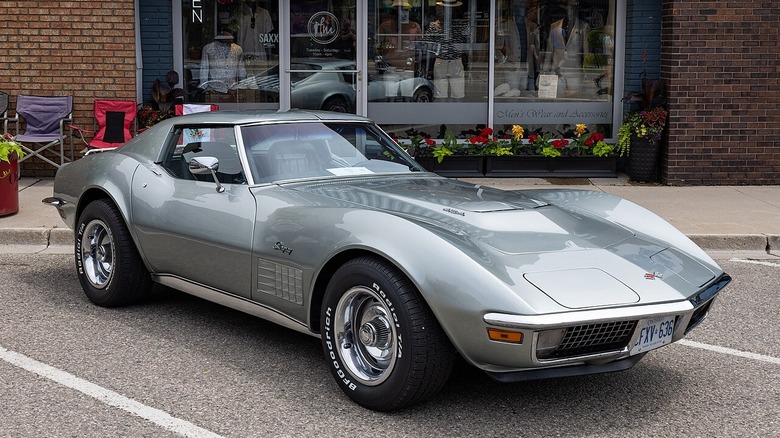
While Corvette prices did indeed double over the course of the decade, it's also important to factor in inflation. After adjusting prices for inflation, that 100+ percent increase in base pricing was actually closer to 50% between the years 1970 and 1979. That is still very significant, and the pain doesn't end there, sadly. Hagerty currently pegs a 1970 Corvette in base Coupe guise at $29,000 in good condition, whereas it values a '79 example at just $12,300. Mid-'70s models fall somewhere in between, with base models trading in the mid-to-high $10,000s, according to Hagerty. Factoring in the power lost over the years, we realize that not only did buyers pay double for later cars, but they also received merely two-thirds of the car's original output, only for those cars to then depreciate to be worth less than half the value of earlier models. Ouch.
There are exceptions to the rule, of course. Really lovely examples of the aforementioned '78 Pace Car Edition have gone on to fetch sums in the region of $50,000 and beyond. However, that's still far from earlier cars like the 1971 Corvette ZR2, which Hagerty values at $421,000. So exact specifications clearly matter a lot, but the obvious trend is that earlier cars are what collectors covet today, and looking at the evidence of questionable body tweaks and tumbling outputs, it's not exactly difficult to understand why.