

How A Ball Bearing Company Rolled Volvo Into Existence 100 Years Ago
If you've replaced any wheel bearings, transmission bearings, or seals in your car lately, whether it was a Chevrolet or a Ferrari, chances are high that you received them in a little box marked with the stylized letters SKF. Founded in 1907, Svenska Kullagerfabriken is the world's largest manufacturer of bearings, and among the largest companies in Sweden. The company was so big and immediately successful that it was able to build an entire automobile company inside its corporate structure in 1926. Volvo — Latin for "I roll," which has obvious bearing-related connection — emerged into the world, birthed from SKF, and eventually was spun off into a stand-alone company by 1935.
Assar Gabrielsson, head sales manager for SKF, approached the bearing company's managing director with a plan to build an initial experimental run of 10 passenger cars using existing SKF components. Confident that the plan would work, he offered to bankroll the 10 cars himself. The SKF board agreed to build the cars, but since the company could use this as an opportunity to study its products' longevity and functionality in the booming global automobile market, it told Gabrielsson his offer to pay for the initial run was unnecessary. It was a frictionless beginning, to say the least.
Technically, the name Volvo was first used by SKF for its automotive bearings spinoff starting in early 1915. But World War I, which had begun the previous July, caused car production to pause, and following the war SKF shelved the brand in favor of unifying all of its bearing products under the initialized name. It wasn't until Gabrielsson's flash of brilliance that the company took the Volvo name out of a drawer and applied it to the fledgling automobile company.
Getting rolling
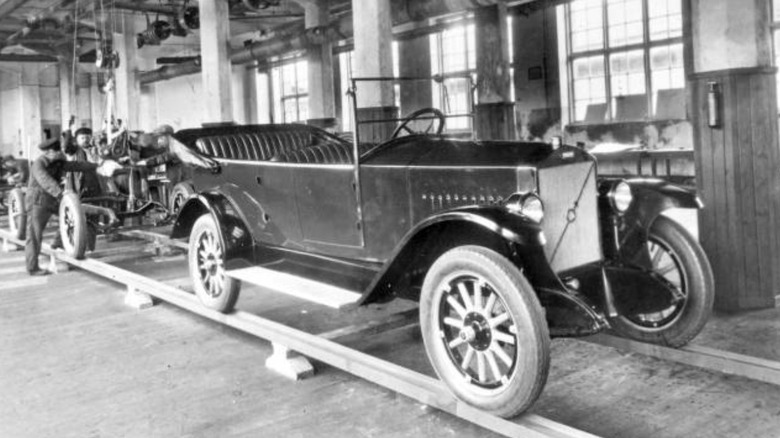
Being a salesman, Gabrielsson knew little about building automobiles, so his good friend, engineer Gustaf Larson, carried out the engineering for the new car. Their contract implied that Gabrielsson was sticking his neck on the line to make Volvo a going concern, as Larson wrote later in Volvo Ratten: "Gabrielsson was personally obliged to make a great many financial sacrifices but a firm belief in the future made all things possible. He also got SKF to believe in us." High risk and high reward.
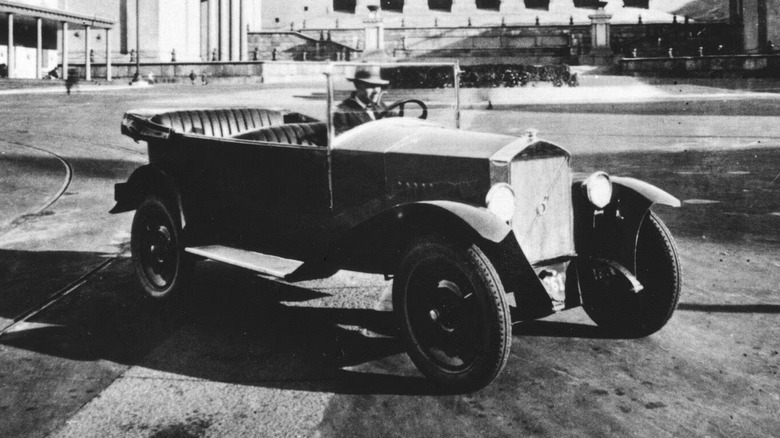
July 25, 1926 marked the "name day" of Jakob, one of 10 pre-series Volvo prototypes. The car is believed to have been so named because July 25 was Saint Jacob's Day, the feast of Apostle Saint James the Greater. The first series production Volvos, the Öppen Vagn 4 cylindrar or ÖV 4, followed closely in the prototypes' wheeltracks, rolling out of the factory just over eight months later. They also were known colloquially as Jakob because they so closely mimicked the prototypes, powered by a 28-horsepower four-cylinder and riding atop an ash-and-beech wooden frame.
Jakobs were marked with the symbol of the Roman god Mars, and there was an established relationship between Mars and Swedish iron. Volvo used the symbol as a way to associate itself with the ideas of strength and steel. Still visible on Volvos today, it rode on a diagonal strip of metal across the grille to hold it in place.
The open-top version was not overly successful in Sweden's cold climate, leading Volvo to introduce a Weyman-bodied closed-top version, basically its first boxy wagon. Nearly 1,000 of the two models were built between the spring of 1927 and the end of 1929, with more than two-thirds of production being the closed-top "Personvagn 4 cylindrar" PV4 model.
The rest is history
With the launch of the ÖV 4/PV 4 line of cars, SKF increased its investment in Volvo in an effort to give the fledgling motor company a strong foundation. The next handful of years were important for Volvo and SKF as the company slowly started expanding its export reach to Europe, building somewhat popular commercial trucks. In 1935 SKF determined that Volvo was self-sufficient, and in a desire to focus on its core business of ball bearings, spun the company off with its own entry on the Stockholm stock exchange. SKF sold its ownership of Volvo, making it an independent public company.
Volvo, with newfound independence, focused on investment in vertical integration. Volvo purchased its engine supplier, a manufacturer called Pentaverken that was also popular in the marine engine market. Seeking further engineering input and beginning to study the effects of aerodynamics on automobiles, Volvo became majority owner of Swedish engineering company Svenska Flygmotor during World War II, later renaming it Volvo Aero.
Volvo, celebrating its 100th year building cars and now majority-owned by China's Geely Holdings, is still an important part of the automotive landscape today. So many car brands that started 100 ago met their end for one reason or another, but Volvo has managed to remain solvent and innovative. And much of Volvo's strength today is found in the diversification it managed in those early days. Not only does Volvo build high-quality automobiles, it's a leader in heavy trucking and pleasure boats. (The company sold Volvo Aero in 2012.) All that from inauspicious roots as the off-the-wall gamble of two men working at a ball-bearing company.