

Why Your Tire's Official Pressure Recommendation Isn't Always The Right PSI
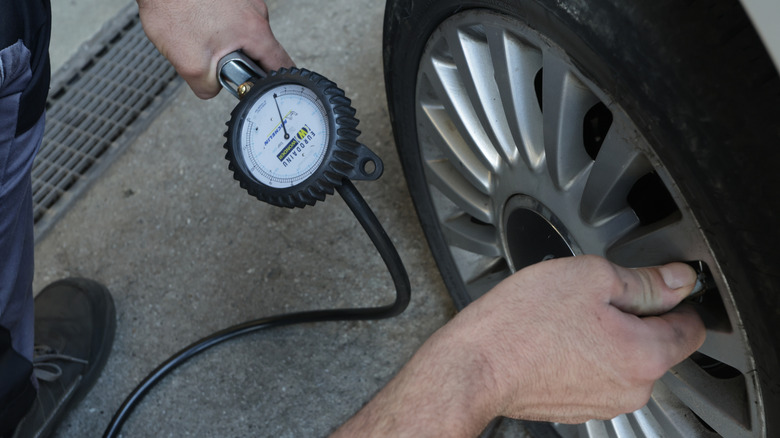
Today in tire school, we'll start off by addressing some terms. First, what do we mean by the official tire pressure recommendation? It is not the numeral on the tire sidewall, because inflating to that number is a terrible idea. Usually, those sidewall digits refer to the maximum allowed pressure, and for normal use, you want to avoid that — but, as we'll explain later, normal doesn't mean all circumstances. Instead, the National Highway Traffic Safety Administration wants you to look at your car's B pillar — the junction where the driver's door meets the back of the car – for a placard that lists the correct pounds-per-square inch (PSI).
Now, there are other words to address — "the right PSI." Right for what? If you drive your car on your tires' maximum inflation pressure listed on the sidewall, you're inflating the tires a lot more than with the suggested PSI. Presumably, that's because you need to, for instance, when tracking your car, and sometimes for towing or carrying more weight. Further guidance by many tire experts, including Tire Rack, suggests following the 4 PSI rule for inflating your tires. The idea is that, if correctly inflated, the pressure in cold tires should rise by roughly 4 PSI after driving because the heat of friction between the tire and the pavement expands the air inside. This means that if you were trying to get to that maximum volume for a heavier payload, you should overinflate with care. Note that overinflating by just 6 PSI can increase the risk of a puncture.
When more pressure in your tires is better
You may not think of a road trip, where you pile the whole brood into car, add a rooftop box and the canoe and hit the Interstate as a high payload event. But it is. This is when to reference the maximum PSI number on that door placard. Also, set the pressure when its tires are cold. Yes, that number will rise as the tires heat, but there's still a far bigger risk of an under-inflated tire, which can cause a blowout, than an overinflated one. Low pressures typically lead more tire wear, too.
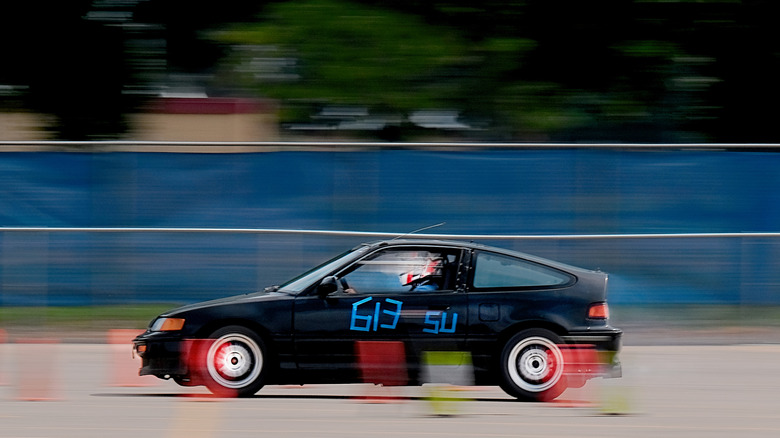
For sports like autocross, over-inflating your tires can lead to sharper handling and quicker cornering. Tire Rack says you can run the front tires of a front-engine, front-wheel, or all-wheel-drive car at roughly 40-45 PSI and the rear tires at 30-40 PSI on the track. With a front-engine, rear-wheel-drive car, they recommend front pressures ranging from 35-45 PSI and the rears from 30-40 PSI. And with a mid-engine car, the fronts at 35-45 PSI and the rear tires at 35-40 PSI.
This is general guidance and will vary depending on the tire and the model of the car, so be methodical and increase pressures in 2-PSI increments. And definitely decrease pressures to the door placard recommendation when you return to public roads. Tire Rack adds that tire pressure greatly impacts understeer and oversteer, and notes that more pressure reduces wear during racing. Plus, the company also suggests that increasing pressure for racing in the rain can improve performance and reduce hydroplaning. Of course, specific regulatory bodies like the Sports Car Club of America may have their own ethics or guidance for the PSI for their events. When a car goes through an inspection before an event, they may (or may not) bother with tire pressure as well.
When airing down your tires is a good idea
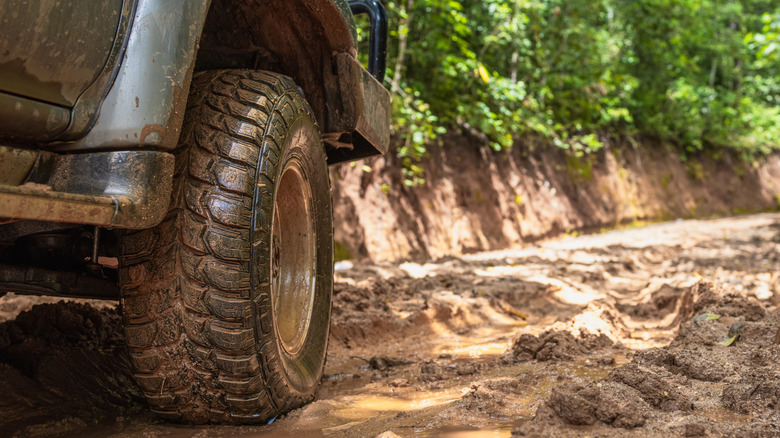
There's one reason to run way less air than the recommended rating: traction. BF Goodrich explains that if you're driving on sand, airing down your tires is a good idea because it increases the tire's contact patch. But how much should you let out? Nappa suggests dropping 5 PSI per tire on sand and up to 10 PSI on rock, but also alerts you that decreasing pressure increases your chance of tearing the tire sidewall. And just like airing up for racing on pavement, you should air down in small bites, only dropping pressure to gain needed traction.
In fact, airing down any car tire — not necessarily a specific off-road tire — can also amplify grip on snow for short distances — a handy technique for getting unstuck. However, running low pressures greatly increases the heat buildup inside the tire, and as you'd guess, since overinflation leads to sharper handling, running on squishy rubber will make your car understeer — the sensation of pushing through a corner. You also risk a blowout by running as low as 6 PSI below the recommended inflation.
Airing down has another issue: You'll need to air back up when you hit pavement. Unlike with racing, where you can air down to the recommended pressure just by bleeding air with a pressure gauge, if you need to air back up, you'll need a portable compressor. And don't think you can just crawl to the nearest service station. That risks having a blowout, and at the very least, running low pressures on pavement can accelerate tire wear by as much as 25%. That'll prove hazardous to your wallet, since even the best bang-for-your-buck tires aren't cheap.