

11 Toyota GR Supra Alternatives For Tighter Budgets
Here's the issue: Toyota has now ceased production of the A90 Supra, and this beacon of classic sports car ingredients — a 335-to-382-horsepower turbocharged straight-six, rear-wheel drive, a manual transmission, and a sleek exterior design — is now in finite supply. Disregarding the issues Supra buyers have had with the nonexistent custom ordering system and big dealer markups, it's not outlandish to infer that the A90s out there will stay fairly expensive.
According to Classic.com, the straight-six-powered A90 Supras (the ones everybody wants) have a current market value of around $47,000. Is that too much for what the Supra offers? There's no need to take sides on that issue — the Supra is a capable and fun sports car. But many folks don't want to spend nearly $50,000 for an experience they can get for less.
What you'll find in the following group of alternatives are not necessarily direct competitors of the A90 Supra. Instead, they represent the sentiment we conveyed above — a comparable experience with all the engagement you want in a sports coupe for slightly friendlier price tags than those in the window of a modern Supra.
Nissan 370Z NISMO
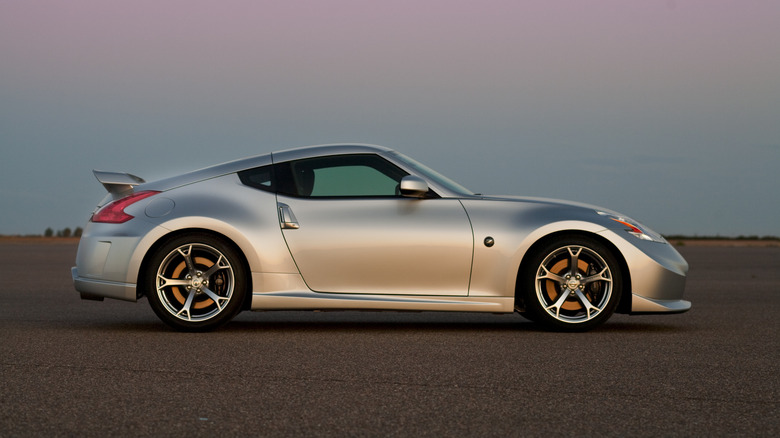
The 370Z was first blessed by its racing division (NISMO) in 2009, the same year that the model debuted, with the purpose of replacing the outgoing 350Z. While the regular 370Z sported 332 horsepower and 270 pound-feet of torque, the NISMO additions bumped things up to 350 horsepower and 276 pound-feet from the same naturally aspirated 3.7-liter VQ-series V6.
In addition to a SynchroRev Match six-speed manual transmission (which automates heel-toe downshifts for you), the NISMO also received anti-vibration transversely mounted structural dampers, stiffer suspension components, a front splitter and rear wing, and a bunch of special NISMO badging, of course. About five seconds is all it took for the Z to jump to 60 mph, and grip levels were impressive — 0.99 g around Car and Driver's skidpad test.
Power outputs stayed the same all the way until the 370Z went out of production in 2020, so no need to worry about major model year differences. What you'll really care about is that the average used NISMO cost only about $25,800, or $15,000 cheaper than when new, and more than $20,000 in savings compared to the average Supra. As comparisons go, the Z is fairly well paired to a Supra with horsepower figures in the same ballpark and weights that are almost identical. What you may be left wanting is the vast advantage in torque with the Supra, along with all the more modern tech.
Ford Mustang Boss 302 (S197)
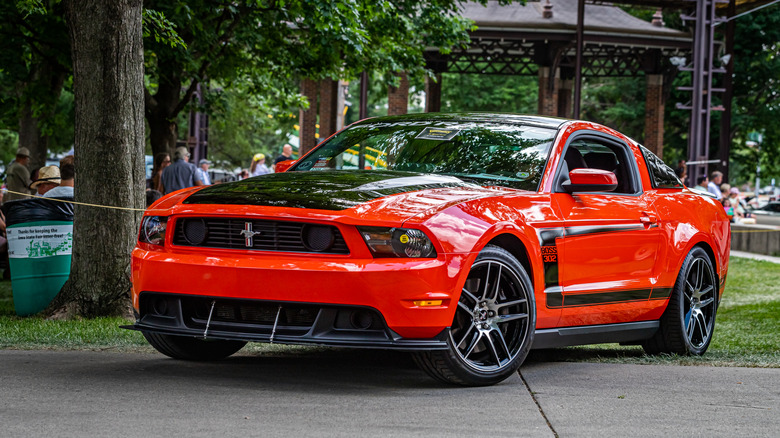
For under $40,000, or rather about $35,000 on average, the S197-generation Boss 302 is likely the best pony you could possibly purchase. Even better, it's one of our audience's favorite Mustangs. The Boss 302 came later in the S197 cycle (2012-2013), providing what would be the modern equivalent of the track-ready Shelby GT350R that came during the sixth-generation Mustang's run. With changes including a new intake manifold, higher-lift camshafts, larger intake valves, new bearings, and upgraded cylinder heads, the Boss 302 could pump out 444 horsepower and 380 pound-feet of torque from the all-aluminum 5.0-liter V8.
But more than just a fine piece of powertrain engineering, this Mustang was considered the most complete Mustang on the market at the time. Instead of a lazy chassis with a big V8 shoved up underneath, this was a cohesive package that demanded spirited driving without having to look over your shoulder for unexpected squirliness. It utilized stiffer-than-standard springs, bushings, bars, and larger Brembo brakes, as well as a six-speed manual transmission to bring it all home.
Unfortunately, the even more special Boss 302 Laguna Seca edition and all of its racing suspension and weight savings are out of our budget, but the regular model is all but sure to satisfy nonetheless. For a car that's nearly 10 years older than the earliest A90 Supra, the 302's 4.3-second 60-mph run is, impressively, only about four-tenths slower than the Supra. In the handling department, its roadholding is slightly worse, but according to most accounts, the experience was top-notch. The main drawback of this comparison, though, is certainly the interior. It's still just a Mustang, and the Supra's modern cabin is undoubtedly a nicer place to spend your time.
Porsche 911 Carrera (996.2) (Manual)
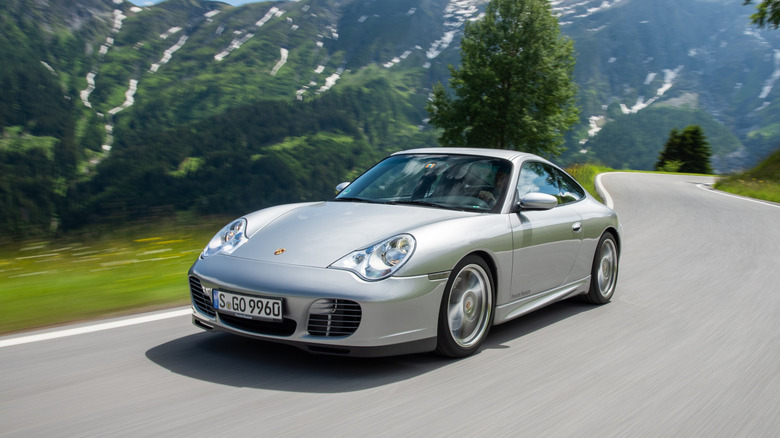
Some people would genuinely desire an A90 Supra over a Porsche 911, which is great. More power to them. However, others might gasp upon realizing they could have a manual transmission Porsche 911 driving experience for less money than a used A90. It's true, and it's all thanks to the ugly duckling of the 911 lineage — the 996.
We've chosen the 996.2 specifically, which ran from 2002 to the end of the 996 in 2004, as it still stays well within our budget (average value is $36,492 for a manual example) and features improved performance over earlier 996s. Porsche changed 80% of the Carrera's engine internals for the 996.2 and updated its "VarioCam" variable valve timing system for an improved torque band, resulting in 315 horsepower and 273 lb-ft from its 3.6-liter naturally aspirated flat-six, enough to shove it to 60 mph in anywhere between 4.6 and 5 seconds.
Other updates to this 996.2 were significant decreases in lift at the front and rear, a 25% increase in frame rigidity, lighter standard 17-inch wheels, Turbo-style headlights, and re-tuned dampers. It's a tidy little package for anyone who enjoys driving, and while there are things to "hate" about the 996 – including the fact that it will be noticeably slower in a straight line than the Supra, not to mention its famously uninspiring interior — saving $10,000 and getting to drive a 911 is not a terrible trade-off.
BMW M3 (E46) (Manual)
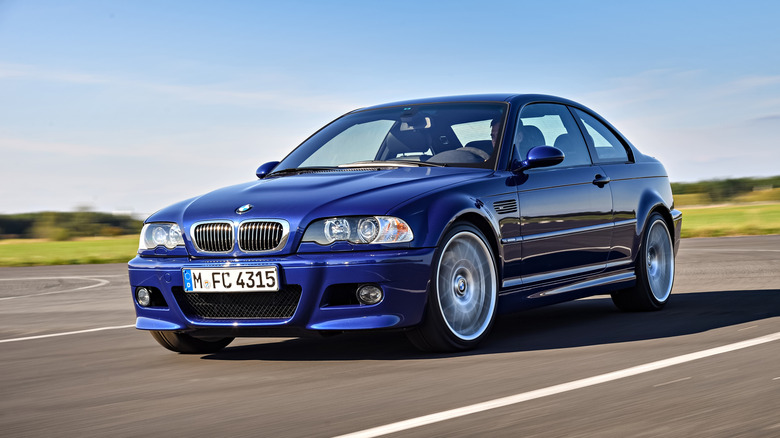
The E46 M3 is consistently ranked at the top, or near the top, of the M3 generation ladder, simply because it had exactly what enthusiasts wanted — handsome and timeless looks, a powerful straight-six, manual gearbox, wonderful on-road chassis control (period racetrack tests did cite noticeable understeer), and comfort. It simply delivers.
During the previous E36 M3 generation, BMW gave the U.S. a different, less powerful engine than those meant for the European market, but for the E46, that changed. From its debut year of 2001 onward, the North American spec M3 finally got the engine everyone else had, a 333-horsepower 3.2-liter naturally aspirated S54 straight-six. More than just a rowdy engine, though, the M3 sported a completely bespoke set of suspension components compared to the regular 3-series, a quicker-than-stock steering rack, and wider fenders, among many other changes.
Like the Porsche and Mustang, the M3 isn't quite as quick as the Supra, and the BMW's ride quality will likely be less pleasant on the road than the modern Toyota. With a manual, these go for around $37,000, which is far more than they used to cost. And while it is German, the E46 is one of those BMWs you can buy with a little more confidence in the reliability department. If you can swing it, it may be worth it. And heck, if you can spend $40,000, you could likely pick up a competition-spec E46 M3.
Honda S2000 (AP2)
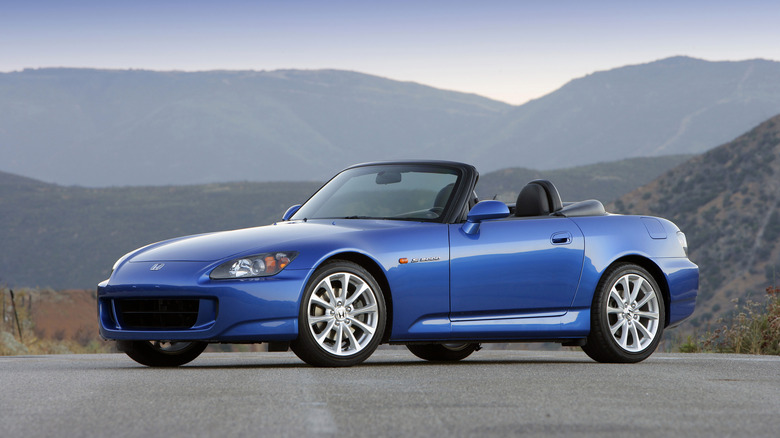
We wanted to include a Honda in this. However, the only modern sporty cars that could compete with the Supra would be the Civic Type R, which does make the cut price-wise by a few thousand dollars but is a little too different from the sport coupe philosophy of the Supra, or the NSX, which is far too expensive. So, we've "settled" for the AP2-generation S2000.
Of course, a Honda S2000 is not something you settle for. It's one of the company's most beloved sports cars in history, blending the brand's mastery of engine development with its proven sports car heritage from cars like the early S500, S600, and S800. The AP2 utilized a larger 2.2-liter naturally aspirated inline-four with 240 horsepower and 162 pound-feet of torque, connected to a six-speed manual that has gained cult status over the years. This lump spins to a dizzying 8,000 RPM, benefiting from additional compression and revised VTEC components to contribute to the larger displacement compared to the 2.0-liter version from the AP1 S2000.
Around $35,000 is what it takes to get into the driver's seat of a well-kept AP2. Once again, that's higher than it used to be, but desirability speaks for itself, and that jewel of a motor under the S2000's hood makes average prices seem like a steal. In a direct comparison to the Supra, like many of the others, it's not as quick (5.4 seconds to 60 mph, or about 1.5 seconds slower than the Toyota), plus you have to be okay with owning a convertible and the maintenance that comes with car that's more than 20 years old. Luckily, it's a Honda.
Mazda Miata (ND)
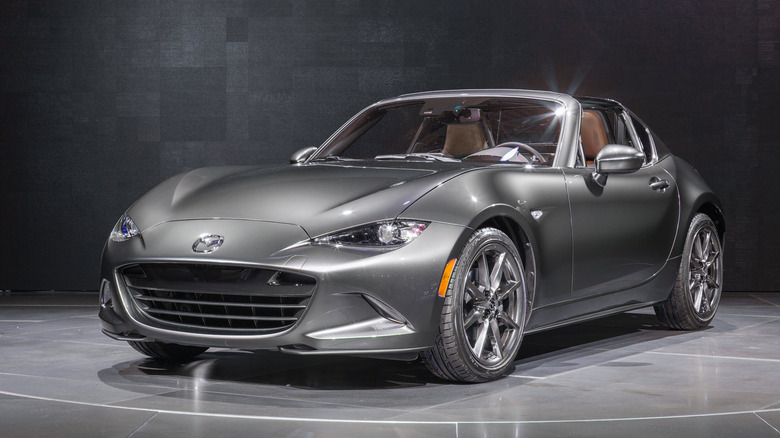
In line with the drop-top sports car as a Supra alternative is our next pick, the ND-generation Mazda Miata. Yes, it's an obvious, overdone suggestion, but don't ignore it. The Miata, while slower, smaller, and one might say less sexy than the Supra, has consistently been one of the best enthusiast experiences on the market. Since its debut in 1990, the Miata has been featured on Car and Driver's "10 Best" list 19 times. And because the Supra is a modern car, it seemed that the modern ND was the obvious choice.
The Miata is a true "tighter budget" fit for this Supra debate. On average, a used ND sells for around $25,000, but you could literally buy a brand new 2026 model for less than a used Supra, too, if you so choose. Regardless of model year, the ND has always come with a naturally aspirated 2.0-liter inline-four; however, output has risen over the production cycle from 155 to 181 horsepower in the 2026 model. And obviously, the ND provides a six-speed manual transmission.
We did mention that the Miata is a traditional soft-top convertible, though if you want a slick top option that's closer to the Supra we're comparing against, Miata RF models come with a solid targa-style top.
BMW M2 (F87)
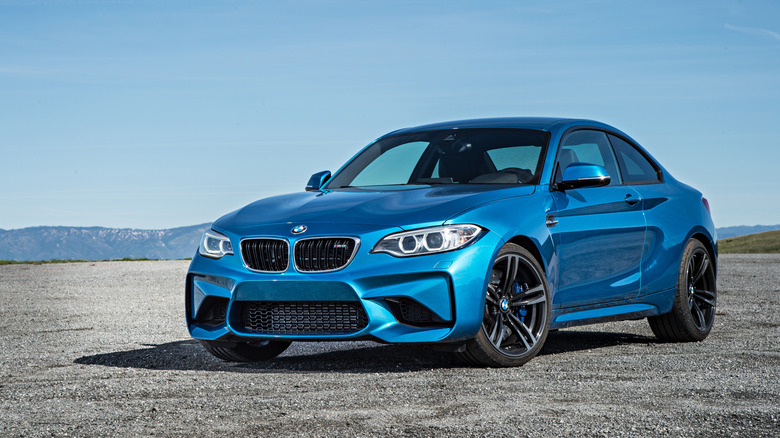
The F87 M2 was the car that breathed life back into BMW's M department. After an M3 and M4 that were a bit soulless, and the bittersweet taste of the compact 1M Coupe that left too soon, BMW needed something true to its performance and driver-focused mantra, which it seemed to have left behind with the E46 M3 of the 2000s. And though the M2 wasn't perfect, it was exactly what the M division needed.
The M2 was a simplified approach to a modern sports car. Instead of adjustable shocks like those on the M3 or M4, the M2 got fixed dampers and springs, and rather than a traditional M-engine, it received a regular old 365 horsepower turbocharged N55 straight-six. Still, the M2 was a little rocket. Zero to 60 mph was done in just 4.2 seconds, and the quarter-mile in 12.7, both of which are within spitting distance of the Supra.
The only thing not comparable to the Supra is the F87's current average values. Non-Competition spec, base model M2s are selling consistently for around $37,000 — $10,000 less than the average Supra, while still retaining the Toyota's core bits: a turbocharged straight-six, manual transmission, two doors, and rear-wheel drive.
Porsche Cayman (987.2) (Manual)
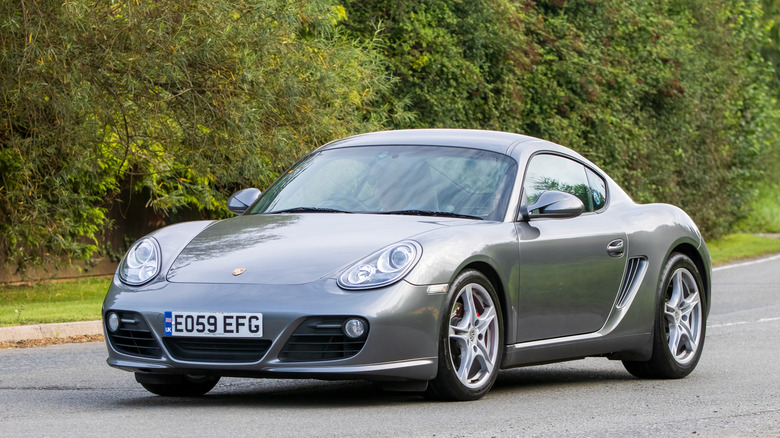
Another classic choice for the driving enthusiast is the Cayman, and truly, it doesn't get purer than a Cayman on a back road. The 987.2 Cayman is a sweet spot for this model because it is the refresh that got rid of the IMS bearing issues completely, and the manual-transmission base models are still affordable, at least in the context of an A90 alternative, typically selling for an average of around $38,000. They came standard with a 2.9-liter naturally aspirated flat-six producing 265 horsepower and 221 lb-ft of torque, along with, of course, a six-speed manual..
And no, it's not as powerful, spacious, or modern as the Supra, and parts are certainly more expensive, but it'll pump out beautiful sounds, stay reliable as long as it's properly taken care of, and deliver a driving experience just as satisfying, if not more.
Despite being more than a decade older than the Supra, the Cayman's grip levels are nearly the same, posting a 0.96 g run on Car and Driver's skidpad versus the Supra's slightly better 0.98 g. The Cayman is also mid-engined, which is not only the generally preferred sports car layout but also makes it a rarity in the sub-$40,000 range.
Toyota GR86
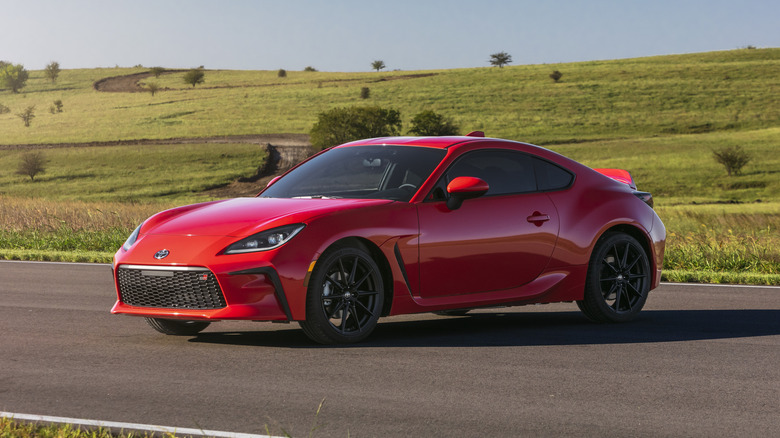
If it's the truth you want, you can get a fantastic driving experience on par with the Supra without ditching Toyota at all. Heck, you don't even have to stray from the GR sub-brand. It's the GR86. It's a part of an exclusive club of affordable entry-level sports cars that still exist in 2026, and on average, it only costs about $30,000 used. The GR represents the second-generation 86, following the incredibly popular first-gen cars that ran from 2012 through 2021.
Upon its debut in 2022, the GR86 was confidently a new car that still retained the charm and enjoyable driving experience we had come to know this nameplate for. The Toyota's bodywork is well-proportioned and looks fast when standing still — fitting, considering it also received a new powerplant, a 2.4-liter naturally aspirated flat-four capable of 228 horsepower and 184 pound-feet of torque. Speaking of that torque number, it's really the rpm at which it's achieved, 3,700, that's notable. The old 2.0-liter from the first-gen car had a massive torque hole that didn't wake up until well into the 5,000 rpm rev range. Now, the engine provides more than enough thrust for daily driving without redlining in every gear.
It's slower, obviously, than the Supra, boasting a humble yet still competitive 0 to 60 mph figure of 5.4 seconds. It also won't sound as symphonic as that sweet BMW-sourced B58. Taking everything into consideration, though, including its genuinely nice interior, impressive skidpad grip of 0.98 g, six-speed manual, and enthralling back-road character, it's $30,000 we'd consider extremely well spent. And don't forget, you can also buy a brand-new example for well under $40,000.
Chevrolet Camaro SS (Sixth Generation)
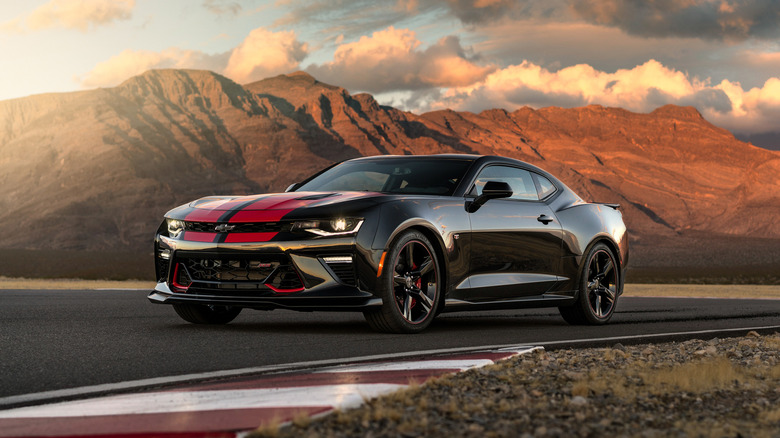
On average, the 6th-gen Camaro SS is pretty up there in terms of our budget. Remember, the average Supra 3.0 Premium costs about $47,000 on the second-hand market, and the sixth-generation SS costs $44,000 on average, leaving you with savings of only $3,000. Technically, it is a tighter-budget option, but we figured that this entry should certainly have an asterisk next to its name.
Earlier sixth-gen Camaro SS model years, however, can be found for far less than that $44,000 average — anywhere between the high-$20,000 range and about $40,000. For the money, you get the 6.2-liter LT1 V8 (also featured in the Corvette Stingray at the time) with 455 horsepower and 455 pound-feet of torque, a six-speed manual, and a fantastic chassis that can handle both the road and the track with grace. Also available with the SS package are big Brembo brakes, optional magnetic dampers, and a drive-mode selector that can tune everything from stability control interference to damper stiffness.
With all that grunt from the 6.2-liter V8 under the hood, the Camaro is one of the few cars we've recommended so far that can genuinely hang with the Supra in a performance test setting. The 0 to 60 mph run is an identical 3.9 seconds, and the quarter-mile is also a dead heat at 12.3 seconds. Even skidpad figures are tied at 0.98 g. If there were demerits to the Camaro's case, they would likely be its poor visibility and outdated interior compared to the Supra, though that V8 sound might be enough to overlook those shortcomings considering you're likely spending several thousand dollars less for the Chevy.
Chevrolet Corvette Stingray (C7)
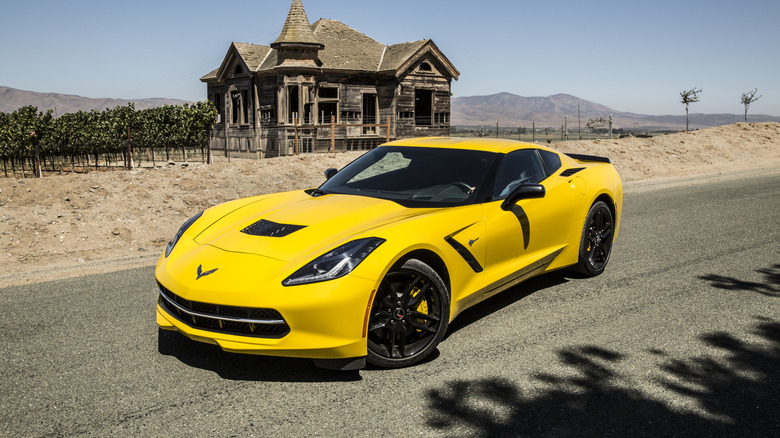
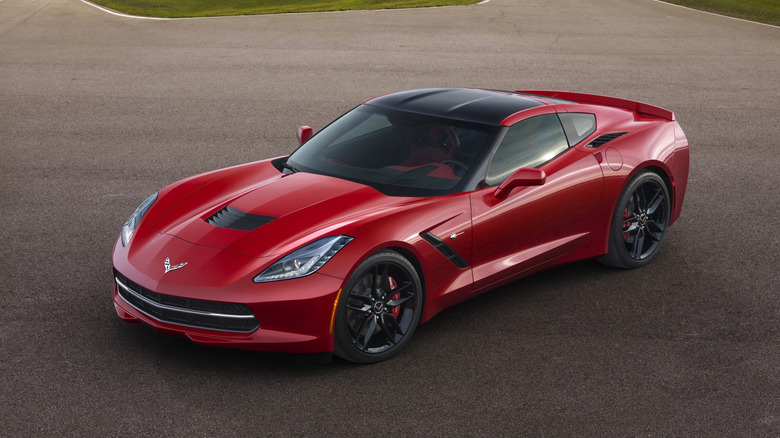
The C7 Corvette, just like the Camaro SS, is at the height of our price limit, averaging in the mid-$44,000 range, but it's plainly one of the most worthy alternatives. The C7 Stingray debuted for the 2014 model year with a body style bolder than any Corvette since, arguably, the C3. It shared the same 6.2-liter LT1 V8 with the Camaro, producing 455 horsepower and 460 pound-feet of torque, but instead of the expected six-speed manual, the Corvette team opted for a seven-speed unit, something not seen frequently in stick-shift vehicles.
Its chassis was always praised as highly capable, and in even base form, the regular old Stingray was as impressive as a Corvette should be. Better yet, if you can snag a car that came with the Z51 performance package, you'd get a bunch of additional goodies, like improved cooling components, an electronically controlled limited-slip differential, one-inch larger wheels at all four corners, close-ratio gearing for your seven-speed stick, larger brakes all around, and an extra 5 horsepower and 5 pound-feet of torque.
The Z51 is a bonus on top of what already is a fantastic stock performance car. Pitted against the Supra, the C7 Stingray is a formidable foe. It ties the Supra's 3.9-second 0-60 mph time, beats it by a tenth in the quarter-mile, and bests even the stickiest Supras with a skidpad result of 1.08 g. The only category in which you'll be lacking with the 'Vette is fuel economy, but if you're buying a 6.2-liter V8-powered sports car, efficiency is not something you're losing sleep over.