

The Engineering That Made The Honda S2000's Manual Gearbox A Cult Object
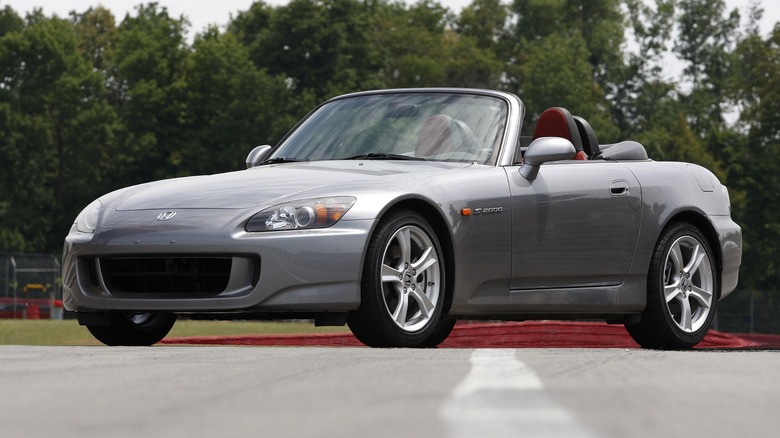
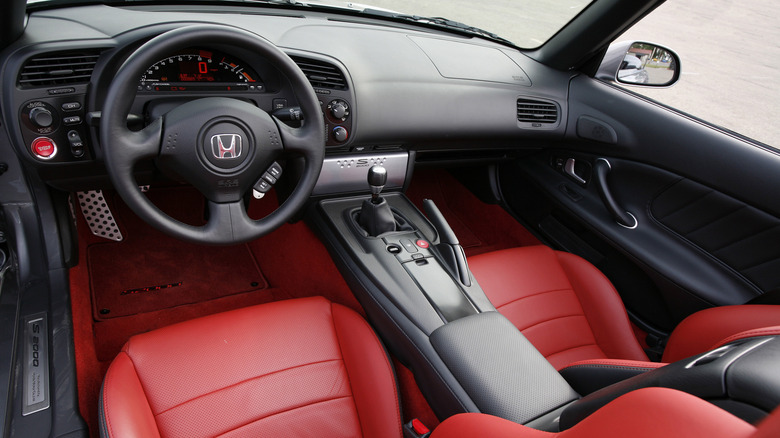
Bringing up the legend of the Honda S2000 comes with a set list of enthusiast talking points. There's the 9,000-rpm redline — a record for naturally aspirated engines that took Ferrari more than 12 years to beat. There's also the F1-inspired gauge cluster, the deeply driver-focused cockpit, and the carbon-reinforced cylinder liners. The conversation usually evolves into the ol' AP1-vs-AP2 debate, and it's only a matter of time before the words "raw" and "analog" are thrown around.
One of the S2K's biggest claims to fame, however, is its manual shifter, which is widely recognized as one of the best-feeling manual transmissions to ever grace a road car. As we found in our review of the S2000, shifting gears feels slick, metallic, and deeply satisfying in a way few other cars can match. The throws are short — it somehow feels like a light switch yet hefty at the same time, and, as the cliché goes, makes driving it feel like you're operating a bolt-action rifle. But what exactly makes this car's six-speed so good? In a nutshell: very short, very metal linkages, and a corporate philosophy that encouraged it.
Heavy metal linkage
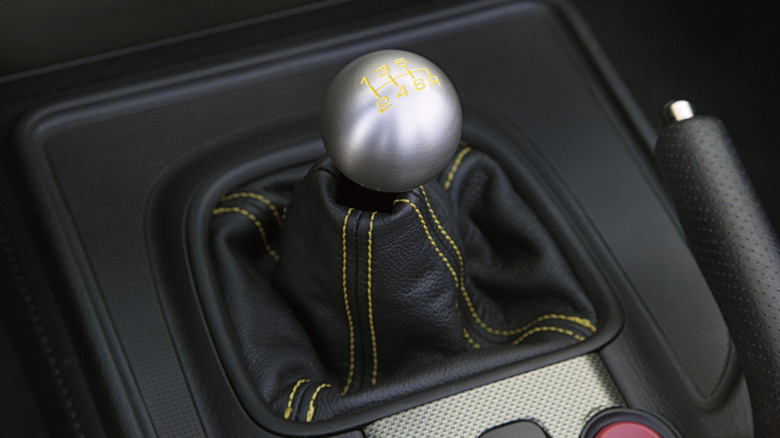
According to the automaker, this gearbox was an entirely new part developed specifically for the S2000, not an existing, off-the-shelf component. The shift linkage — the mechanism that translates knob movement into actual gear swaps — sits right on top of the transmission case, which practically snuggles up beside you when you're in the driver's seat.
Road & Track once described it as "just a rod straight down into the gearbox, about as pure a connection to the transmission as you could ever get." This makes for a very short throw, minimal play, and superb shift feel. Wobble a well-kept S2000's shifter with two fingers, and there is indeed very little play – even in neutral. The S2000's shift linkage is made of metal rods, whereas the one in the original NSX used cables — as did those in most of Honda's post-2000 manual mass-market cars. No prizes for guessing which material produces a more solid shift feel.
Shafts, cones, and packaging
"The shift lever is aluminum alloy and floats in a rubber mounting that absorbs vibration," reads Honda's old S2000 press release. In practice, that very metal accounts for a lot of the magic, and that slightly rubbery edge keeps it from being too mechanical or chattery. This is a road car at the end of the day. The automaker also says parallel transmission shafts coupled at the output end — a feature inherited from Honda's front-wheel-drive gearboxes — cut load on the synchros by up to 40%, reducing shift loads and hence shift effort.
To further reduce shift effort, first, third, and fourth gears in the S2K use double-cone while the second gear uses triple-cone synchros. In basic terms, synchros are what adjust shaft speeds when you shift gears, and multi-cone designs increase the friction surface of the area involved in this syncing process, speeding up shifts. And not for nothing, the roadster's tight packaging means the shifter easily passes the ever-important driver's car test of being less than a hand's width away from the steering wheel.
OK, but why did Honda make it so good?

The answer to this question is so simple it borders on unsatisfying: because Honda cares, and has always cared. When R&T probed Honda about the phenomenon, the Civic Type R's chief engineer replied, saying that "shift feel has always been a focus at Honda." And indeed, even the S800 roadster — the S2000's spiritual ancestor from 1965 — also had a killer shifter. Along with every other Honda manual gearbox I've ever driven.
And while Honda is historically known as an engineering company that specializes in engines, the engines that it does make aren't exactly known to be monstrously powerful. This means the transmissions it builds have less torque to deal with and can therefore afford to be lighter duty and use more delicate internal parts, typically making for better shift feel — or, more accurately, making it easier to develop superb shift feel. So, there you have it. One could say that the Honda S2000's shifter became a cult object because of metal rods, multiple synchro cones, and a bunch of corporate idiosyncrasies coming together. But the simpler explanation feels like the most correct one: The Honda S2000's shifter is a cult object because Honda decided to make it one.