

Honda's 9 Rarest Motorcycles And What They're Worth
Even the biggest global companies have an origin story. But few are as much of a testament to resilience as Honda's. At the end of 2019, the Honda Motor Co. celebrated its cumulative global production hitting a grand total of 400 million motorbikes. But rewind 80 years to the company's founding year — 1946 — and founder Soichiro Honda's reality looked very different.
After selling his piston company, Tokai Seiki (which had been bombed during World War II and hit by an earthquake), Soichiro Honda began bolting leftover military generator engines onto bicycle frames as a way to meet Japan's need for cheap, reliable transportation. In 1949, he built his first motorcycle: the 98-cubic-centimeter Dream D. Its 3 horsepower at 5,000 rpm might seem laughable by today's standards, but the bike was a significant step up from the A-type engine the company developed just two years earlier and produced just 1 hp, used army-issue hot-water bottles as fuel tanks, and ran on fuel made from pine resin.
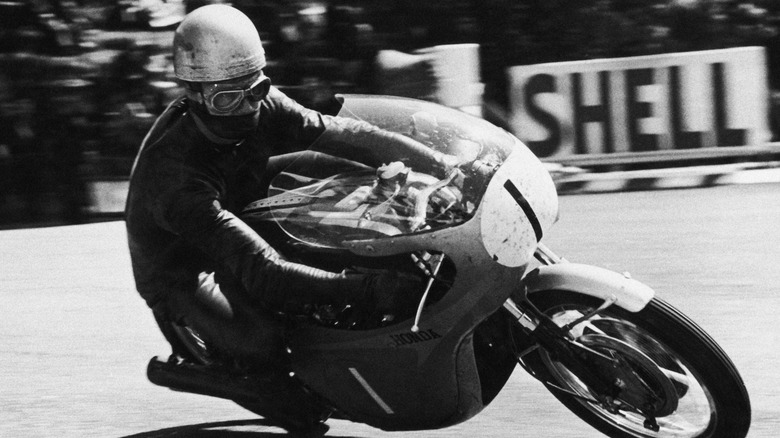
In 1959, Honda entered the Isle of Man TT world championship for the first time, sending a team of four riders to race using the RC142 — a bike heavily influenced by the Honda Benly CB92. That same year, Honda shipped its Super Cub C100 — one of the longest-running motorbike models on the planet — across the Pacific to the U.S., and went on to become the world's largest motorcycle manufacturer. A crown it has never handed back.
But production volume only tells a part of the Honda story. Buried somewhere inside those 400 million mass-produced commuters and scooters are a handful of machines Honda barely built at all — factory racers and homologation specials made in the dozens or hundreds, not the millions. Here are nine of the rarest bikes Honda ever made.
1960s Honda CR93: A Grand Prix bike fit for the street
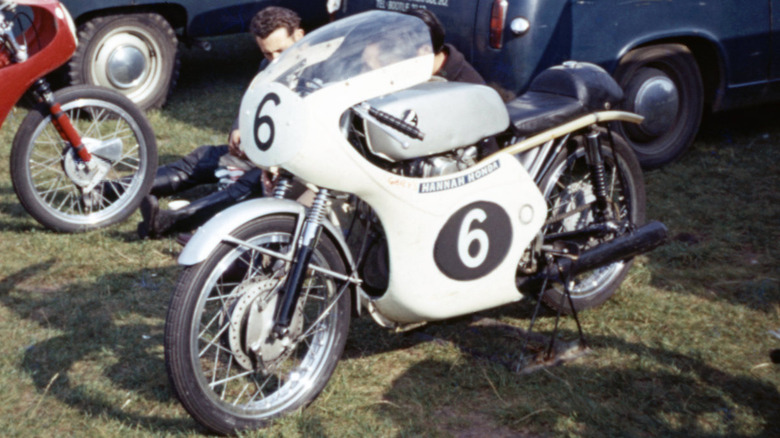
Just a few years after entering the racing world in 1959, Honda was already making a name for itself and its bikes. By 1961, the company held Grand Prix World Championship titles for the 125cc and 250cc Riders' and Constructors' categories. And rather than keep its racing tech locked away, Honda sold it to the public.
Introduced in spring of 1962, the CR93 might not look like much next to a modern sports bike. However, it packed genuine Grand Prix hardware beneath its bodywork: a 124.8cc air-cooled parallel twin engine, gear-driven double overhead cams, four valves per cylinder, and a five- or six-speed gearbox. Power figures for this bike vary slightly across sources, but quoted numbers suggest it boasted 16.5 to 18.5 hp; a rev ceiling of 11,000 to 12,500 rpm, and a top speed of 100 mph. Unsurprisingly, the CR93 dominated racetracks across the world, becoming the bike of choice for private racers and helping launch the careers of future champions like Bill Ivy.
Honda produced roughly 200 racing spec CR93s in 1962-'63 — a small run for such a massive manufacturer. But the company also made just 20 to 30 street-legal versions of the bike, which differ from the racers cosmetically, and also feature a more restrictive exhaust, different ignition components, and a kickstart lever. Both versions are hard to find and command a fair price. A 1963 street version CR93 is currently on auction at Mecum in Las Vegas with an asking price of $50,000. Meanwhile, Bonham's has sold two CR93s: one for $50,310 in 2009, and another for 43,700 British pounds in 2024 (equivalent to $78,313 and $59,610 in today's dollars, respectively).
Honda RC166/RC174 Six: The bike so good they built it twice
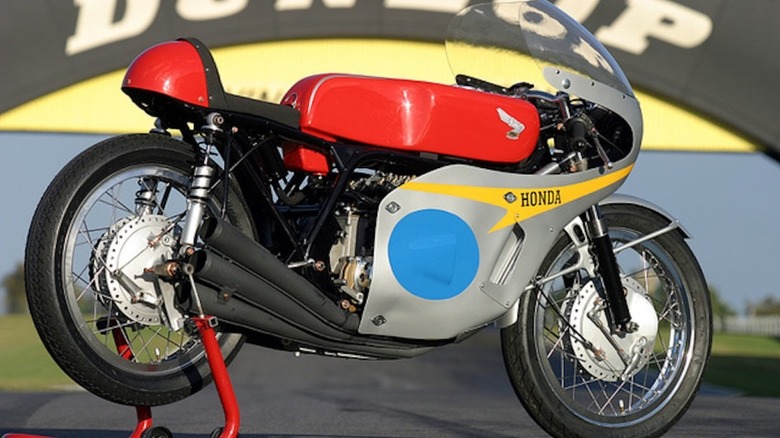
In search of further dominating the racetrack, Honda created the RC165, its first 250cc six-cylinder prototype. By the 1965 Tourist Trophy and 1966 Grand Prix seasons, Honda had refined it to create the RC166, an otherworldly bike even by today's standards. With a tiny 1.5-inch bore per cylinder, its short-stroke engine could reach a top speed of 150 mph and revved up to 18,000 rpm — just 1,000 rpm below the BMW-powered Williams FW23 that Ralf Schumacher and Juan Pablo Montoya would race in 2001 F1. Jim Redman rode the RC166 to victory at the 1965 Isle of Man TT, and Mike Hailwood posted an undefeated GP season on it in 1966. But Soichiro Honda wanted more.
In 1966, Honda enlarged its six-cylinder engine to compete in bigger classes. The resulting RC174 featured a 297cc engine that could produce 66 horsepower at a 17,000 rpm redline, or 223 hp per liter. The bigger displacement qualified it for the 350cc class, and the formula worked: Hailwood won the TT Junior race with an average speed of 107.73 mph, along with seven of eight rounds in the 1967 350cc World Championship, taking both the rider's and constructor's titles.
Honda didn't make a lot of these six-cylinder bikes, and none is currently for sale. It apparently manufactured six 3RC164s that were later upgraded to make the RC166 and two RC174s, one of which is now kept in the Honda Museum, while the other belongs to Japanese collector Teruhisa Murayama. In 2004, British bike builder George Beale was licensed to create 10 RC174 replicas. They sold originally for about 200,000 British pounds (equivalent to $366,000 at the time, or $647,000 today) and one was auctioned for $330,000 at Mecum's LV Motorcycles auction in 2026. Meanwhile, rumors suggest that RC166s sell for up to $500,000, but no hard auction sale data supports this.
1969 Honda CB750 sandcast: The world's first superbike
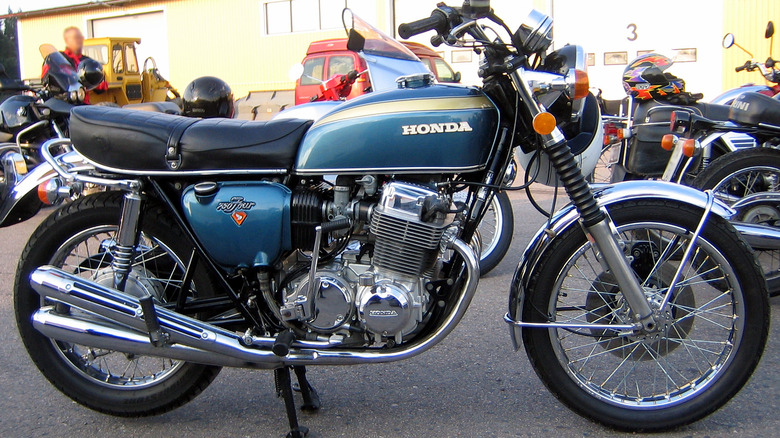
The term "superbike" wasn't a thing before 1969 — because nothing had earned it. But that changed shortly after Honda unveiled its CB750 at the Tokyo Motor Show in October 1968. It featured a 750cc overhead-cam four-stroke inline-4 engine that produced 66 hp at 8,000 rpm; a five-speed gearbox; battery ignition, and front disc brakes — an impressive combination of specs for the time.
There's a lot of debate about Honda CB750 sales figures. But one thing's for sure — these bikes sold extremely well, with sources claiming Honda made over 400,000 between 1969 and the early 1980s. Where's the rarity in that, you ask? Here it comes.
Honda created the CB750 in response to specific demands from its American associates: They wanted a 750cc four-cylinder engine with four carburetors, four mufflers, a max speed of 124 mph, and a quarter-mile acceleration rate of 13.2 seconds. This was Honda's largest bike yet, and to speed up development while reducing costs, it used sandcast engine molds for its first models. Made by pouring molten aluminum into sand molds, these sandcast CB750s can be identified by their unique VIN numbers and their engines' rough texture.
As demand for the CB750 skyrocketed, the company quickly invested in die-cast engine molds and the sandcast era came to an end. In total, Honda made only 7,414 sandcast CB750s — a number dwarfed by the total 400,000 bikes believed to hit the street. This rarity shows in auction figures, though the sandcast bikes didn't command a higher price when they launched, selling for $1,495 in 1969 (equivalent to $13,604 today). In 2025, two 1969 sandcast CB750s sold at the 2025 Mecum Las Vegas Motorcycle auction for $55,000 and $43,450 — equivalent to $57,009 and $45,037 in 2026 dollars — while a unique 1968 prototype (the very first CB750 sent to the U.S.) sold for $313,500 in 2026.
1981 Honda CB1100R: The '80s superbike remix
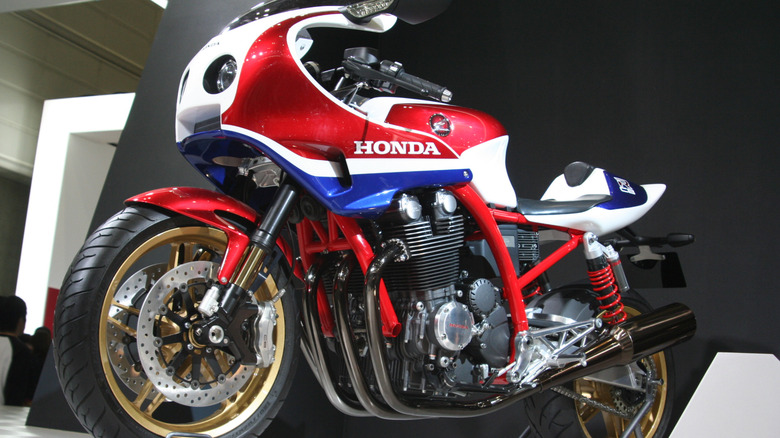
In 1976, Honda responded to endurance racing's growing popularity by entering the Endurance European Championship. Needing a bike that could meet the unique challenges of races like the 24-hour Bol d'Or, Honda's production team created the RCB1000. Equipped with innovative Comstar wheels, Brembo brakes, and a 997cc four-stroke DOHC engine that produced 115 hp at 9,500 rpm, it dominated the track, winning both the manufacturers' and riders' championships in its first year of racing, as well as three consecutive Bol d'Or races from 1976 to 1978. Despite its amazing track record, though, Honda needed a road-legal descendant it could sell to satisfy homologation rules — so the CB1100R was born.
The CB1100R was heavily influenced by the 1979 CB900F but boasted several distinct features. First (and most obvious) were the CB1000R's full fairing (which became standard in 1982), single seat, and 26-liter aluminum fuel tank built for endurance racing. The bike's engine bore was also slightly larger, pushing displacement to 1,062cc. Combined with lighter internals, hotter cams, and bigger 33mm carburetors, the CB1100R boasted 115 hp at 9,000 rpm — enough to make it the most powerful production motorcycle when it hit the market in 1981. It proved its worth on the track, too. The CB1100R won the 1981 New Zealand Castrol Six Hour Race (ridden by Malcolm Campbell and Mick Cole), and Ron Haslam took seven of eight rounds of that year's British Streetbike Series on one.
Honda built just 1,050 CB1100Rs in 1981, followed by another 1,500 in both 1982 and 1983 (4,050 bikes in total). None ever sold in the U.S., making them a true collector's item with prices that vary greatly — from $8,500 to $36,000 (values adjusted for inflation) — depending on individual bike specs, condition, and whether they have well-preserved fairing.
1983 Honda CX650 Turbo: Honda's answer to the 1980s' turbo trend
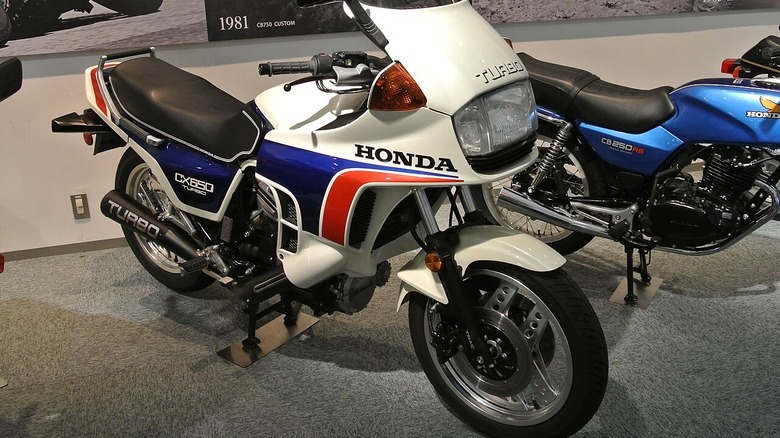
In 1982, Honda shocked the motorcycling world with its CX500 Turbo, the first factory-built, fuel-injected turbocharged motorcycle. By 1983, all four Japanese motorcycle manufacturers (Honda, Kawasaki, Suzuki, and Yamaha) had a turbo bike on sale, and Honda kept riding the '80s turbo wave by creating the CX650 Turbo; a bigger, more refined version of its CX500.
The CX650's engine measured 673cc, and its turbocharger — a separate, exhaust-driven component spinning independently of the crankshaft — ran 19 pounds per square inch of boost, with its impeller reaching over 20,000rpm. Meanwhile, the engine itself delivered the grunt many missed from the CX500: up to 100 hp at a comparatively modest 8,000 rpm, and a 140-mph top speed. The CX650 also featured shaft drive, Pro-Link monoshock, and TRAC anti-dive front forks, as well as a 12-pound weight reduction over the CX500 (despite having a larger engine). Other features included computerized electronic fuel injection with solid-state ignition, and sport touring fairing.
Unfortunately for Honda, the turbo bike trend was short lived, and the manufacturer pulled the plug on the CX650 after a single year of production. In total, it built just 1,777 bikes, of which less than 1,200 reached North America. While it is one of the rarest Honda production bikes, its prices are far from inaccessible: Mecum sold one at its LV Motorcycles Auction in 2026 for just $7,150 — solid money for an '80s Japanese bike, but a fraction of what other rare Hondas command.
1987 Honda RC30: A street-legal endurance racer
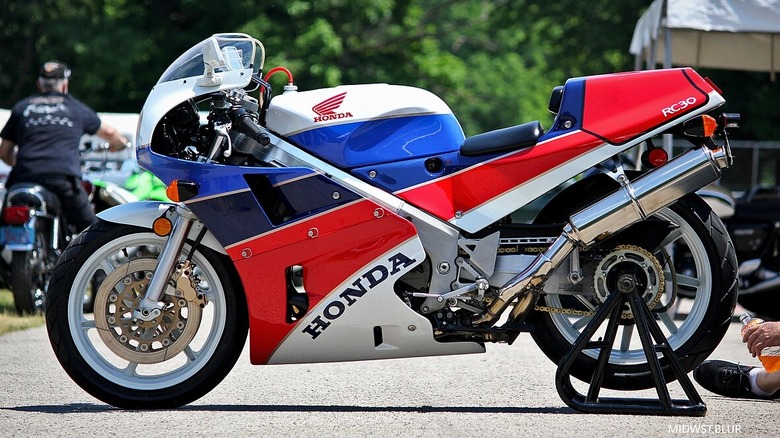
Honda built the RC30 (officially the VFR750R) to homologate its exotic RVF750 endurance racer — the world's most exotic and expensive race bike at the time — for the inaugural 1988 World Superbike Championship. The result was basically the same racing bike, just with lights and mirrors.
Beneath its seat sat a 748cc liquid-cooled 90-degree V4 with 16 valves and gear-driven DOHC — an engine that could easily produce 112 hp and a top speed above 150 mph. Meanwhile, its chassis featured a twin-spar aluminum frame paired with a single-sided swingarm and quick-release front fork — both borrowed directly from the RVF750 racer — that offered extra-fast wheel changes during races. The RC30 also offered titanium connecting rods for optimal strength while minimizing weight, and a 360-degree crank for extra-efficient exhaust tuning.
And its track performance was terrific. Fred Merkel won both the 1988 and 1989 World Superbike Championships on the RC30, and Carl Fogerty took home the TT F1 World Championship the same two years. Steve Hislop also rode a RC30 to achieve the first-ever 120-mph lap of the Isle of Man TT course.
Production figures for this bike vary, with different sources claiming anywhere between 3,000 to 5,000 made — the exact figure seems to lie between 4,700 and 4,800. Its rarity and spectacular performance mean that the RC30 commands high prices. It originally sold for $15,000 in the U.S. in 1987 (equivalent to over $44,000 in 2026 dollars) and now regularly fetches between $30,000 and roughly $68,000 on Mecum (values adjusted for inflation) — though a bike that had never been started sold for a whopping $121,000 in 2019(equivalent to $158,056 in 2026).
1992 Honda NR750: Truly ahead of its time
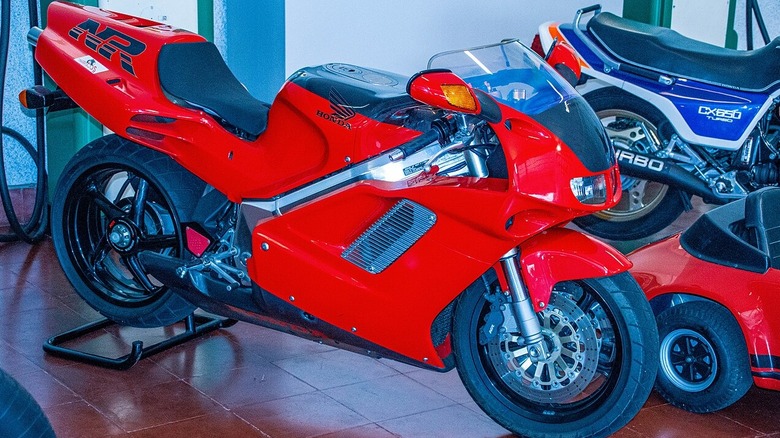
If you need proof of Japan's late '80s/early '90s bubble economy, the NR750 will do more than just cut it. It cost around $50,000 when it hit the street (equivalent to $119,014 today)— more than a same-year Corvette, 1993 Toyota Supra Turbo, or a base-trim 1992 Porsche 968.
At its core, the NR750 featured the same oval pistons seen a decade earlier on the 1979 NR500: a four-stroke race bike designed to compete with the two-strokes dominating the track at the time. Boasting a 747cc V4 engine with eight valves per cylinder, the NR750 produced 125 hp at 14,000 rpm. It also came wrapped in carbon-fiber body work, titanium rods, magnesium wheels, side-mounted radiators, an under-seat exhaust, and (why not?) a titanium-coated windshield. Read the spec sheet, and it's no longer a surprise that the NR750 cost roughly five times as much as Honda's same-year CBR900RR Fireblade superbike.
The NR750 didn't perform well, which, in Honda's defense, wasn't really the point of all this experimentation. It flunked out at the 1987 Le Mans 24 Hours due to engine troubles, and its only major track win came by the hands of Malcom Campbell at Calder Park during the Swann Series that same year.
Honda only made 322 examples of this bike — 220 in 1992 plus an extra 102 in 1993 — and only sold it on a built-to-order basis in Japan and Europe for customers willing to put down a 25% deposit. Rarity plus genuinely unrepeatable engineering has made the NR750 a true collectible: Mecum set an auction record of $181,500 for one at its 2014 Las Vegas sale (equivalent to $256,033 in 2026) while Bonhams sold a clean example for 62,100 British pounds in 2018 (equivalent to roughly $82,600 at the time and $109,797 in 2026).
1994 Honda RC45: The RC30's even-rarer successor
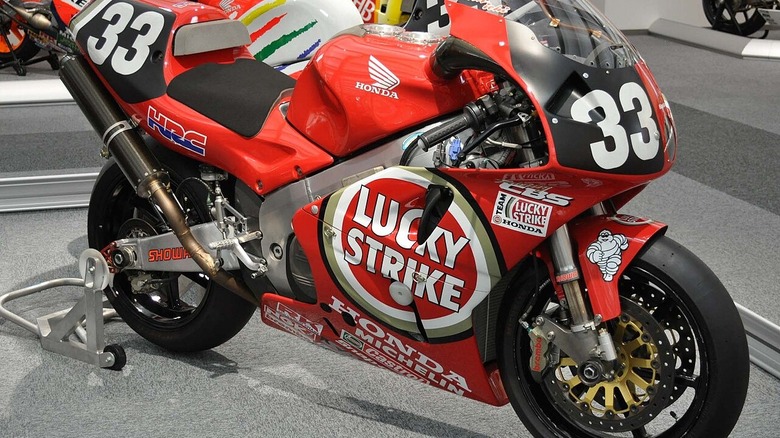
The RC45 (officially RVF750 RC45) succeeded Honda's RC30 and shared two key traits with its predecessor: It was a homologation special, and it was custom-built for endurance racing. It borrowed the electronic fuel-injection tech found in the NR750, as well as a 749cc liquid-cooled 90-degree V4 engine with gear-driven cams relocated on its side.
While it wasn't a scooter, the RC45 didn't deliver the kind of power Honda bikes were known for. Stock bikes shipped to Europe and Japan offered just 118 hp, and U.S. bikes had only 101 (though an RC45 tested by CycleWorld on release produced a measly 86 horsepower at 10,500 rpm). The bike also boasted titanium con rods, short skirt pistons, and a 360-degree firing order that contributed to its beautiful purr.
Unlike the RC30, the RC45 didn't dominate its competition on the track, but it still managed multiple wins: Miguel Duhamel took home the 1995 AMA Superbike title and the 1996 Daytona 200 on an RC45. In 1997, John Kocinski claimed the World Superbike title atop one, and the same bike also won three consecutive Suzuka 8 Hours from 1997 through 1999. The RC45 also flunked in terms of sales. Honda built just 700 of these bikes: 200 in 1994 for homologation, and a further 500 for the Japanese market. As few as 50 were imported to the U.S., likely due to poor reviews and a roughly $20,000 price tag.
Today, RC45s aren't easy to find, and they fetch a considerable price. On Iconic Motorbike Auctions, RC45s regularly sell for the 2026 equivalent of roughly $37,000 — though bikes tied to famous collections have sold for as high as $119,519 in 2025 (equivalent to $123,885 in 2026).
2015 Honda RC213V-S: Once the most expensive Japanese motorcycle in auction history
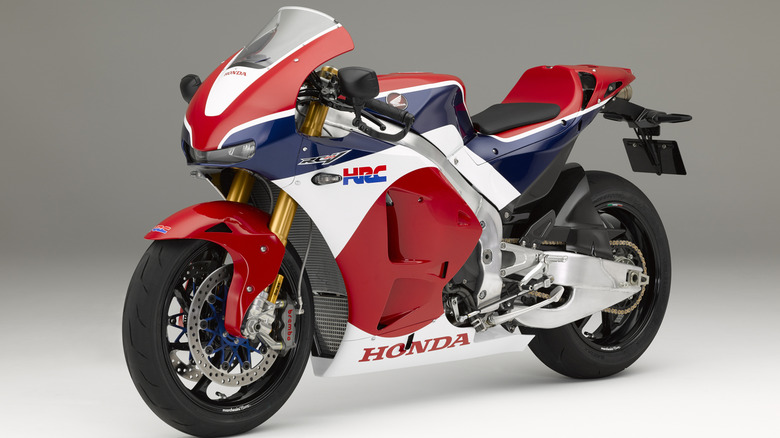
In 2015, Honda launched a bike designed to give customers a taste of the kind of beast Marc Marquez used to win back-to-back MotoGP championships in 2013 and 2014: the RC213V-S. As you'd expect, it wasn't cheap — stock non-racing models commanded $184,000 in the U.S. (equivalent to $259,252 in 2026) — and Honda planned to make only 250, though production apparently halted at 213 total (making for another true rarity in the mass manufacturer's catalogue). In 2022, Honda created the CBR1000RR-R FireBlade (one of the fastest motorcycles available in the U.S. at the time), which was modeled on the iconic RC213V-S.
Of course, adapting a GP bike for the road calls for compromises, but the RC213V-S still packed plenty to get excited about: magnesium wheels, full Öhlins suspension, and the first quickshifter ever fitted to a Honda road bike. It also boasted a slipper clutch and swingarm inherited directly from the RC213V race bike; most of the same Brembo brake components; and Moto GP-derived electronics such as throttle-by-wire, selectable power modes, and traction control. The European bikes delivered 159 hp, while those equipped with the HRC Sports Kit boasted 215 hp. U.S. bikes, meanwhile, delivered a disappointing 101 hp, with no Sports Kit available.
Nonetheless, the RC213V-S's technology, iconic design, and scarcity made it a highly sought-after collector's item: A crated example with just one mile on the clock sold for 182,500 British pounds in 2021 (equivalent to approx. $251,800 then and roughly $310,350 in today's dollars). At the time, it was the most expensive Japanese bike to ever sell via auction, though it was later beaten by the CB750 Sandcast prototype featured earlier in this list, which sold for $313,500 in 2026.