

Who Can Access Footage From Police Body Cameras?
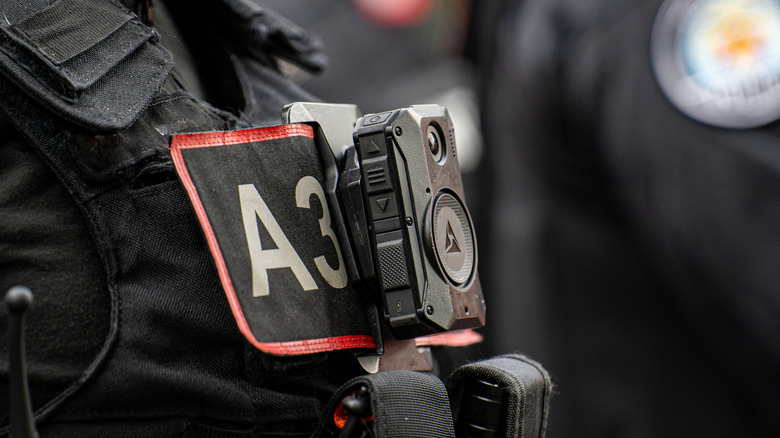
With the proliferation of Flock and Axon AI-powered cameras in towns throughout the United States, the prevalence of public surveillance might just be the top topic of 2026 and beyond. Groups like DeFlock, which offers an open-source map of Flock cameras, are bringing awareness to just how ubiquitous these cameras are becoming and how dangerous they are. Because, no matter what the police department might say, it's neither normal nor safe for them to use Flock cameras to track one driver over 500 times or for 17 Georgia cops to illegally use Flock cameras to stalk people.
With automatic license plate readers (ALPRs) shining a spotlight on privacy concerns and law enforcement's ability to ignore those concerns seemingly at will, it's only natural to wonder about the state of body cam usage and footage throughout the country. Some police departments are considering integrating agentic AI into body cams, which would turn them into a tool for "predicting" and "determining" threats — heavy air quotes here because artificial intelligence isn't particularly good at reasoning on its own and comes to flawed conclusions.
Who can legally view police body cam footage, and how does the public go about getting their hands on said footage? Do body cams lead to accountability? The answer to the first question is that, technically, almost anyone can request body cam footage from the police. In many cases, footage is even legally required to be made public. To view the footage, an interested individual usually needs to submit a public information request, similar to a FOIA request, but specific to the locality and the department involved.
Whether you ever receive the requested information is another matter, though. And even if you do get approval to view the video, you might not be able to afford it.
Body cam policy is a state and city matter
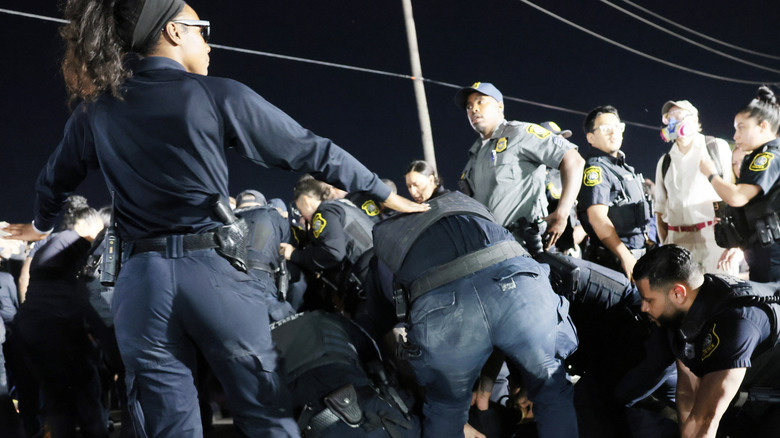
At the end of the day, exactly who can and cannot request access to body cam footage from the police department is up to the state in question. Additionally, only a handful of states require police to wear body cams, so there may not be any footage there to request, depending on where you live. Currently, body cams are required in Colorado, Connecticut, Delaware, Illinois, Maryland, New Jersey, New Mexico, and South Carolina, though they're still widely used outside these states on a piecemeal basis.
Most states have laws on the books regarding who can access police body cam footage, how to do so, and what leeway the police department in question has in redacting information or refusing to release footage. According to The Reporters Committee for Freedom of the Press, Iowa, Massachusetts, Mississippi, Montana, New Jersey, New York, Rhode Island, and Virginia have proposed laws regarding public access to police body cam footage that have not yet come into effect. Alabama and Hawaii have no such laws, while Alaska, Maine, New Mexico, South Dakota, West Virginia, and Vermont have passed tangential laws that leave the question of public access inconclusive.
All other states have laws defining the limits and requirements for public access to body cam footage. To check the details for your state, visit the map here, and click on your state, which will load the relevant legislation. Many states allow police to withhold body cam footage to keep victims or others recorded anonymous or otherwise edit footage to redact sensitive information and bodily harm.
Despite public access to police body cam footage being widely allowed, one 2023 ProPublica survey found that footage is missing or withheld in the majority of deaths at the hands of police.