

Here's Some Stuff You Can Tow With A Slate Truck (And Some You Probably Shouldn't Try)
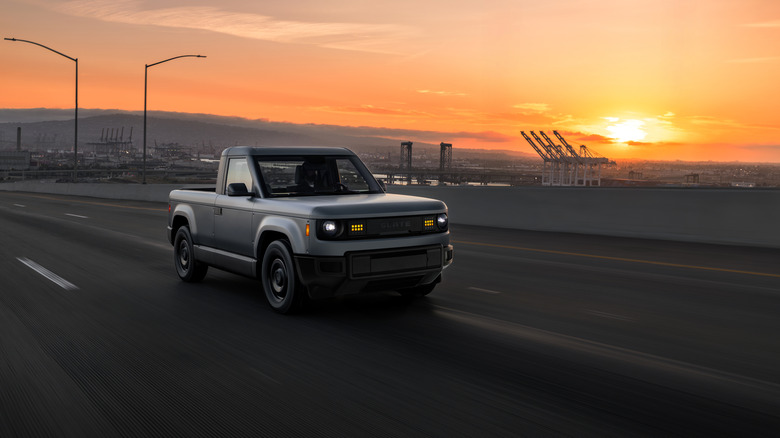
With a projected towing capacity of 2,000 pounds, the Slate Truck is squarely in Class I hitch territory and, frankly, makes it more capable than its price tag might suggest. That figure won't move a horse trailer or a fifth-wheel RV, but it provides more capability than most people realize — especially at a starting price just below $25,000. The question is what you actually do with 2,000 pounds of towing capacity, and where you hit the wall.
A Class I hitch handles up to 2,000 pounds of gross trailer weight and covers small tent campers, personal watercraft, and lightweight utility loads — enough for a weekend's worth of recreation without breaking a sweat. In practice, a Slate can reasonably handle a small teardrop camper, a kayak, most small fishing boats with a modest trailer, or a motorcycle on a trailer — in case your bike can't fit on the Slate's bed.
What you cannot do with 2,000 pounds is tow a pop-up camper, which averages around 2,300 pounds empty. You can't haul a jet ski and trailer if the setup exceeds the limit — and once you add gas, gear, and life jackets, it often does. A standard A-frame camper, which averages 1,700 pounds unloaded, is theoretically within range, but its fully loaded gross weight typically runs upwards of 2,500 lbs, far outside the Slate's capability.
EV's are just not ideal for towing
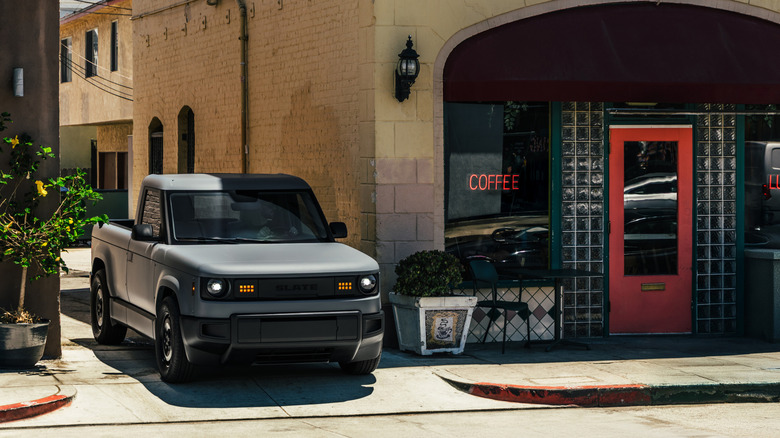
Slate's own towing page is upfront about what EV towing means in practice: range drops when you're pulling weight. Heavier loads mean more energy consumption, When you pick up speed, the wind pushes back harder, while climbing hills demands even more energy from the battery..
The Slate's 205-mile range estimate assumes normal driving conditions — not a trailer attached at highway speeds. Factor in the weight penalty, and that number can shrink significantly depending on what you're hauling and where you're going.
The upside is instant torque delivery. EVs don't need to build to peak power the way a combustion engine does, which means low-speed maneuvering — backing a trailer into a campsite, pulling out of a boat ramp — all of which Slate says feels stronger than with a comparable gas-powered vehicle.
It's also worth noting that the tow rating drops when the slate is configured as an SUV — the heavier body raises the curb weight, which reduces the platform safe towing capacity. Besides the nostalgia factor, the truck configuration is one to choose for maximum towing.