

These 7 SUVs Have Engines From Proper Muscle Cars
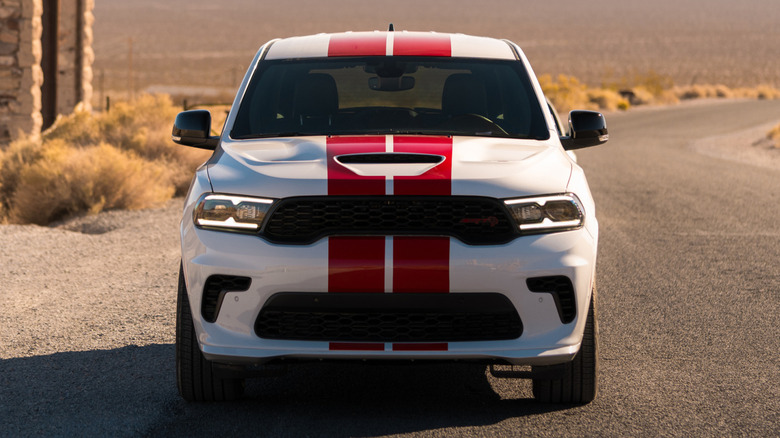
There are things family SUVs need to do well and others that aren't as important. One might say they should have a smooth, fuel-efficient engine, a relaxing and quiet driver/passenger experience, and the sole purpose of safely transporting two or three rows of your closest friends or family. But in America, we have desires that can override even the hardest-headed car planners. We sometimes like to take well-thought-out concepts and bastardize them at their very core, creating oxymoronic vehicles that are, frankly, cool as hell.
So instead of putting our most refined motors in our top-trimmed SUVs, we look around at the rest of our lineups and pick the rowdiest engines from our most diabolical muscle cars. It's a formula born from stories of the GMC Typhoon outrunning sports cars and the Lamborghini LM002's outrageous V12; however, instead of toiling around with six- or 12-cylinder power plants, it's the high-output V8 that drives the soul of this subcategory.
To stay true to our headline, though, we made some concessions in choosing these SUVs. Germany and Britain, for example, make impressive performance SUVs, some even with V8s; but this idea hinges on engines with origins that can be directly traced back to pure muscle cars. Additionally, we've done our best to avoid repeating models with older versions of the same engine family, so as not to overcrowd this piece with too many Jeep Grand Cherokees, for instance.
Cadillac Escalade-V
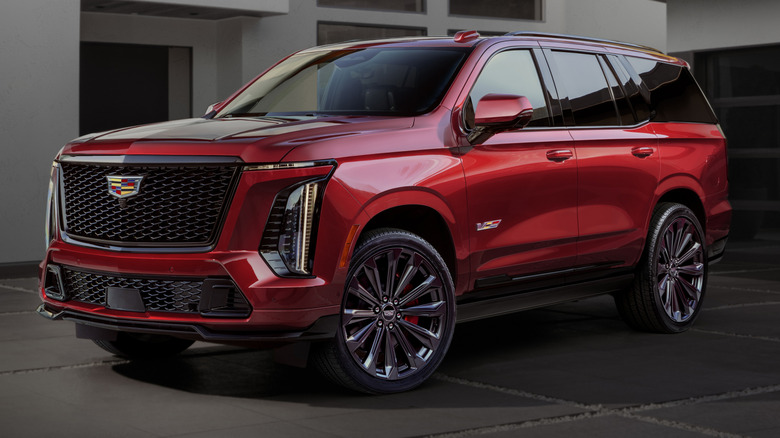
The Escalade-V is one of the best modern examples of this phenomenon. It's big, brawny, and Caddy reached right into its muscle car repertoire when deciding how to power this beast. Under the hood of the Escalade-V is GM's supercharged 6.2-liter V8, also known as the Gen-V LT4. We first interacted with this small block when it debuted in 2015, powering what was then the baddest C7 Chevrolet Corvette on the market, the Z06. The dry-sumped, Eaton supercharged beast made a healthy 650 horsepower and 650 pound-feet of torque at the time, figures that even the Z06 had a hard time keeping under control.
The LT4 was also featured in the Camaro ZL1 and Cadillac CTS-V, but the Escalade-V's version of the LT4 is most closely related to the current Cadillac CT5-V Blackwing, which, with its updated LT4, makes 668 hp. However, to apply this engine to a big truck like the Escalade, engineers made significant changes to the cooling and induction systems, swapping out manifolds and even installing a larger 2.65-liter supercharger versus the Blackwing's 1.7-liter unit. All said and done, the Escalade-V produces a monstrous 682 hp and 653 lb-ft.
As is often the case for SUVs with this level of grunt, the Escalade-V is relegated to an all-wheel drive setup only, but, if nothing else, this full-time system ensures you're always ready to rip off a 0-60 run in less than 4.5 seconds. The V first entered production for the 2023 model year, but more than three years later, it's still being built. Better yet, a 2027 model is also on the books. The only obstacle in your way is a starting price of around $170,000.
Dodge Durango SRT Hellcat
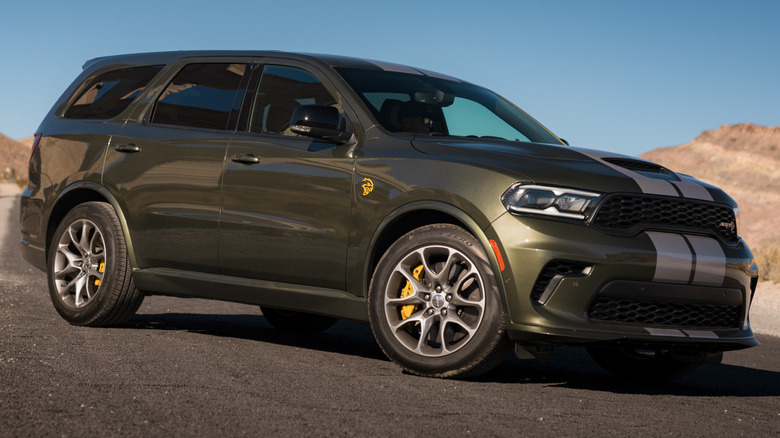
If there's one brand you'd absolutely expect to be on this list, it's probably Dodge. Its answer always seems to be more power, even when it comes to its only current full-size family SUV, the Durango. Of course, there were the R/T and 392 versions of the Durango, both of which had muscle car-derived engines, but the one we're presenting here is neither. Rather, in the spirit of top-trim V8-powered SUVs, we're featuring the obvious choice, the Durango SRT Hellcat.
Debuting in 2021, the Durango SRT Hellcat featured the updated 710-hp, 645 lb-ft of Dodge's iconic Hellcat power plant. This 6.2-liter kitty is arguably a top-five American muscle engine of all-time, even though its debut was just about a decade ago with the Dodge Challenger Hellcat in 2015. Since then, the engine has made its presence known in vehicles including the Dodge Charger, the Ram TRX, the Dodge Demon (a heavily modified version, that is), the Durango, and another Stellantis SUV that you'll see very soon.
The Durango SRT Hellcat, however, might be the coolest of all, considering that an engine like it has absolutely no business being in a family SUV. Regardless, Dodge went for it. Upon launch in 2021, in addition to all the power and torque, all four wheels were driven by an eight-speed automatic transmission, and the 20-inch wheels could be wrapped in optional Pirelli P Zero performance tires. Together, this package could shoot from 0-60 mph in 3.6 seconds, and reach the quarter-mile in 12 flat. Thankfully, just like the Escalade-V, this purring Durango is still on sale, and a 2027 model is arriving.
Jeep Grand Cherokee Trackhawk
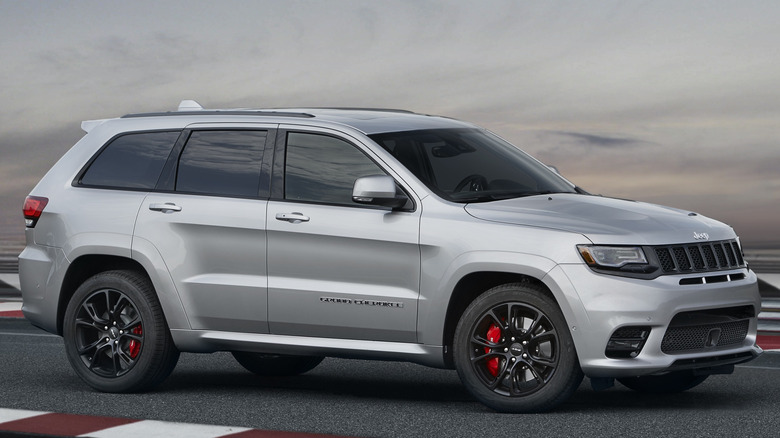
Speaking of that mysterious Hellcat-powered Stellantis SUV ... this is it, the Trackhawk. However, don't let the word "mysterious" guide your opinion, because this Jeep is anything but subtle under all that fancy Grand Cherokee bodywork. Not only did the Trackhawk enter production years before our previous two modern performance SUVs, but it also seemed to have far more cultural relevance than they did, playing on the dichotomy of Jeep's lavish, comfortable, and expensive luxury SUV stuffed with a drag-strip-ready power train that could put purpose-built automobiles to shame in a quarter-mile scrap.
Explaining the power train is easy, because the Trackhawk uses the same 6.2-liter supercharged Hellcat V8 we just mentioned regarding the Durango. However, since the Jeep debuted a few years earlier, in 2018, it got "only" 707 hp instead of the Dodge's 710 (though the same 645 lb-ft). If numbers are your only method for bragging rights, then you may be a bit disappointed, but in a performance setting, a 2018 Trackhawk would actually outrun a Durango Hellcat to 60 mph by one-tenth of a second (3.5 seconds vs. 3.6) and tie it in the quarter-mile at 12 seconds.
To accomplish these muscle car numbers, the Jeep received a beefier-than-base eight-speed ZF transmission and stronger versions of just about all the running gear, including the drive shaft, half shafts, differentials, and CV joints. The suspension was stiffer than a regular Grand Cherokee at both the front and rear, and all buyers, regardless of spec, got yellow brake calipers. The Trackhawk, with its near-$90,000 base price tag at launch, didn't last very long on the factory floor, going out of production in 2021, to the dismay of many Mopar folks. Maybe the world just wasn't ready for such boldness.
Jeep Wrangler Rubicon 392
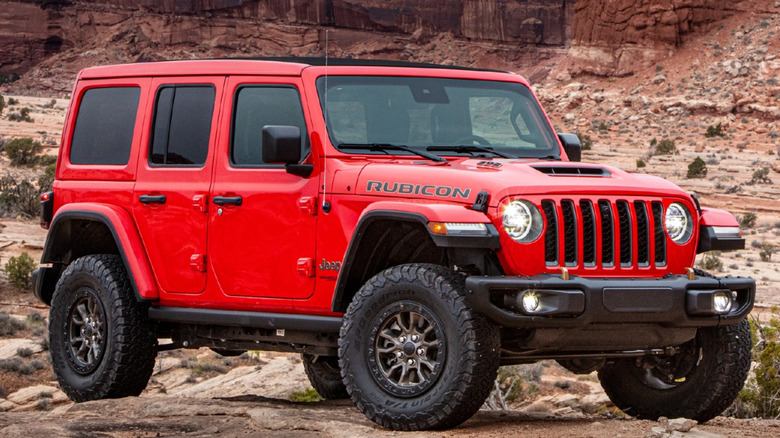
Though not quite as outlandish in the power department as our previous picks, the retro Jeep Wrangler Rubicon 392 makes up for its lack of supercharged horses with its pure childlike mantra. Most rock-crawling or overlanding Jeeps can make do with mild power plants, but the Rubicon 392 steps things up in a big way, using 392 cubic inches of naturally aspirated V8. This might make more sense in a hot-rod kind of way than it does in the Grand Cherokee, but it's hard not to love the ridiculous idea nonetheless.
If you don't have a calculator for a brain, the 392-cubic-inch Hemi translates to a metric measurement of 6.4 liters — slightly larger than the Hellcat in terms of pure motor mass, but without the addition of a supercharger, the 392 produces a slightly less bonkers, yet even 470 hp and 470 lb-ft. And the "392" moniker is something you've certainly seen plastered elsewhere on Mopar muscle cars like the modern Challenger and Charger 392 Scat Pack, though the engine also has origins in even earlier Gen-III Hemi-powered cars like the early 2010s Challenger SRT.
If 470 hp wasn't enough of a selling point for the Rubicon 392, then you'd also be happy to hear about its Fox dampers, 2-inch factory lift, larger tires, functional hood scoop, active exhaust, and cylinder deactivation, among several additions. There isn't a 2-HI gear selection with its transfer case, but we're certain that those who indulged in the $76,000-plus base price have found a way to make this fire-breather do adequate burnouts with what they were given.
Chevrolet Trailblazer SS
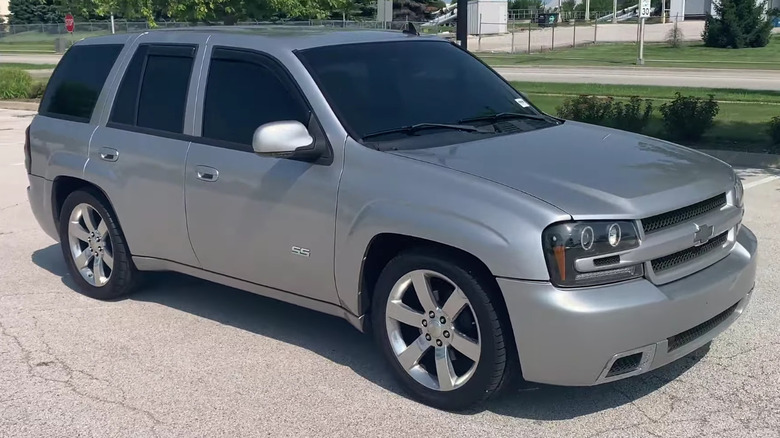
By the mid-2000s, Chevy had legendary Sports Car Club of America racer John Heinricy and Corvette's chief engineer, Tom Wallace, in charge of a high-performance project based on the Trailblazer. And from their involvement it should be clear that this wasn't a case of simply tossing in a big V8 and hoping the GMT truck platform could handle it.
No, the Super Sport, or SS, was a complete makeover. Underneath, it received a special Torsen transfer case to split torque 33/67 front to rear, got beefier rear axles, a 4.10-ratio gear set, a heavy-duty 4L70E four-speed automatic transmission, and a limited-slip differential, all of which contributed to the SS' full-time all-wheel drive system (a rear-drive version was also available). The team also installed monotube Bilstein shocks, sturdy anti-roll bars, lower and stiffer springs, and higher-resistance bushings. All of this stuff was relentlessly tested by GM's engineers at the Nürburgring Nordschleife — a tradition they would continue for years with their high-performance endeavors.
Of course, in proper American style, they had to toss in a big V8, too. Specifically, the then-new LS2 6.0-liter V8, which was already producing 400 hp in road-going base-C6 Corvettes and the Pontiac GTO. In the Trailblazer, the LS2 lost 5 horsepower (395 total) due to its truck-centric exhaust system and manifolds. In SS spec, the Trailblazer could sprint to 60 mph in just 5.4 seconds and reel in the quarter-mile in 13.9.
The SS would only last from the 2006 to 2009 model years; the Great Recession wasn't a popular time for 400-hp performance SUVs. Still, its base price of $33,600 in 2006 feels like a dream to us now.
Chrysler Aspen
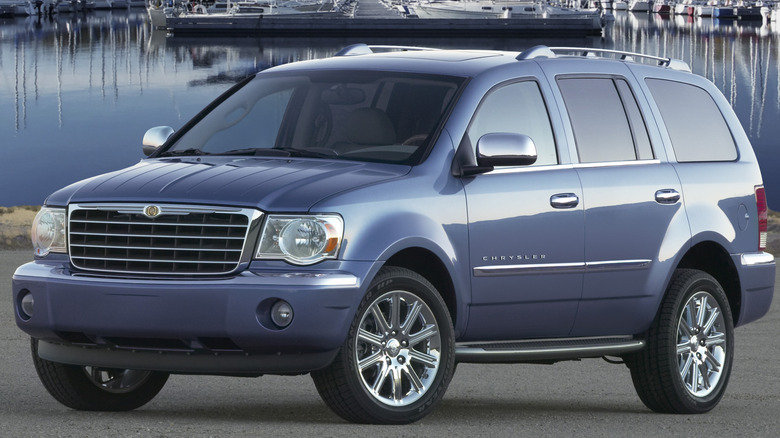
To keep this list interesting (and maintain our no-repeated-models rule), we've included a deep cut most of you won't remember: the Chrysler Aspen. This was during a time when damn near every brand, including the likes of Porsche, was rushing to capitalize on the SUV craze. All the big European, Japanese, and American conglomerates (and the brands underneath them) had to have an attractive SUV to cash in. At Chrysler, one such answer was the full-size Aspen.
Its name was derived from the original Dodge Aspen, a compact car that launched in the late 1970s and didn't last beyond 1980. We won't say that's foreshadowing, but it's foreshadowing. The new Aspen, this time debuting in 2007, was essentially a Dodge Durango done up in "fancy" Chrysler clothing, which ended up looking more like a minivan than anything else. Upon launch, buyers could have either the standard 4.7-liter V8 with 235 hp or the brawny 5.7-liter Hemi V8, which produced 335 hp. Importantly, this engine was also featured in the Dodge Charger R/T of the time, where it made 5 more horsepower for a total of 340.
As the years went on, sales never really got off the ground for the Aspen, but there were improvements in the powertrain department. By 2009, the Hemi-optioned Aspens were making 376 hp, and there was even a Hemi-hybrid power train available that made 385 hp. Period reviews were fairly positive, citing its smooth ride, powerful V8, and decent towing capability, but the Aspen would traverse no further than 2009, leaving us with a slightly forgettable SUV to look back on.
Saab 9-7X Aero
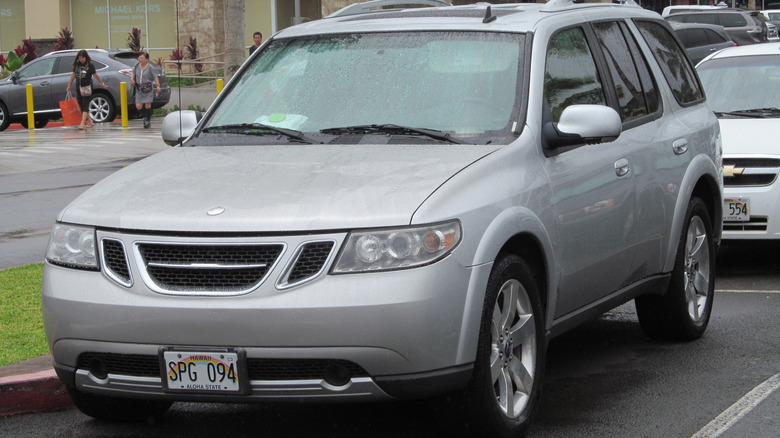
We finish off with arguably the most obscure SUV in this group, the Saab 9-7X Aero. From the outside, the Aero looks like nothing more than a regular 9-7X. Its midsize proportions are handsome and confident, but even the most seasoned enthusiasts would likely chalk this one up as a regular old commuter, despite this Saab being the closely related cousin to one of the best American performance SUVs ever, and one that we've already featured — the Chevy Trailblazer SS.
Enthusiasts will often think of Saab and Subaru as the iconic duo because of the Impreza WRX-based Saab 9-2X Aero and its "Rebadged Subaru" claim to fame. But one also must remember that General Motors owned Saab at the time, and the only reason that the "Saabaru" existed was because GM also owned a 20% stake in Fuji Heavy Industries (parent company of Subaru). Long story short, Saab's 9-7X Aero was essentially the same thing as its WRX-based project, but instead with the Trailblazer SS.
We don't want to say this was an example of a lazy rebadged car, but much of the differentiation comes in the form of styling and interior changes, while the fundamental mechanical parts stay the same. It does, however, have a slightly different Torsen center diff that could give 100% power to the front wheels if needed, while the Trailblazer stuck with a standard full-time torque-split system. Otherwise, the 9-7X Aero retained the LS2 V8 of Corvette and GTO fame (albeit with 5 fewer horses for a total of 390), and most of the performance bits that the SS donated. The 9-7X Aero only lasted two model years (2008 and 2009), unsurprisingly going out of production the same year as the Trailblazer SS.