

Why GMC Built A Truck That Could Outrun Sports Cars But Not Haul Cargo
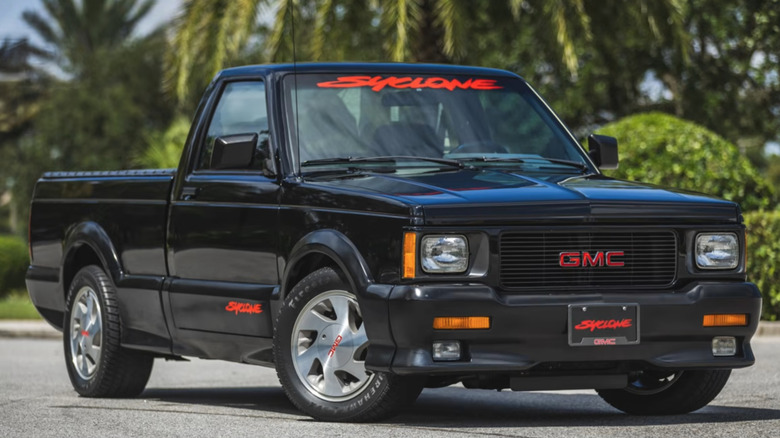
Back when we weren't desensitized by nearly 10,000-pound electric behemoths like the 2026 GMC Hummer EV darting to highway speeds faster than you could read this sentence, the idea of a pickup truck outrunning a pedigreed sports car was a bit like a shot putter taking down a champion sprinter in a 100-yard dash. In 1991, GMC launched the Syclone — a pickup that did just that.
The GMC Syclone was designed to haul ass, not cargo. GM noticed the overlap of a sporty car with a pickup truck wasn't being served, so the Syclone's mission was to fill a performance and excitement void in the General Motors garage as cars like the Buick GNX and Chevrolet Monte Carlos SS left the stable in the late 1980s. The trick was cost-effectively cobbling together something exciting from GM's available ingredients, which ended up radically altering the Syclone's hauling and towing abilities.
The performance truck's 500-pound payload and advertised 2,000-pound towing capacity paled in comparison to other contemporary Sonoma variants, which could pull up to 6,000 pounds. However, the reward for this compromise was a lightweight, all-wheel-drive sled powered by a turbocharged V-6 that, famously, took down a Ferrari 348ts over the quarter-mile, as Car and Driver announced on newsstands everywhere.
Pickups were becoming more refined in the '90s, but they were still really designed for the rigors of construction duty or farm life. While the 1989 Dodge Dakota Shelby did try to shift that paradigm to some degree, only GM was truly dabbling in trucks that could do truck things while packing a performance punch in the early '90s.
How the GMC Syclone become the fastest truck of the '90s
The Chevy C1500 454SS was sold alongside the Syclone, and it delivered a 1,000-pound payload capacity with a 6,000-pound tow rating, with a 7.7-second 0-60 mph times, according to testing by Autoweek. However, Car and Driver clocked the Syclone doing it in 4.3 seconds, fulfilling its mission of bending the sports car spectrum away from traditional expectations. That puts it just outside our list of the nine fastest pickup trucks ever built, and it did it a full 4 years before the NASCAR Truck Series officially launched.
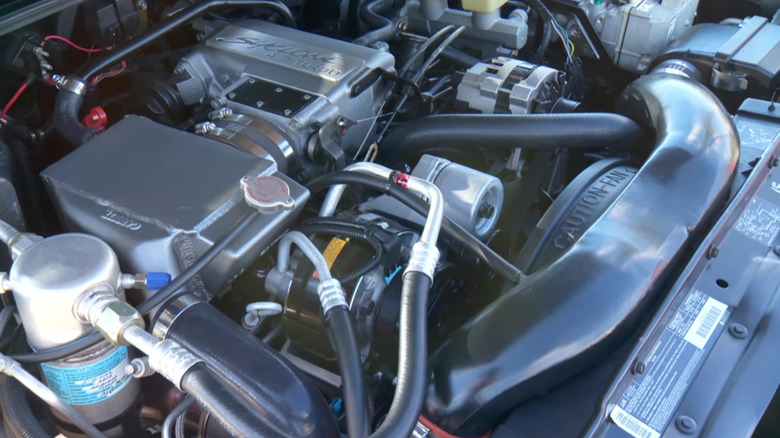
This was made possible by a collaboration with PAS, Inc. –a GM performance engineering partner, which engineered a 280-hp beast out of the naturally aspirated 160-hp Chevy 4.3-liter V-6 in the Sonoma. It received an intercooler and a Mitsubishi turbocharger, while the all-wheel drive system came from a contemporary GMC Safari van, allowing it to channel 360 lb-ft of torque and 65% of power rearward with the help of a limited-slip differential and meaty Firestones.
The Syclone's suspension was lowered, and the springs were softened. A mere 37% of the truck's weight was out back. Stopping duties fell on a 9.5-inch rear drum and 10.5-inch front disc ABS duet, which brought the 3,536-pound sports truck from 60 mph to a halt in 131 feet, according to Hot Rod's instrumented testing.
Boost came on ferociously, and power peaked at 4,400 RPM, but the wild thing is that revs were electronically limited to 4,700 RPM. You could mash the gas and hold on as the Syclone worked through its Corvette-sourced four-speed automatic. Anything in the bed that wasn't tied down was in for a hell of a ride.
The GMC Typhoon continues the Syclone's ethos in SUV form
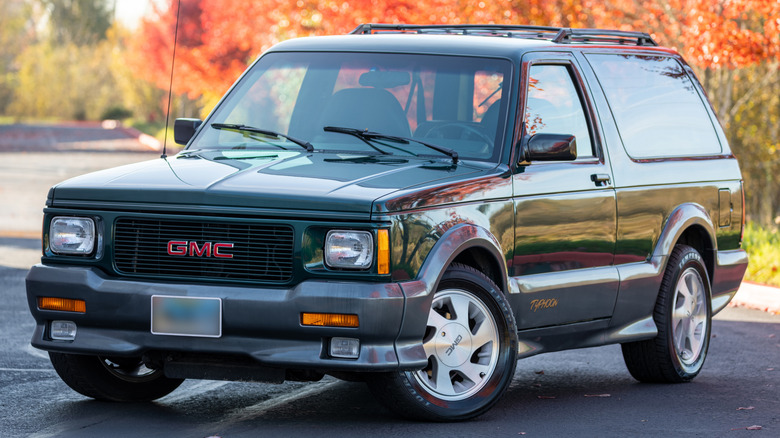
Limited payload and passenger capacity are common for sports cars, but not trucks, and perhaps the Syclone and its standard-cab design couldn't outrun that stereotype. Just 2,995 examples of the 1991 GMC Syclone left the assembly line, with three stragglers crossing the line in its planned second year of production. That's when GMC turned its attention to the blossoming SUV market and gave the Syclone treatment to a two-door, S-15 Jimmy, dubbed the Typhoon.
The Typhoon shared the Syclone's mechanicals, but added a self-leveling rear suspension to improve the ride. It weighed a bit more and was a touch slower, but it was also more practical. The Syclone was only ever available in black, but the Typhoon came in green, a few shades of red and blue, and the standard black or white. GMC cranked out 4,697 units before pulling the plug. It may not fulfill childhood fantasies of Baja racing like a modern Ford F-150 Raptor R, and in the end, it was probably too compromised — as either a sports car or truck — to survive. Regardless, the Syclone stands alone in history as one of the coolest performance vehicles ever built.