

I Hope F-35s Don't Need Radar, Because They're Being Delivered Without Any
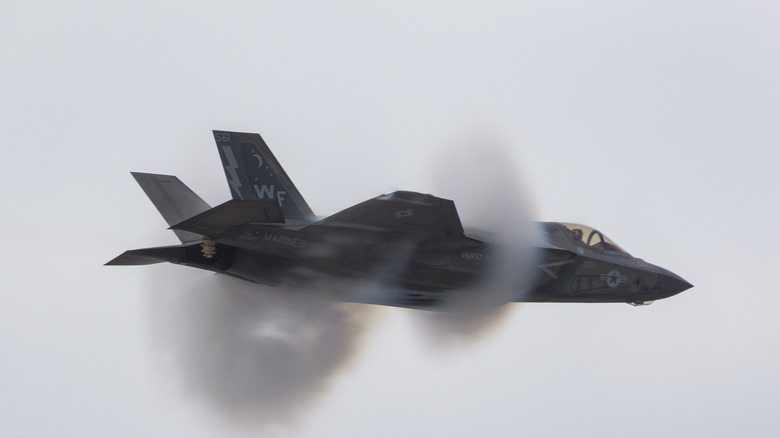
At a Senate Armed Services Committee hearing last week, the U.S. Marine Corps admitted that it had taken possession of six brand-new Lockheed Martin F-35B Lightning II stealth fighter jets. That would normally be routine were it not for one, small detail: none of them had radars. This is the first official confirmation of an issue that has been brewing for months. In brief, the new F-35s are the first of the upgraded Block 4 models, which are supposed to be the most advanced and powerful fighters ever built. A major part of that is a new, cutting-edge radar system. The only trouble is that those radars won't actually be finished for another two years. So Lockheed just went ahead and delivered the rest of the plane. Radars aren't useful in wars, right?
You might be wondering why, in the meantime, the Marine Corps (and soon, Air Force and Navy) doesn't just put the old radars into the new planes. Hey! You can't use common sense like that, this is the military! As the War Zone points out, the actual mounts within the F-35's nose are only designed for the new AN/APG-85 systems, not the older AN/APG-81 systems. That means that all Block 4 models are stuck waiting for the new radars to finish. And if development of those things gets delayed for any reason, well, they'll just have to wait even longer. Just what a well prepared military force wants to hear.
So, what exactly will these new F-35s be getting instead of fancy new radars (or any radars at all)? Not to worry: you'll be pleased to learn that America's brave pilots will be getting... ballast. Yes, ballast. Because the nose is actually too light to fly properly without the radar inside, you see.
What do you do with an F-35 that can't see?
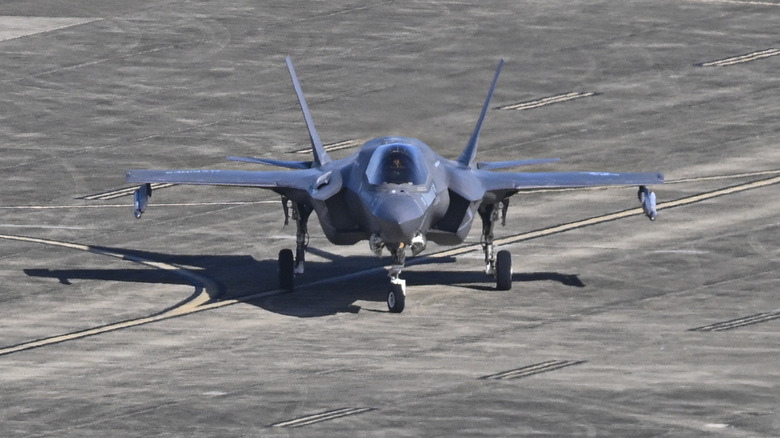
Spending north of $100 million for a plane that can't see might seem like an odd use of taxpayer dollars, but they actually can do more than just taking up space in a hangar. Air & Space Forces Magazine notes that such aircraft can still be used for flight training. Since a portion of the F-35 fleet needs to be earmarked for training anyway, it would make sense just to designate the Block 4 models for this purpose for a few years.
In addition, one of the F-35's party tricks is that it can share information between planes, allowing one plane to be the eyes for another to do the striking. In principle, even a radar-less F-35 could simply use the shared information from a nearby older model to conduct a mission. That's not exactly the definition of fully mission capable, but it is a fallback the military could use in an emergency scenario.
Besides, the future of aerial warfare is going to involve drones one way or another. While the Russo-Ukrainian war makes headlines for its ultra-low-cost fliers, the U.S. and other militaries are also experimenting with much higher-budget options. So-called collaborative combat aircraft (CCA) drones are basically mini-fighter jets controlled by the pilot or weapons officer of a nearby traditional fighter jet. The Pentagon has already run several tests like this from an F-35, so a Block 4 model would be well suited to further CCA testing. If for whatever reason CCAs get fielded before the new radars, that might well be how Block 4 models get deployed in combat.
In any case, the Block 4 models must be made, radar or no radar. Otherwise, a two-year moratorium on production would force skilled workers to seek out other jobs. There's also an enormous backlog of F-35 orders that need to be fulfilled, both by American military branches and also allied nations. So they will keep rolling off assembly lines, and tax dollars will keep buying them, one way or another.