

Why It's Hard To Pin Down Which Cars Are Truly Roadsters
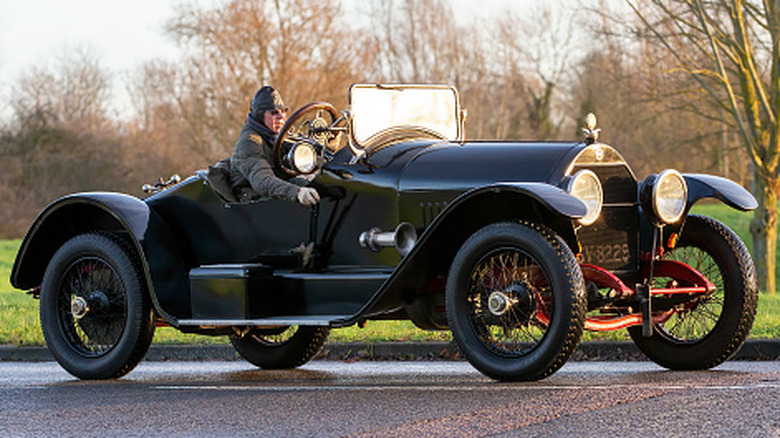
The English language is malleable, and words' definitions tend to distort and loosen up as they age, particularly if the word isn't commonly used in daily vernacular. This goes a long way toward explaining why the term "roadster" can't really be whittled down to anything truly specific. For one thing, it's a made-up term, originally applied in the early 19th century to describe a horse that was suitable for pleasure riding rather than a workhorse. Several decades later, it grew into a term for a small, lightweight two-seat carriage — frequently not fully enclosed — pulled by a single small horse. And again, nearly 100 years from its origination, horse terms migrated over to cars and a small two-seat automobile became known as a roadster.
Obviously, cars changed a lot from the early 1900s through the post-World War II American car-enthusiast explosion. The definition has largely stabilized, but the cars themselves were transformed. A roadster now is typically a small two-seat sports car, usually one with a completely removable roof, and often without side windows. A roadster driver is typically someone who values connecting with their automobile and feeling the road rise up to greet them. This type of convertible is occasionally called a spider or a cute litle barchetta, and before it got all muddled up, these terms were all used for vehicles intended for competitive sport driving.
Early examples of roadsters can be found in the 1910 Mercer Raceabout or the 1912 Stutz Bear Cat. Aftermarket roadster-style bodies were available from any number of manufacturers for commonplace cars like the Ford Model A and Model T, converting them from typical family-toting daily drivers to race-ready two-seaters. They were essentially the first track-day cars, built to be driven to the racetrack, raced, and driven back home again.
What is a roadster?
It's been over 100 years since the first car was called a roadster, and much has changed since then. Nowhere has change been more evident than in the automotive industry. Motor racing is a completely different sport now than in 1908, and most sports cars are no longer fit for competitive "sport" use without serious modifications. (This early use differed from a "touring car," which was effectively the same as a roadster, but with an additional row of seats.) The "roadster" term continues today, but from about the 1950s onward it started to broaden its definition through colloquial use.
Usually "roadster" is reserved for open-top two-seat cars designed with open tops from the beginning. The original meaning of the word implied a lack of side windows and a completely removable top, but that stipulation has largely gone by the wayside. Considering convertibles are basically nonexistent in 2026, the only real example of that left is probably the most iconic roadster of all time, the Lotus Elan-inspired Mazda Miata. Throughout the years, however roadsters have historically been quite popular, exemplified by Porsche's Boxster, the MGB, or Dodge's awful but awe-inspiring Viper.
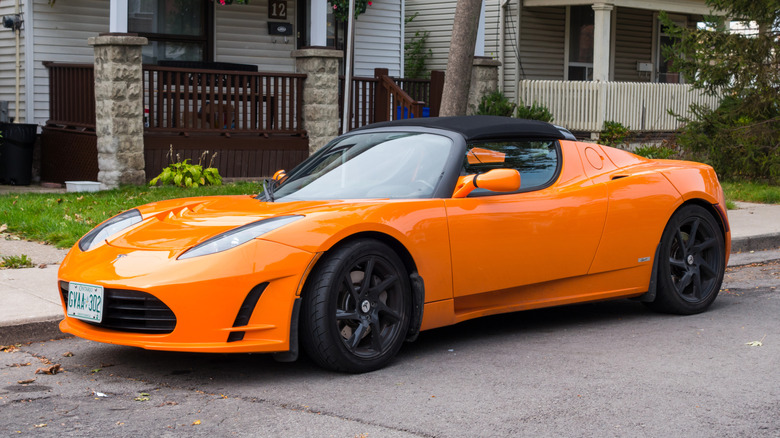
Particularly in the last 30 years or so the term, has grown to basically encompass any sports car with an open top. Many manufacturers, including Porsche, Morgan, and Mercedes-Benz, have built cars that come with a Roadster badge but are explicitly not roadsters, usually because they seat four or more passengers. Tesla is perhaps most egregious with this naming convention, as it unveiled its second-generation Roadster in 2017 as a four-seat coupe with a removable targa panel. Thankfully that car has never actually made it into production, but the company keeps threatening to further muddle the roadster name.