

Why Mazda Is Literally A God-Tier Name For A Car Company
Mazda likes to do things differently — it always has, and hopefully always will. The Japanese automaker pushed rotary engines for decades, and it continues to explore new hybrid rotary powertrains today. Mazda also recently introduced an all-new inline-6 engine, despite competitors increasingly dropping big-displacement engines for compact inline-4s and aggressively downsizing across entire model ranges in pursuit of efficiency targets.
In fact, Mazda's tendency to stand out from the crowd can be traced back to the automaker's roots, and even to the name it bears. The name "Mazda" carries historical and even spiritual importance. And while many competing automakers chose names that solely link back to founding surnames or convenient abbreviations, the interpretations that surround the name "Mazda" are far more interesting. Here, mythological connections and corporate history intersect with one another, creating an interesting dual-origin narrative that continues to build intrigue today.
Mazda's dual meaning
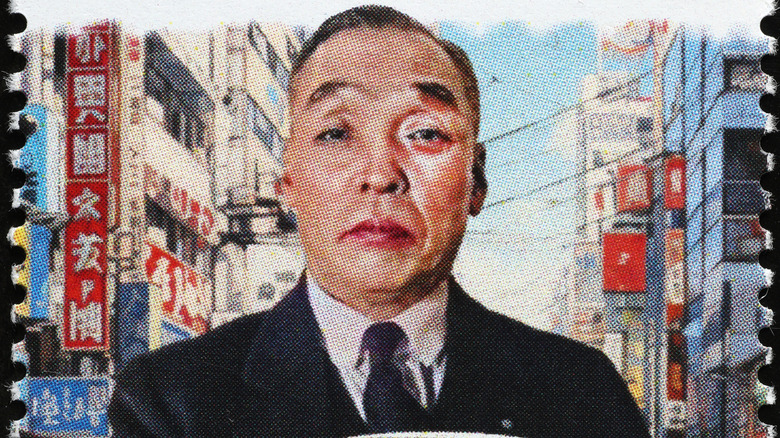
Mazda didn't begin as Mazda. The company's history started in 1920 with the founding of Toyo Cork Kogyo. Just a year later, Jujiro Matsuda took over as the company's president and reshaped the firm by shifting away from cork production and into machinery — a path that eventually led to producing cars.
Matsuda's influence and direction are no doubt the reason why his surname is widely documented as being the driving force behind Mazda being chosen as the company's name. Of course, you've probably noticed that the names are not the same, although there is a link between them. As noted by Mazda, the Japanese pronunciation of the word Mazda shares some phonetics similarities with Matsuda.
For further context into Mazda's early history, the name "Mazda" didn't actually appear until 1931. It was then that the firm produced its first vehicle — a three-wheeled truck dubbed the 'Mazda-Go.' Mazda would be registered as a trademark 3 years later, in March of 1934. And while the Matsuda connection remains one well-documented explanation for the name's formation, there are also further and more divine interpretations for its origins.
Mazda's divine connection
Automakers seemingly love packing hidden meanings behind their logos and names, and Mazda is no exception. The brand name is also attributed to a deity from Zoroastrian tradition — Ahura Mazda — which represents the concepts of wisdom and harmony. The automaker has confirmed Ahura Mazda is behind the brand name, in addition to the phonetic similarity with the founder, Jujiro Matsuda. It's also important to note that, in the early '30s, when the Mazda-Go — the company's first truck — was launched, other spiritual names were also floated for the model. Among others, Sumera-Go and Tenshi-Go were put forward, both carrying meanings tied to divinity and angelic themes.
According to Autoweek, an older quote taken directly from Mazda explains the connection between the automaker and deity in quite some detail. Mazda detailed how it "interpreted Ahura Mazda, the god of wisdom, intelligence, and harmony, as the symbol of the origin of both Eastern and Western civilizations, and also as a symbol of automobile culture. It incorporates a desire to achieve world peace and the development of the automobile manufacturing industry."
Mazda highlights the importance of harmony and world peace as defining features for both itself and the deity, and yet just a few years after the Mazda name became a trademark, the company began producing rifles and carbines in connection with World War II. Of course, this was no unusual practice at the time, as Ford once made a mile-long factory to build bombers in record time, but producing weapons of war doesn't really follow that religious narrative. A definitive end to its weapons production was reached with the Hiroshima bombing in August 1945, which claimed the lives of roughly 200 employees at Mazda's plant.
How the Mazda logo evolved
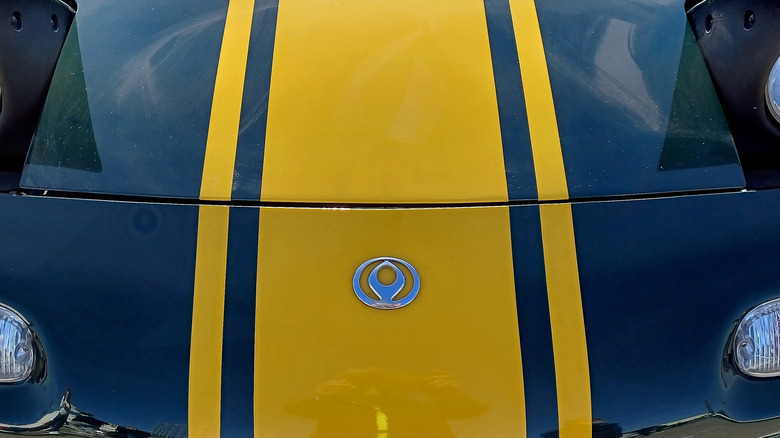
Mazda evolved from a humble cork-maker to an automaker with a rich and illustrious history. Over those years, tweaks and alterations to the logo continued to reflect the connection between automaker and deity. Most notably, when Mazda debuted its luxury arm Eunos in 1990, the logo that came attached to these models was distinctly different from the traditional design, with the automaker stating it evoked the symbol of Ahura Mazda. The thought behind intertwining the deity once again was to express how the brand aspires to create vehicles that are enriching for its customers and human-friendly. It wasn't until 1997 that Mazda started using an early version of its current winged logo.
Of course, Mazda isn't alone in drawing from mythology or religion when crafting logos or brand names. Just think of Saturn — GM's budget brand –or Apollo Automobil, the German automaker behind exclusive icons such as the Intensa Emozione. Saturn, of course, has celestial links, and it shares a name with the Roman god of agriculture and divine distance, while Apollo is the Greek god of light, knowledge, and music. Even the Subaru logo reaches for the stars. That said, merging corporate history and spiritual symbolism is likely a tough tightrope to walk, but kudos to Mazda's marketing team, as in doing so they have created an interesting backstory to one of the most celebrated Japanese automakers that still intrigues today.