

You Can Find These 5 New Hybrid SUVs For Well Under $50,000
According to Kelley Blue Book (KBB), the average American paid $49,220 for a new car in May 2026. However, for some buyers, that's a bridge too far, and it's natural to look for cheaper options. Over 62% of new cars registered in 2025 were SUVs, so given America's love for the segment, this article targets five crossover options for lighter duty on the wallet. And with the average price of gasoline still north of $4 per gallon, focusing on hybrid powertrains makes sense. However, to keep things on a level playing field, we only focused on regular hybrids, not plug-ins.
Given we're looking for options that fit well under the $50,000 mark, we capped the MSRP threshold at $40,000, but most of the SUVs mentioned in this article hover in the $31,000–$35,000 range. We even included one model that retails for under $30,000. Finally, only those SUVs that have an average or higher reliability rating from Consumer Reports made the final selection.
As a result, this list is mostly a roster of staples such as the Toyota Corolla Cross Hybrid and Honda CR-V Hybrid. But if you're not up on the latest hybrid, Subaru now offers an electrified version of the Forester. Meanwhile, the Hyundai Santa Fe tops the list as the most expensive option, while the Kia Niro is on the opposite end of the price scale, with the lowest MSRP of the group. Speaking of MSRPs, all the price tags mentioned here include destination charges and reflect the least-expensive 2026 trims for each respective model (unless otherwise noted). Finally, any mentions of fuel efficiency are based on EPA estimates for combined fuel economy ratings. Here are our sub-$50,000 hybrid SUV choices for 2026.
Toyota Corolla Cross Hybrid: $31,190
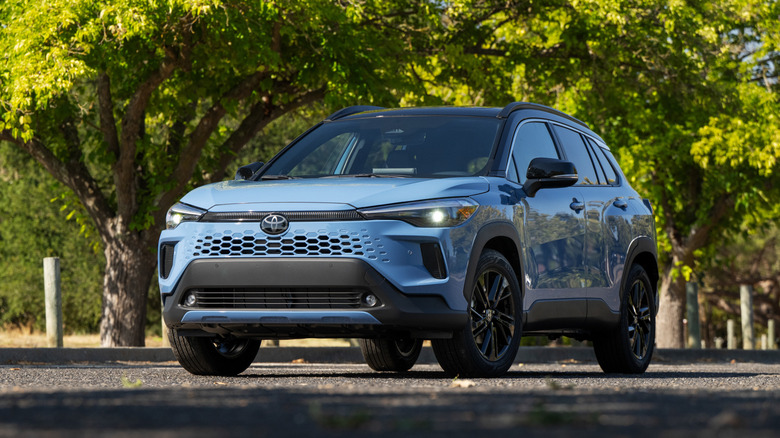
It's hard to argue with a Toyota crossover that has standard all-wheel drive, a 42-mpg fuel economy rating, and a $31,190 window sticker. In our review, we tagged the Corolla Cross as both affordable and efficient. Keep in mind that the average used car sold for $26,342 in April 2026, according to KBB. So, the spread between factory-fresh and pre-owned isn't that significant.
Of course, don't expect perfection at this price point. The Corolla Cross Hybrid only earned an average predicted reliability score from Consumer Reports (CR). This is also a subcompact crossover, so there's only 17 cubic feet of cargo space behind the rear seats, while 32 inches of rear legroom falls short of competitors like the Subaru Crosstrek Hybrid. The Crosstrek Hybrid is a reasonable alternative, but it's over $4,600 more expensive and less than $400 cheaper than the larger Forester Hybrid (also covered in this article). On the plus side, the Corolla Cross Hybrid is relatively zippy for an SUV in this class. Car and Driver recorded a 0-to-60 mph run of 7.3 seconds, compared to 9.2 seconds for the conventional Corolla Cross and 7.7 seconds for the Crosstrek Hybrid.
Honda CR-V Hybrid: $37,080
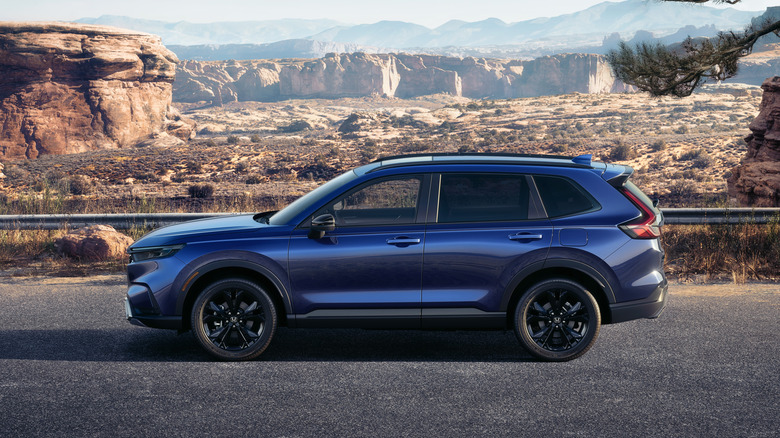
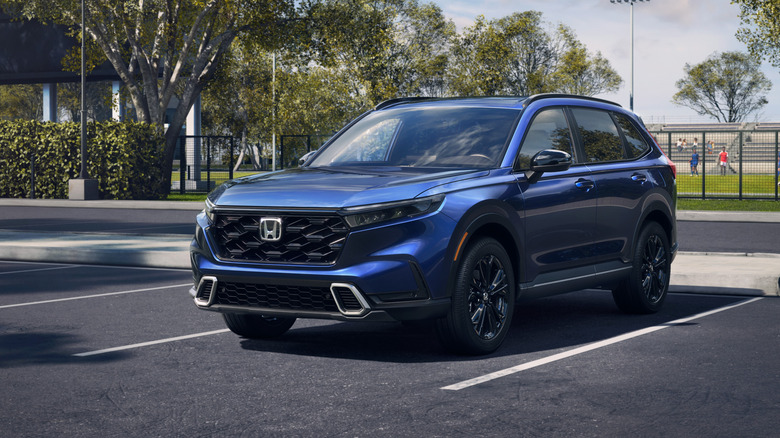
At $37,080, the Honda CR-V isn't the cheapest compact hybrid crossover, and adding all-wheel drive (AWD) to the mix increases the price tag by another $1,500. However, the CR-V Hybrid ranks among the highest in CR testing so far. This is a crowded field, but the hybrid versions of the Hyundai Tucson, Kia Sportage, and Mazda CX-50 have only average reliability scores. That's not terrible, but you can do better. The CR-V and the Forester have above-average ratings.
The CR-V Hybrid has several other positives, including a 7.1-second 0-60 mph time for the AWD-equipped Sport Touring trim and a fuel economy rating of 40 mpg. Its 41 inches of second-row legroom and 76.5 cubic feet of maximum cargo space also outstretch the RAV4. And while the RAV4, which went hybrid only in 2026, is cheaper ($33,320 or $34,720 with AWD), it's not quite an apples-to-apples comparison with the CR-V. The base RAV4 LE is just that — base. On the other hand, Honda has positioned the CR-V Hybrid to be a bit more upmarket. The least-expensive Sport trim has heated front seats and a power moonroof.
Subaru Forester Hybrid: $36,180
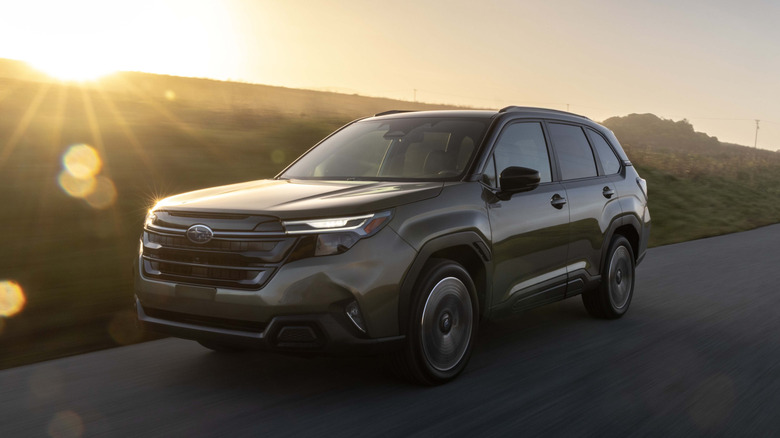
The Forester Hybrid is a worthy competitor to the CR-V, as $36,000 and change gets you standard AWD, a power moonroof, and heated front seats. This Subaru also holds the distinction of being the highest-rated compact SUV (conventional or hybrid) in Consumer Reports' testing. Above-average reliability and a CR Recommended badge are also part of the results. The Forester Hybrid is also only $380 more than the Crosstrek, although there are some differences between the two models.
This hybrid does have some shortcomings, especially compared to the CR-V. There's less rear legroom (39.4 inches) and total cargo space (69.1 cubic feet). Fuel economy is 35 mpg. At the same time, the Forester Hybrid's engine produces 194 total horsepower, while the hybrid versions of the CR-V, RAV4, Sportage, and Tucson cross into the 200-hp territory (the Hyundai and Kia also have turbochargers). As a result, it takes a leisurely 8.6 seconds for the Forester to reach 60 mph, while the others are below 8 seconds.
Hyundai Santa Fe Hybrid: $38,000
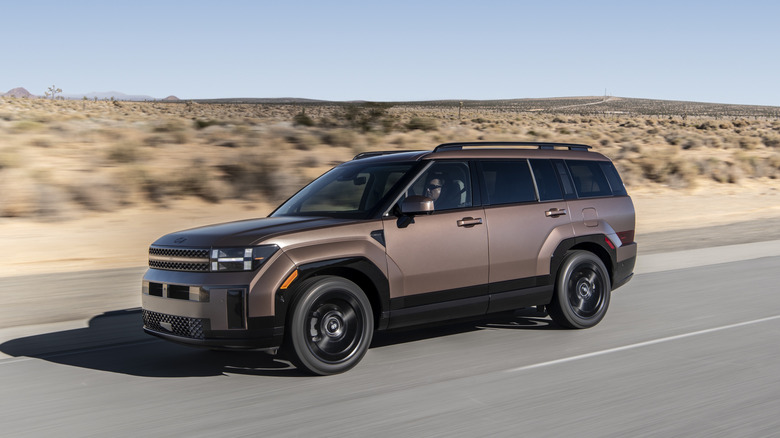
If you need to haul more than five people, then the feature list must include three rows. However, hybrid standard-bearers like the Toyota Highlander and Grand Highlander pretty much start at the $50,000 mark, and the hybrid versions of the Hyundai Palisade and Kia Telluride aren't much cheaper, either. In fact, there's only one choice below the $40,000 benchmark: the Hyundai Santa Fe Hybrid. The Kia Sorento Hybrid cracks that price ceiling at $40,385, so it just misses our cut-off.
Admittedly, the Santa Fe's third-row legroom may not be as generous as some of the pricier options, but 30 inches is actually more than the Highlander's 28 inches. The cheapest Santa Fe Hybrid starts at $38,000, with an AWD-equipped version just squeaking in at $39,800. In base FWD form, this Hyundai is EPA-rated for 35 mpg, while the AWD version gets a 2-mpg penalty. Consumer Reports ranked the Santa Fe third among midsized three-row hybrid SUVs –behind the Palisade and Grand Highlander, while the Sorento was in fifth place. The Santa Fe and Sorento share a similar hybrid powerplant and have an average CR reliability rating.
Kia Niro: $28,885
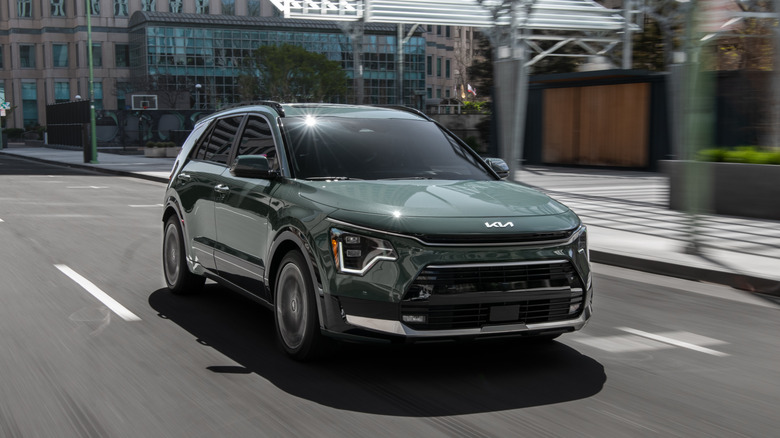
The Niro is almost a rounding error compared to other Kia models. In 2025, all versions — a hybrid, plug-in hybrid, and the EV – sold fewer than 32,000 units (via KBB). That represents about 3.7% of the automaker's total U.S. sales. However, the Niro deserves more attention for one notable feature: price. At under $29,000, the base Niro is the cheapest hybrid here. There is one caveat: This Kia only comes with front-wheel drive, despite its five-door, crossover-like body style. If AWD is a deal-breaker, you'll need to look elsewhere and pay more, but if FWD is workable, the Niro is worth checking out.
Fuel economy is rated at 49 mpg and second-row legroom is respectable at 39.8 inches, while 63.7 cubic feet of maximum cargo space puts the Niro ahead of other subcompact hybrids. Among small hybrid sedans and hatchbacks, Consumer Reports ranks the Kia behind the Hyundai Elantra Hybrid and Honda Civic Hybrid but still gives it decent overall ratings and an average predicted reliability rating. Don't forget that Kia (and Hyundai) offer a 5-year/60,000-mile base warranty and powertrain coverage for 10 years or 100,000 miles.
There's another positive: Upgrading to a higher Niro trim won't break the bank. For example, the SX trim stickers at $34,885, which is more than $2,000 less than a base CR-V Hybrid, but it comes with many bells and whistles. This second-from-the-top edition has a sunroof, heated and ventilated front seats, a heated steering wheel, a driver's memory system, a power liftgate, Harman Kardon audio, and leatherette upholstery.