

7 Used Hondas With Superb Reliability You Don't Want To Ignore
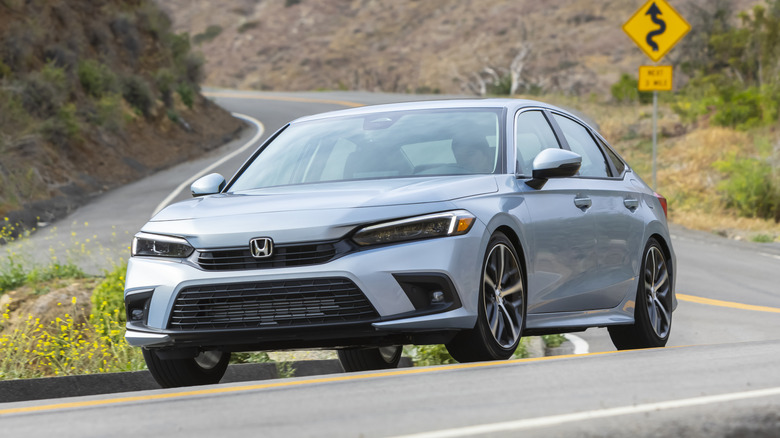
Honda established its reputation for reliability decades ago. Now one of the world's best-known automakers, Honda's first cars didn't hit the scene until the early 1960s. Yet, by the following decade, it was already renowned for building ultra-dependable vehicles. As Motor Trend noted in a 2021 retrospective on the 1978 Accord, "Simple and reliable, that was Honda's unique selling proposition in 1978." Its cars aren't as simple as they used to be, but the other half of that formula remains true.
RepairPal, which bases its reliability ratings on repair orders at thousands of auto shops, says, "The Honda Reliability Rating is 4.0 out of 5.0, which ranks it 1st out of 32 for all car brands." It tallied the average repair costs for Hondas at $428 per year, compared with an industry average of $652. Other sources agree that Honda offers superb dependability. Consumer Reports ranks it number four among all brands for both new car reliability and used car reliability for 2026.
To determine which used Honda models are the most reliable, we're mainly using JD Power's rankings for two reasons. First, the organization generates its ratings by surveying verified car owners after 3 years of ownership, which provides a great barometer for used car buyers to go by. Second, its model reliability histories are broken down by year, going back 2 decades. The overall scores are derived from four separate scores, one of which is labeled "Quality and Reliability," which is what we're interested in here. Any model that scores 81 or higher for reliability receives a rating of "great."
2009 to 2017 Honda Accord
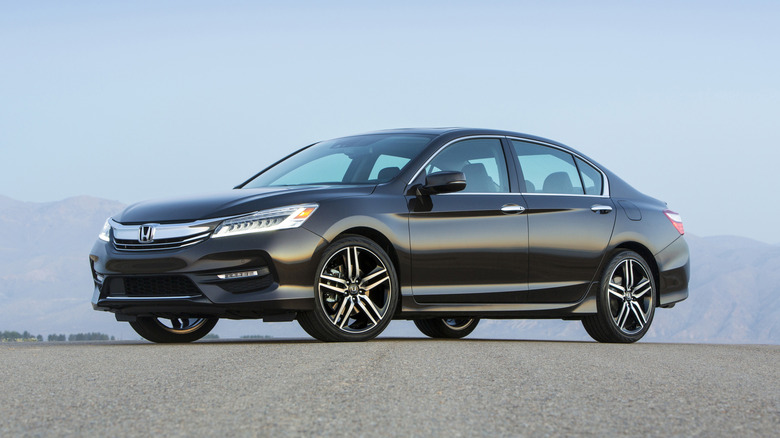
Honda's family car has been a perennial favorite of American car buyers since its introduction in 1976. In fact, the Accord has been America's best-selling car four times, in 1989, 1990, 1991, and 2001. In no small part, this is because there are few cars that are expected to last like a Honda Accord. According to JD Power, the quality and reliability rating of the 2009 through 2017 Accord models is particularly stellar, scoring 81 points or higher in those years, earning a rating of "great." AutoTrader backs that up by noting that "resale value is a strong measure of reliability, and historically, this vehicle has been a value-retention champ."
The 2009 Accord was the second year of the eighth-generation model, which was produced between 2008 and 2012. Per JD Power, the 2010, 2011, and 2012 versions of this iteration of the Accord were exceptionally reliable. For most vehicles, recommending a 14- to 17-year-old car would raise eyebrows, but the vast number of older Accords on the road means these models may be a viable choice for shoppers on a budget. It was available as a coupe or sedan, with a choice of four- or six-cylinder engines.
The entire ninth-generation, 2013 through 2017 Accord also earned JD Power's "great" rating for reliability. The ninth-gen Accord was slightly smaller than its predecessor but retained its legroom in front and boosted it by an inch in back. Its sophisticated new exterior was matched by interior technology, including the HondaLink connectivity system, introduced in 2013. As such, car shoppers looking for a more modern used car may find this generation to be worth considering.
2021 to 2025 Civic
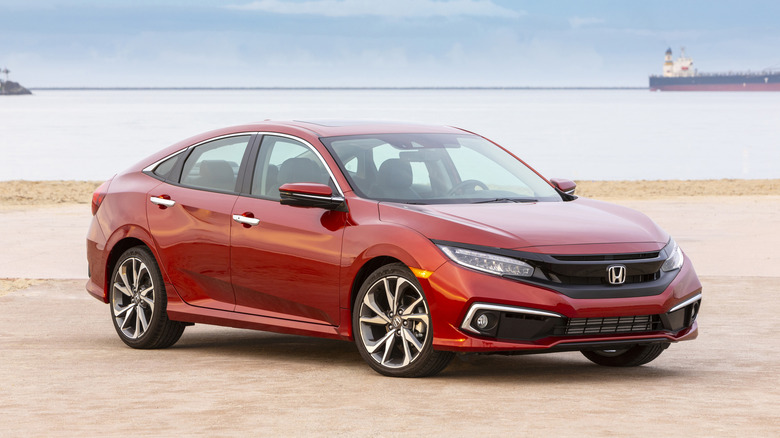
It's no secret that we love the Civic here at Jalopnik. We even called the 2025 Honda Civic hatchback hybrid the platonic ideal of economy cars, combining terrific fuel economy with an almost unreasonably high fun-to-drive factor. This combo has made the Civic a best-seller since its introduction in 1973, since which time Honda has sold more than 15 million of them in North America alone. Reliability has always been a strong suit for this little Honda, but JD Power singles out the 2021 to 2025 Civics, in particular, for a reliability ranking of "great."
The 2021 model was the last year of the 10th-generation Civic, and judging by JD Power's endorsement, Honda really nailed it just before moving on to the next generation. RepairPal concurs, giving the 2021 Civic an "excellent" rating of 4.5 out of 5.0 stars, noting that this "ranks it 3rd out of 36 for compact cars." This model was available in sedan and hatchback forms. Engines included a base four-cylinder and a 180-horsepower, turbocharged, 1.5-liter unit that was good for a 7.2-second 0-to-60 time with a manual transmission. A very competent continuously variable transmission (CVT) was available, too.
2022 saw the introduction of the 11th-generation Civic, which also received a 4.5 rating from RepairPal. This model swapped the 10th-gen model's angular exterior for a more sophisticated look. The interior received refinements, too, in both the layout and the displays. The base 2.0-liter engine generated 158 hp, while the 1.5-liter turbo made 180 hp. There was also a 200-hp Civic Si model. Aside from the 2023 return of the Honda Civic Type R, there were few changes until 2025, which saw new trim levels, including a reborn Civic Si model.
2007 to 2014, 2016, 2024 and 2025 CR-V
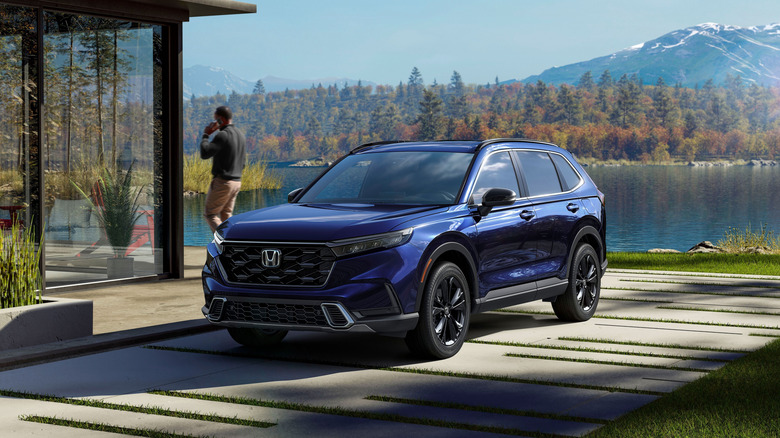
Since its introduction to the U.S. market in 1997, the compact Honda CR-V quickly became one of the most popular vehicles in the segment. As of 2023, Honda claimed it was the best-selling compact crossover SUV (CUV) in the U.S. since its launch, with nearly 6 million sold. JD Power weighed in on the CR-V's reliability, giving a "great" rating to the 2007 through 2014, 2016, 2024, and 2025 models. ISeeCars rates the CR-V number two out of 66 crossover SUVs for reliability, noting that statistics show it has a "30.3 percent chance of reaching at least 200,000 miles during its usable lifespan."
The 2007 through 2011 models were part of the CR-V's third generation. Its exterior featured more rounded, car-like lines compared to earlier models, with a new double grille and other sophisticated styling cues. A 2.4-liter, 166-horsepower engine was the only choice under the hood. The 2012 fourth-generation CR-V got a new grille and gained a 185-hp version of the 2.4-liter four-banger. JD Power gives a "great" rating to the 2012, 2013, 2014, and 2016 models of this generation.
The CR-V doesn't get blessed with a "great" rating again until the 2024 and 2025 model years, which followed a complete redesign in 2023. It looks more sophisticated than earlier models both inside and out, with a well-designed interior and a more modern exterior. Powertrain choices include a turbocharged, 1.5-liter, 190-hp inline-four and a 200-hp hybrid system that features a 2.0-liter four-cylinder matched with electric motors. There have been no significant changes to the current-gen CR-V since its introduction, so used 2024 and 2025 models are very competitive with new 2026 versions.
2007 to 2009, 2011 to 2013, 2017, and 2019 Fit
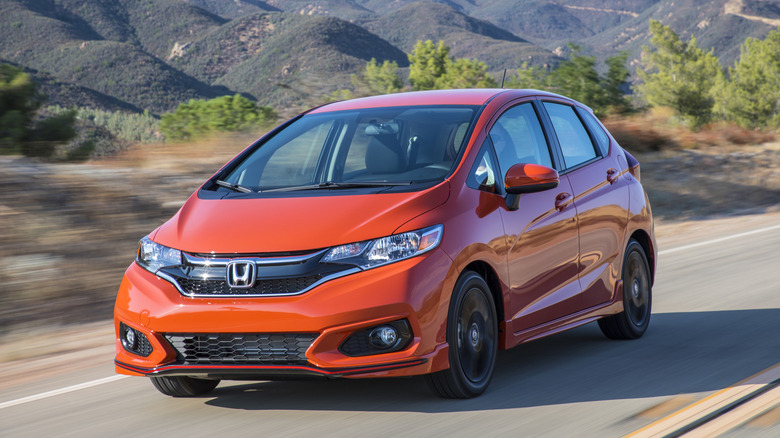
The subcompact Honda Fit held down the entry-level spot in Honda's lineup in the U.S. from 2007 through 2020. It was sold across three generations, the first (2007 to 2008), second (2009 to 2014), and third (2015 to 2020), all of which scored highly for dependability. JD Power awarded a rating of "great" to eight Fit model years: 2007, 2008, and 2009 from the first generation; 2011, 2012, and 2013 from the second; and 2017 and 2019 from the third. Kelley Blue Book scores the first generation a stellar 4.9 out of 5.0 stars, the second a 4.8, and the third a 4.6.
An older Fit may be a better buy for the money, since newer models have enjoyed a resurgence of popularity recently, perhaps, in part, because of the higher price of fuel in light of recent spicy geopolitical events. As a result, newer Honda Fits are basically depreciation proof. But even first-generation Fits are great little cars, with reviews for the 2007 model praising its fun-to-drive quotient, its roomy cabin for such a small car, and its versatile second-row "Magic Seat."
The second-generation Fit that debuted in 2009 drew similar praise for its interior, which Consumer Reports called "unusually versatile and flexible." CR notes that the Fit received standard stability control beginning in 2011. Motor Trend's review declared, "Honda improves on an already superb recipe," and highlighted improved horsepower and handling. The third generation, if you can find one at a reasonable price, offers more power, better fuel efficiency, and a more upscale interior.
2021 to 2026 HR-V
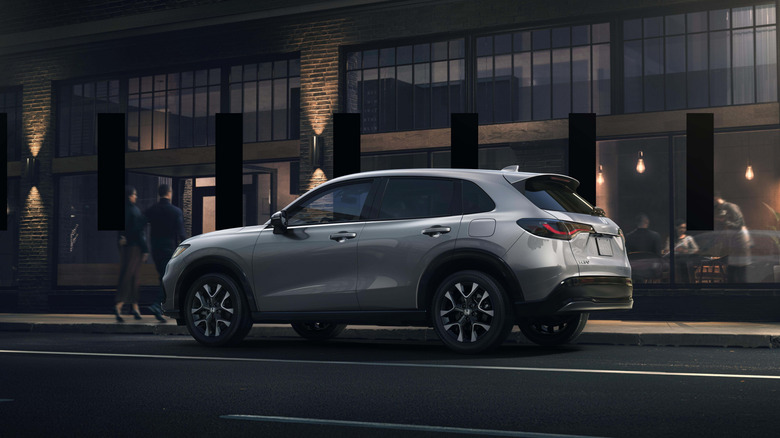
The Honda HR-V debuted for the 2016 model year in the U.S., offering many of the advantages of its bigger CR-V sibling in a smaller, nimbler package. It was based on the subcompact Fit's platform, so it's not surprising that it gained a reputation for being a fun and reliable little vehicle. The first U.S.-spec generation of the HR-V was sold from 2016 through 2022, with the second generation arriving in 2023. JD Power gives a "great" reliability score to the 2021 through 2026 models, splitting the two generations.
CarGurus agrees, describing the HR-V as a good used vehicle, due to its "solid reputation for reliability, strong resale values, and very practical interior." It notes that first-generation HR-Vs tended to have issues with their CVTs, although, judging by JD Power's reliability rating for 2021 and 2022 models, that problem was apparently sorted out by late in the first generation's model run. So, generally, you should find that HR-Vs from 2021 and onward will fully live up to Honda's reputation for dependability.
The first generation HR-V arrived with a 141-horsepower, 1.8-liter four-cylinder engine, a standard manual transmission, an optional CVT, and optional all-wheel drive (AWD). There were few changes before a 2019 mid-cycle refresh, which brought a revised front end, new driver-assist features, and a CVT designed to shift more like a regular automatic transmission. The second-gen model appeared in 2023 with a completely redesigned, more sophisticated exterior and a 158-hp, 2.0-liter four-cylinder. This edition of the HR-V is still in production in 2026, so used models still look fresh and new.
2012 and 2015 Odyssey
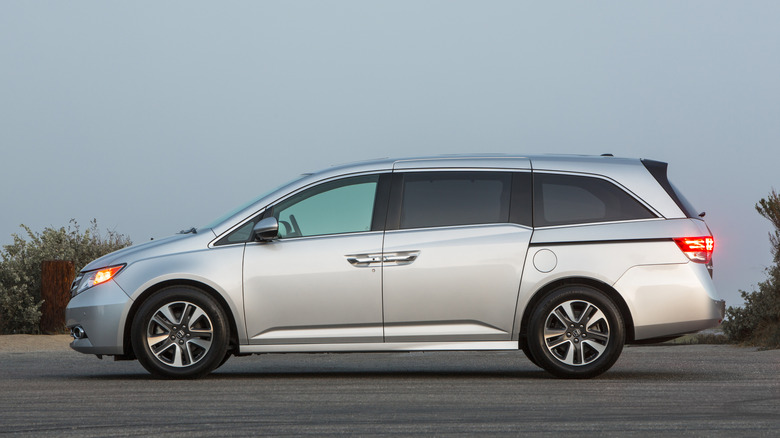
It's hard to remember now, but minivans used to be hugely popular, and Honda created the Odyssey to grab a chunk of that market way back in 1995. Today, minivan sales have dropped by three quarters from their peak, and many carmakers stopped building them, but the Odyssey soldiers on. JD Power assigns a reliability rating of "great" to the 2012 and 2015 models, both of which are part of the van's fourth generation, which debuted in 2011. Owner reviews collected by Kelley Blue Book agree, describing "long-term reliability, with some vehicles lasting over 200,000 miles with only routine maintenance."
The fourth-generation Odyssey featured a completely refreshed exterior with a distinctive down-and-up kink in the beltline behind the rear doors that Honda calls the "lightning bolt." Reviewers praised its handling and its optional six-speed automatic transmission, which helped to overcome a relative lack of power from its V6 engine. The engine wasn't a slouch, though, being a 248-horsepower, 3.5-liter unit. The powertrain delivered a quality that's relatively rare in the minivan segment: fun, or something darn close to it.
The fourth-gen Odyssey also sported the thoughtful and clever design features for which Hondas are renowned. The aforementioned "lightning bolt" kink in the rear windows provides a better view from the rear-most row. The second row of seats can be slid forward or set with the outboard seats wider apart for easier three-across seating. The third row is the famous Honda Magic Seat. Sliding rear doors on both sides enable easier access.
2008, 2010, and 2011 Element
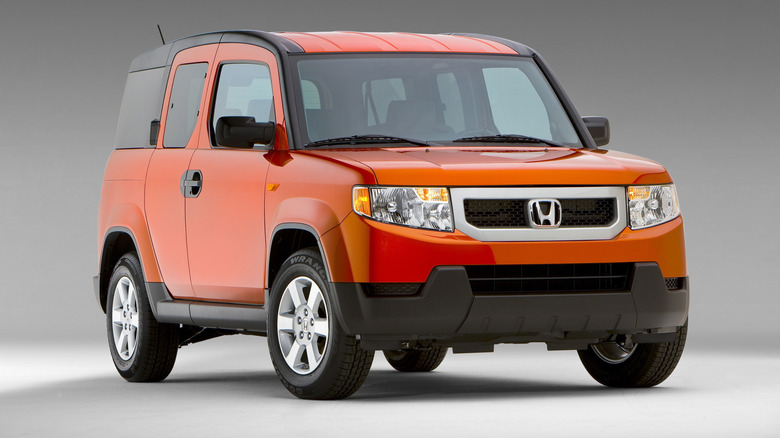
SUVs have converged on a certain degree of blandness in the 2020s. However, back around the turn of the century, automakers were much more daring and experimental, resulting in such unusual models as the Isuzu VehiCROSS, the Chevy HHR, and, of course, the hallucinatory Pontiac Aztek. Honda entered the fray with the Element in 2003, and the odd but almost infinitely versatile little SUV soon became one of the cars that defined the 2000s. It was discontinued after 2011, but along the way, it racked up "great" reliability ratings from JD Power for the 2008, 2010, and 2011 model years.
CarGurus agrees that it's dependable, going so far as to say of the Element, "There are no unreliable model years." It does note, however, that the 2003 model had a few first-year glitches with its door locks and ignition. We'll go with JD Power's recommended model years listed above, which may put it at the older end of our model recommendations, but given that there's nothing like the Element on the road today, if you can find one, you just may want to grab it.
Right from the start, the Element was notable for its cute-but-rugged exterior, its clamshell doors that offered easy access to a spacious interior, and rear seats that could be removed, reclined, or stowed against the side walls. Throw in optional AWD and a washable plastic floor, and the Element is the perfect outdoorsy lifestyle trucklet. The first generation featured a 160-horsepower four-cylinder powerplant. The 2009 redesign brought exterior and interior refinements, additional functionality such as an optional cooler, and 6 extra horsepower.