

9 Alternatives If You Can't Afford A Shelby Cobra
There are many cool Carroll Shelby cars, but there's not an enthusiast on Earth who wouldn't want to own an original Shelby Cobra. Those unmistakable early-1960s British roadster looks with Ford V8 power are a combination hot enough to singe your eyebrows. But alas, most of us common folk are plagued by a problem as old as time — money. According to Hagerty, the cheapest examples are typically the early 260-powered cars, with "good" condition prices sitting in the high $700,000 range. As condition increases and the big blocks start showing up, well, now you're looking at a million-dollar car or even far beyond that.
If you already happen to own cars in the high-six-figure range or exceeding $1,000,000, first of all, congratulations, and secondly, you probably don't need to read this. But for the average financially stable adult who has some money set aside for just one truly special car in their garage, the Cobra is just another one of those toweringly expensive cars you see at auctions. And hell, there were only 998 factory units built over the six-year production run (from 1962 to 1967), so even if you did have the dough, that's just half the battle.
Anyway, you read the headline; you know what's going on here — affordable Cobra alternatives. We wanted to keep an open mind while compiling this list so as not to leave out comparable driving experiences that may not be of the same era or number of cylinders, but in general, this group of vehicles (mostly) stays within that V8, rear-drive, open-top roadster faction. Most importantly, though, nearly every pick here costs just a small percentage of a factory-built Shelby Cobra.
Sunbeam Tiger (Mk I)
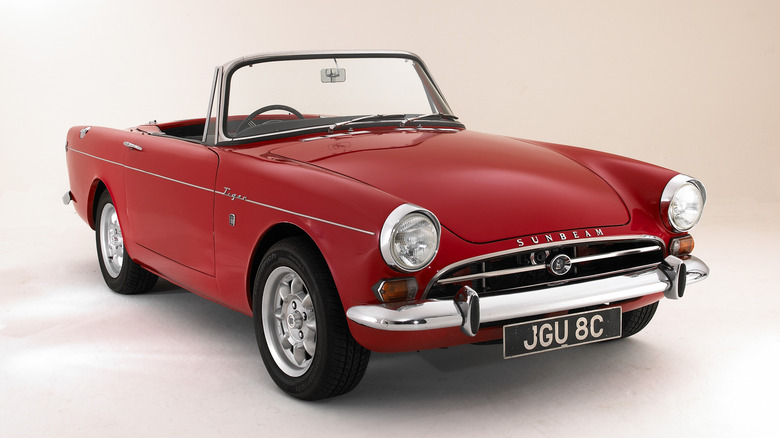
The Rootes Group, based in England, had been the parent company of Sunbeam since 1935, but by the early 1960s, its brand of small British roadsters was being outclassed by the likes of MG. Brian Rootes, whose father owned the company, was well aware and immediately took interest in delivering an X-factor to the existing Sunbeam Alpine roadster.
Rumor has it that Rootes looked far and wide for a new powerplant, even inquiring with Ferrari about supplying a four-cylinder engine. Shocker: they didn't bite. Later, it was legendary F1 racer Jack Brabham (he had recently raced a Sunbeam Alpine) who suggested to Rootes that a small-block Ford V8 would pair nicely. Long story short, Rootes approached Carroll Shelby and Ken Miles (of Le Mans fame) to each build prototypes of the updated Alpine with a 260 cubic-inch Ford V8. His father was skeptical at first, but once he drove it, the green light was given, and a new name was chosen — Tiger.
The sleek new Sunbeam nearly doubled power and vastly increased torque compared to the old Alpine, using the 164-horsepower (258 lb-ft) version of the 260 V8, connected to a Ford-sourced four-speed manual transmission. All of these "Mk I" Tigers used the same powertrain throughout their 1964 to 1967 production run, though there are subtle changes from year to year. While not quite as thrilling as a Cobra, the solid rear axle and wishbone front suspension — paired with V8 noise, an excess of torque, and open-air body style – is enough to quench most of that thirst. And because this is a Ford-powered car, upgrades are readily available. Of course, the real pull is its very non-Cobra pricing. Current average values sit in the low $50,000 range, and many still sell for under $40,000.
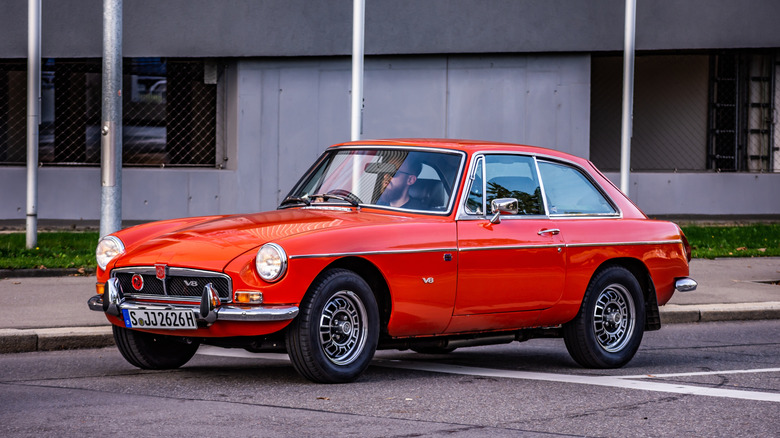
MGB GT V8
It doesn't happen often, but there were moments when enthusiasts influenced a car's fate instead of product planning paper pushers. It happened in the 1990s with the E36 BMW M3, where BMW club members in North America successfully lobbied to bring the M3 across the pond. A similar story occurred with the MGB GT V8, but in its case, the enthusiast involvement did not concern global markets, but rather what was literally going under the hood of the new MGB.
Ken Costello was the man behind this feat. He studied automotive engineering, worked in the industry research sector, and even raced here and there. But after being inspired by a Maserati V8 displayed at a museum in Monza, Italy, he ended up conducting an engine swap between a Rover V8 (based on the 215 Buick/Olds V8) and an MGB. The product was so enjoyable that he even started a business selling these conversions, and before long, Costello allowed British Leyland (owner of MG at the time) to take inspiration from his creations. Unfortunately, the company would end up excluding Costello from the development process of the production car and any credit for the idea. The Costello relationship was severed, but the MGB GT V8 still came true.
Built from 1973 to 1976, the GT V8's 3.5-liter Rover made 137 horsepower and 193 pound-feet of torque and was geared via the standard four-speed manual transmission. An important caveat for this piece is that the GT V8 was a hardtop instead of a roadster like the Cobra. However, the GT V8 retains that British-bred charm and eight-cylinder grunt that the Cobra is known for. Not to mention, the MG is one of the cheapest on this entire list, as average sales in 2026 hover around $18,600.
Chevrolet Corvette (C2)
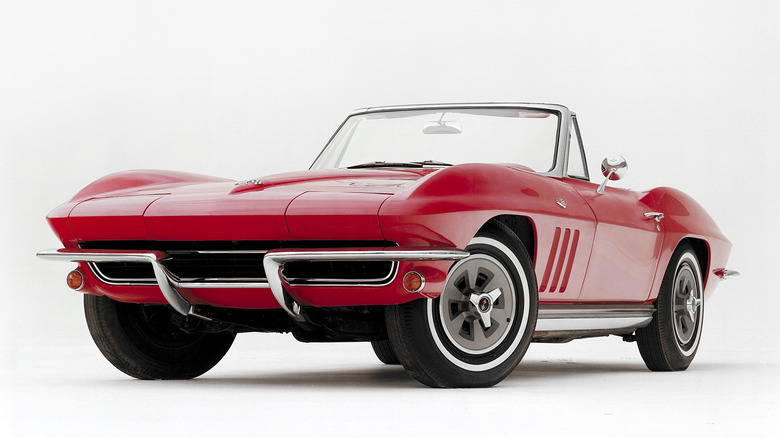
With all this talk of European-bred roadsters, as the Cobra was itself, we can't forget about the good ol' USA. And what better place to start than with America's sports car, the Chevy Corvette. Considering its timeline, the C2 was on the market throughout much of the 1960s, and though it wasn't as stripped down and racecar-esque as the Cobra may have been, there might not be a better direct competitor to the Cobra when it comes to American muscle.
Throughout the C2's production cycle (1963-1967), a dizzying number of engines and special order codes were available. There were 327s, 396s, and 427s, all offered in multiple performance trims, which, depending on year, could be an L76, L84, L68, L71, L79, L78, and on and on. Every generation of Corvette had several options, but for the C2 specifically, you'll want to do some research for the particular spec you want. In the interest of time, we can't go through the C2's whole catalog, but because we're competing with the Shelby Cobra, a big-block Corvette seems appropriate.
Of the big-block Vettes, the ones that stick out are the 425-horsepower 396 V8 (L78), which currently averages in the $130,000 range, the 425-horsepower 427 V8 (L72), which sits at $115,000 on average, the 400-horsepower 427 V8 (L68) for around $150,000, and the 430-horsepower 427 V8 (L71), which tops our group at around $170,000 average sale prices. Not cheap, but not even near Cobra money. Plus, the big-block C2s of this era usually came with stiffer suspension, limited-slip differentials (Chevy calls it Positraction), four-speed manuals, and the option for a convertible body style, checking just about every Cobra-related box there is, other than that seven-figure price tag.
Devin SS
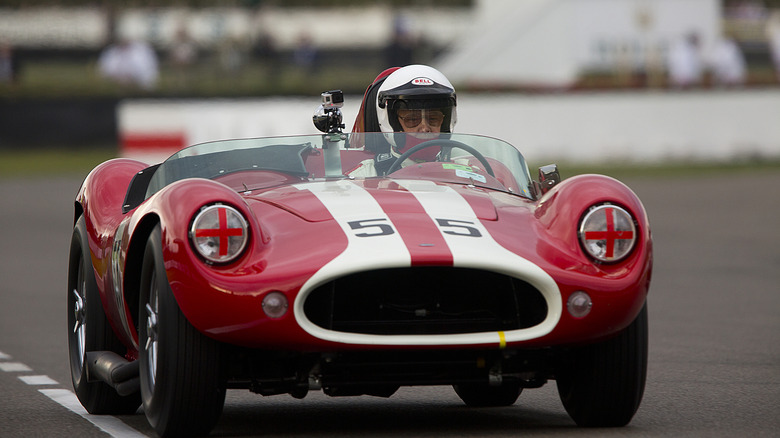
Bill Devin launched his own car company, Devin Sports Cars, in 1954, and immediately began innovating. On his first production car, he took a Panhard racing chassis, designed his own overhead cam system for the engine, and sculpted an entirely new body shell from fiberglass – something that was considered fairly revolutionary at the time. For the next several years, Devin would continue to produce fiberglass bodies and performance tweaks for existing chassis that competed in all kinds of motorsports. But his claim to fame was what occurred in 1957.
This was the Devin SS, the first ground-up build for Devin Sports Cars. It had a European, Le Mans-inspired body with big front overhangs, dramatic body curves, an open top, and not a single right angle whatsoever. Under the hood was a slightly modified Corvette-based 283 small-block V8 making around 220 horsepower (with a four-speed Borg Warner gearbox) for the road cars, while race-spec cars were likely tuned for a bit more. As was expected of Devin's cars, the SS competed in many different racing series, including SCCA and Pikes Peak (where it was driven to overall victory six times by driver Ak Miller).
However, there's probably a good reason you may have never heard of the Devin SS; only about 30 total chassis were built, with just 10 for the U.S. They're about as rare as it gets, and thus far more expensive than, say... the MGB GT V8. About 15 years ago, a Devin SS racecar sold in 2010 for €134,400 (or about $175,000 USD in 2010), and in 2025, a well-preserved 1958 Devin SS road car sold for $260,000. Again, it's expensive, but a small fraction of Cobra money for a very comparable experience.
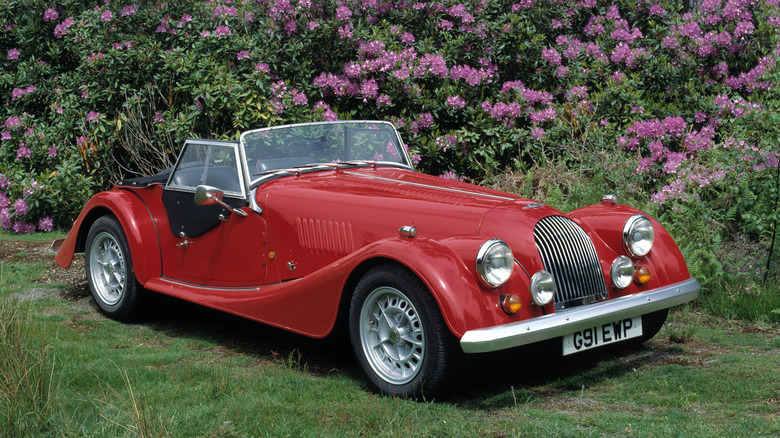
Morgan Plus 8
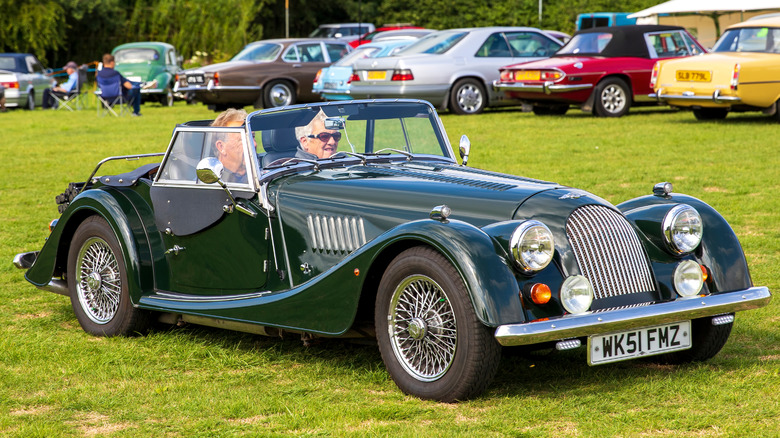
You may know this brand for building crazy stuff like the Morgan 3 Wheeler, but in the context of the Shelby Cobra, its most comparable model in terms of era and philosophy is the Morgan Plus 8. The idea for the Plus 8 materialized out of necessity. Its previous roadster, the Morgan Plus 4, was reliant on an older Triumph four-cylinder engine for its power, but when Triumph began phasing it out of production in favor of a longer straight-six (that wouldn't fit in the Morgan), the team had to be decisive in finding a replacement.
During this period in the mid-1960s, the brass at Morgan and Rover had a meeting, and unsurprisingly, this engine dilemma was brought up. Rover wanted to take control of the Morgan brand entirely and handle the issue independently, but because Rover director Peter Wilks and Morgan founder Peter Morgan were close friends, Rover eventually allowed Morgan to use its 3.5-liter V8 — the same Buick/Oldsmobile-based engine used in the MGB GT V8.
By 1968, the Plus 8 would be shown to the public and subsequently hit the streets, weighing just 1,900 pounds and packing 151 horsepower from the Rover lump. The aluminum construction of the engine, along with other improvements, allowed the Plus 8 to weigh nearly the same as the previous Plus 4, but with massive power and torque improvements. The Plus 8 remained in production all the way until 2018 (production paused from 2004 to 2012) with a final edition in 2022, and due to this 50-year history, buyers have some wiggle room. While average values are around $40,000, earlier examples typically sell in the $30,000 range, while 1990s and 2000s models and their updated features sit in the $50,000+ range.
Panoz AIV Roadster
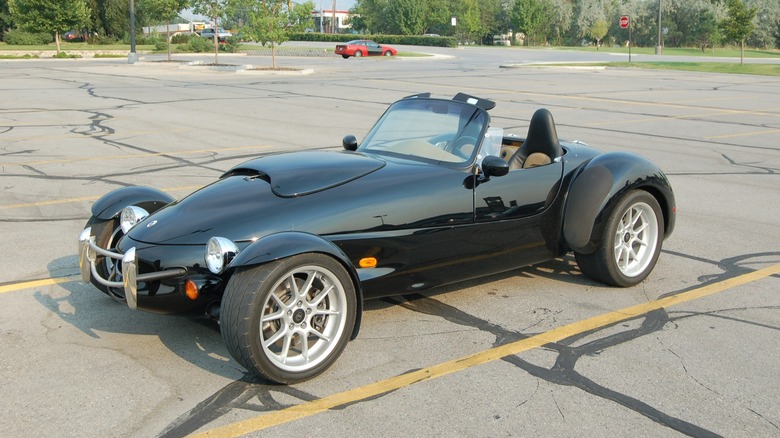
While Shelby and Devin operated within the wild west era of the 1950s and 1960s, Panoz's endeavors got underway in the late 1980s — a time when American cars were, arguably, not at their best. The AIV Roadster, specifically, was championed by Dan Panoz, whose father, Don Panoz, was a successful medical product businessman in the 1970s. Don would help finance his son's dream, and after purchasing the rights to a small aluminum sports car chassis, hiring a pair of engineers to help develop the car, and bringing on the guy who would eventually design the Audi TT (Freeman Thomas), the newly established Panoz Auto Development was finally a reality.
What they came up with was a classic, refined roadster look, and a much less cartoonish silhouette than the Plymouth Prowler it's often compared to. Underneath the original Roadster (1992) was a 5.0-liter Ford V8, but by 1995, the updated and newly named AIV Roadster would end up debuting with the SVT Cobra's 4.6 quad-cam V8 with 305 horsepower. In fact, the Panoz AIV Roadster was essentially what every enthusiast wanted from the Prowler but never got — a V8 powertrain, a manual transmission (five-speed), and a proper sports car chassis.
The AIV went out of production in 1999 after just 176 units left the factory, but not before reaching some impressive performance achievements — 4.6 seconds to 60 mph, a 13.5-second quarter-mile, and a power-to-weight ratio about as good as that of the then-current Porsche 911. In 2026, the Panoz doesn't just undercut the Cobra for current prices, but even the 911 it was compared to, sitting at a cool average of $43,000 on the second-hand market.
Dodge Viper (1st Gen)
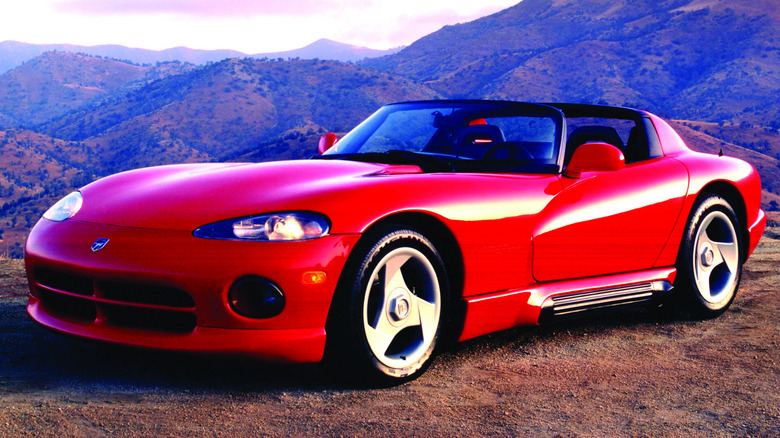
Not only was the original Dodge Viper inspired by the Shelby Cobra, but Carroll Shelby himself played a role in pushing this radical idea through to production. It all began with Bob Lutz, who was president of operations at Chrysler. He desperately wanted a Cobra-esque American sports car for the Chrysler brand, and with Mr. Shelby's backing for the project, it was only a matter of time before the higher ups caved in.
Luckily, Lutz knew he could utilize not just the recently developed Ram V10 truck engine, but also basic structural parts from other Dodge trucks to keep the bean counters at Chrysler happy. And while they were limited to $80 million to develop the first Viper, far more work went into this thing than expected. Lamborghini (which Chrysler was in business with at the time) helped make the V10, well... less like a truck motor, and by the time of its debut in 1992, the 400-horsepower 8.0-liter monster was almost an entirely different unit from the V10 it was based upon.
The original Viper is the one you want as a Cobra alternative because it's arguably even more outlandish. This production Chrysler product had no door handles or windows, no roof, a 400-horsepower V10 with zero electronic aids, and brutish side-exhaust pipes. It doesn't get more metal than that. And of course, it has a manual (six-speed) gearbox just like the Cobra. The first-gen car is also on the lower end of the price spectrum when it comes to the five iterations from 1992 to 2017, hovering in the low $50,000s on average. Of course, low-mileage, factory examples can creep closer to six figures, but on the other hand, those a little rough around the edges can sell in the $30,000 range.
AC Ace Bristol
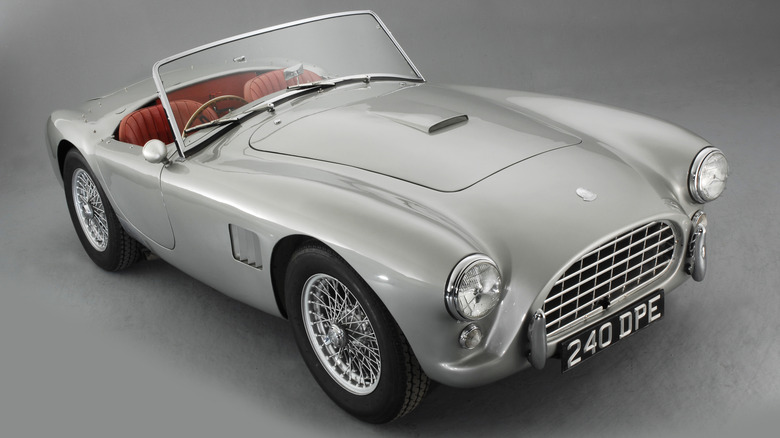
Let's get one thing straight — the Ace Bristol is not an affordable car. Hagerty gives a Bristol in "excellent" condition a valuation of $374,000, and previous auction sales don't typically dip down below $200,000 on the low end. So, why include it? Obviously the technical answer is that even the worst Cobra is still twice as expensive, but the deeper answer goes something like this: In a conversation about the Cobra, you would be remiss if you didn't mention the car that gave it life — and that's the AC Ace.
The original Ace that debuted in 1953 was what many would consider the paradigm of the British roadster — beautiful, small, light, rear-wheel drive, and shifted manually. One thing it wasn't, however, was powerful. The AC 2.0-liter straight-six was only good for about 100 horsepower. That's where the Ace Bristol comes in. Launched in 1956, it used Bristol's identically displaced 2.0-liter straight-six, which offered customers 120 horsepower. In addition, the Bristol had a bespoke tubular chassis, front and rear independent suspension, as well as a four-speed manual transmission, all of which helped with its successful racing endeavors at Le Mans and elsewhere.
For those who are drawn more to the Cobra's looks and presence, the Ace is literally the best possible option. Though it bears several key differences, the Ace directly inspired the Cobra that came after it, and shares an uncanny resemblance to Shelby's future sports car. There's also the argument that the more powerful V8s in a Cobra are nothing more than a liability (as if real Cobras are still driven), being just one over-zealous throttle thwap from losing a seven-figure car. In the Bristol, you could theoretically wring its neck on a backroad and be left with nothing but smiles.
V8-swapped Mazda Miata
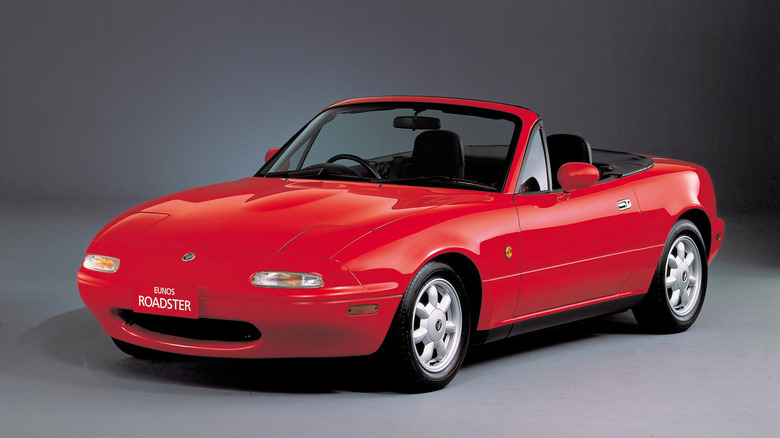
This entry was meant to catch you off guard, yes, but honestly, we're not entirely joking. The Mazda Miata has been, for more than 30 years, one of the greatest drivers' machines on the market, and the evil geniuses that make up the automotive community have proven time and time again that with enough mechanical ability (and maybe a bit of fabrication), the Miata will accept a V8 under the hood, willingly or not.
Additionally, if one were seriously considering the other options listed above, they'd already be on the hook for $30,000 to $40,000 or more in most cases — a budget easily capable of purchasing a Miata (probably nothing later than an NC), an LS V8, and the services of a professional shop to perform a high-quality swap. Though if you're a talented mechanic in your own right, the total cost would be far cheaper. Doing it yourself with the proper parts has cost folks around $15,000-$20,000 in the past, while professional shops can run closer to $50,000. Still, a bargain in the Cobra-sphere.
If the goal is a driving experience somewhat related to a Shelby Cobra, you just can't count out the V8-swapped Miata. The heaviest one you'll find is only about 2,500 pounds in factory form; it's got a convertible top, a manual transmission (though you'd probably have to swap it out for a beefier unit anyway), and a tossable chassis base to work from. Throw an understressed 300 to 350 horsepower V8 in the mix, and Bob's your uncle.