

Toyota Tacoma Vs. Nissan Frontier: Which Truck Offers More At Their Price Point?
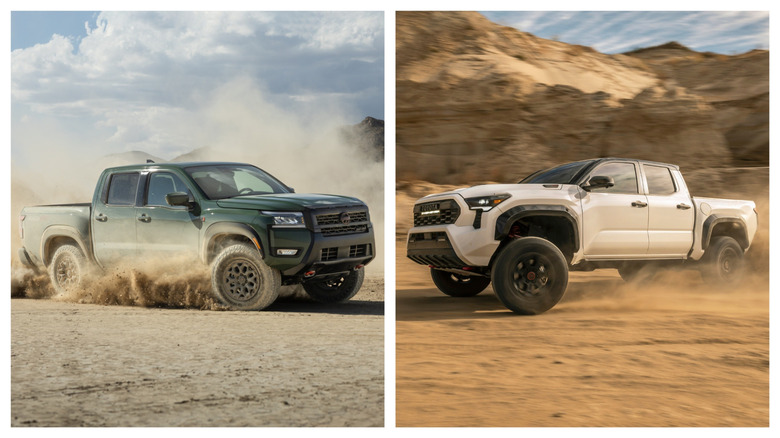
While the full-size truck market is dominated by American automakers, the midsize Toyota Tacoma has a commanding sales lead over its rivals. The gap only widened in 2025, as the feature-packed Tacoma enjoyed a 42.44% sales spike (to 274,638 trucks) to pull further ahead of the competition. Meanwhile, the Nissan Frontier saw a modest dip in demand, with sales dropping 3.99% to a total of 67,027. And it's not because the Frontier is an aging model; Nissan revamped its midsize contender for the 2022 model year, bringing a more modern design and tech features to the table.
Sales figures aside, how do the Tacoma and Frontier really compare? That's exactly what we'll focus on in this piece, giving you the nitty and gritty of Toyota's and Nissan's latest midsize pickup trucks. This head-to-head is a textbook battle of the tech-forward Tacoma versus the refreshingly old-school Frontier. We've divided our comparison into several critical categories to evaluate exactly what these trucks bring to the table and whether their capabilities justify their sticker price. Before we dive into the details, a quick note: all prices cited throughout this comparison include destination charges. Now let's see how the Tacoma and Frontier stack up at their price point.
Power-train options
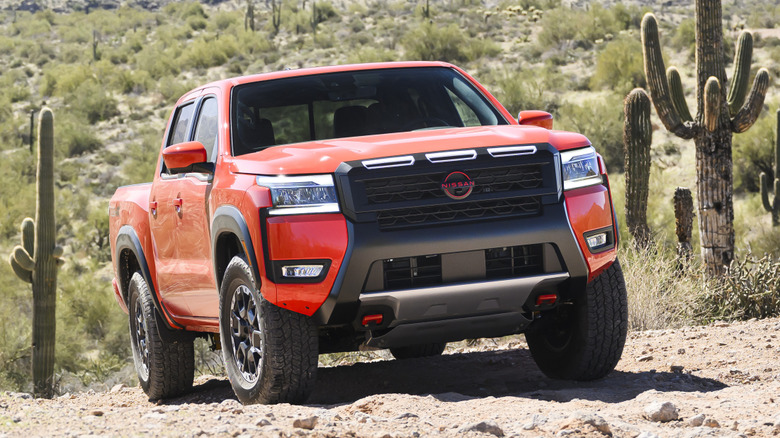
For most truck buyers, the evaluation begins under the hood. And when it comes to power, these pickups take two entirely different paths. Nissan went the good old "no replacement for displacement" route, while Toyota went all in on downsizing and hybridization.
The only engine offered in the Frontier is a 3.8-liter V6. It produces 310 horsepower and 281 pound-feet of torque, making it among the most powerful in the segment. The V6 is paired exclusively to a nine-speed auto and reaches 60 in 7.5 seconds according to MotorTrend. The V6-equipped Frontier with rear-wheel drive is EPA rated at 21 mpg combined and starts at $33,895. Meanwhile, the Tacoma comes with a 2.4-liter turbocharged four-cylinder with 228 hp in the entry-level $34,190 SR trim.
From the SR5 onward, the Tacoma comes with a higher-output engine offering 278 hp and a meaty 317 lb-ft, which MotorTrend says brought the 2026 Tacoma to 60 in an equal 7.5 seconds. The Tacoma's turbo-four is more economical than the Frontier's V6 with a 23-mpg combined EPA rating (2WD model). The Tacoma can be equipped with an eight-speed automatic transmission, but a six-speed manual with 270 hp is also available.
Still, the showstopper in the Tacoma lineup is the i-Force Max hybrid. Thanks to the added electric motor between the 2.4-liter turbo-four and eight-speed auto, the hybrid power train produces 326 hp and an astonishing 465 lb-ft, blowing away every truck in its segment. It comes with standard four-wheel drive and has a higher 23-mpg combined figure than the regular 4WD Tacoma (21 mpg), but it starts at a whopping $48,980 for the TRD Sport trim.
Towing and carrying capacity
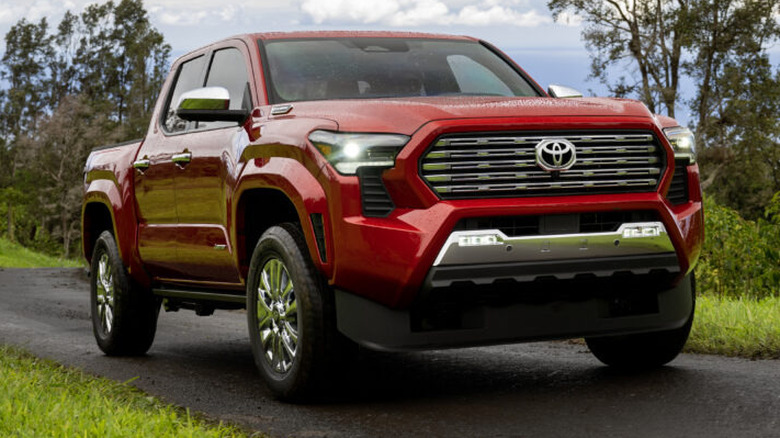
The Nissan Frontier takes the crown for towing, pulling up to 7,160 pounds in the King Cab 4x2 configuration, easily outclassing the Toyota Tacoma's 6,500-pound limit for the SR5 4x2 XtraCab trim with the 278-hp engine. If you want the more potent Tacoma Hybrid, you're looking at an even lower 6,000-pound limit for towing.
And the difference gets bigger in the base trims. The entry-level Tacoma SR has a maximum towing capacity of only 3,500 pounds, while the cheapest Frontier King Cab S 4x2 Long Bed gets you the full 7,160-pound capacity. So, for the cheapest Tacoma with the maximum 6,500-pound capacity you'll need to shell out $38,280, compared to just $33,895 for the base Frontier.
Toyota does offer some cool trailering upgrades, like a wireless trailer camera that streams a live HD feed from behind the trailer directly to the digital rearview mirror. In the Frontier, you'll need to rely on the Intelligent Around View monitor, which gives a 360-degree bird's-eye view, but doesn't provide a behind-the-trailer view. That said, the system comes as standard even in the base model.
With a maximum payload capacity of 1,710 pounds, the Tacoma can carry slightly more stuff than the Frontier, which is capped at 1,610 pounds. However, only the Tacoma Hybrid can reach the highest capacity; the regular 2.4-liter turbo-four model is capped at 1,690 pounds.
Bed utility and configurations
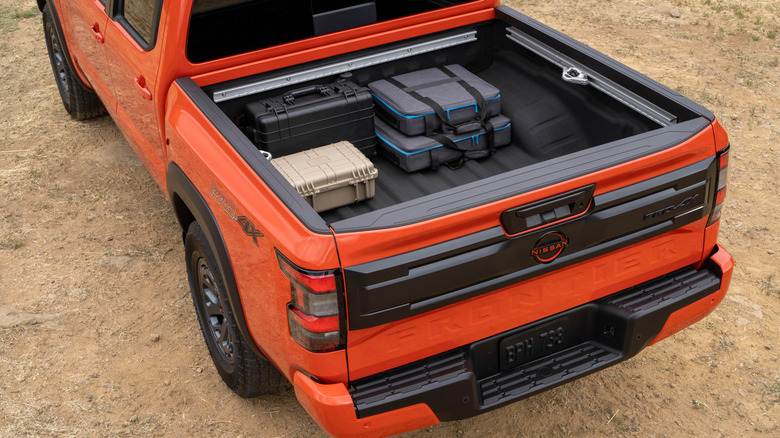
The Frontier and Tacoma are basically neck and neck when it comes to payload capacity, but Toyota's truck comes standard with an aluminum-reinforced bed covered with a sheet-molded composite surface. This combination provides superior impact strength over regular steel and eliminates the need for the traditional spray-on bed liner. Aluminum provides superior corrosion resistance over steel, too.
Unfortunately, you can't drill into this surface to attach aftermarket accessories. To keep your gear locked down, the Tacoma Deck Rail System features adjustable heavy-duty cleats that slide exactly where you need them. Meanwhile, the Frontier comes with a regular steel bed, with a spray-on bedliner available only as an option. For added utility, Nissan equips its midsize truck with the Utili-Track Channel System (available as an option from the Crew Cab S 4x2 upward), which works similarly to Tacoma's Deck Rail System.
A 120-volt AC power outlet is available on both trucks. However, the Tacoma Hybrid can deliver up to 2,400 watts (with 400 watts in the standard versions), while the Frontier is capped at 400 watts. The Tacoma Hybrid can also be equipped with an air compressor, which you can use to inflate the tires.
Both trucks come in standard and long bed sizes. Tacoma's standard bed is 60.3 inches long, compared to 59.5 inches in the Frontier. When comparing the long-bed configurations, the Tacoma holds a more microscopic advantage, offering 73.5 inches of length over the Frontier's 73.3 inches. Tacoma's bed is also 53 inches wide, or 44.7 inches between the wheel wells, and up to 21.2 inches deep. Meanwhile, Frontier's bed is wider at 61.4 inches, or 44.5 inches between the wheel wells, and 19.4 inches deep.
Approach/departure angle/ground clearance
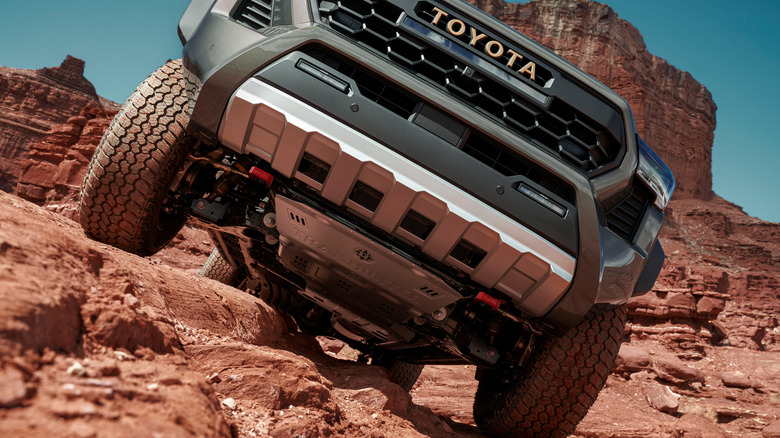
While four-wheel drive is considered the minimum for good off-road traction, high ground clearance, along with big approach and departure angles, takes care of overcoming big obstacles. The standard Frontier Crew Cab 4x2 and 4x4 models have a 9.3-inch ground clearance below the rear differential, while the 4WD version has an 8.9-inch ground clearance below the front differential. The 4x2 model has 29.8-degree approach and 21.8-degree departure angles, which grow to 31.4 inches and 22.4 inches for the 4x4.
Toyota only lists the overall ground clearance of the Tacoma. For the 4x2 XtraCab model, Toyota says the clearance is up to 11 inches, while the 4x4 XtraCab tops at 10.7 inches. The popular SR5 trim with 4x4 has a higher 32.8-degree approach angle than the Frontier, but also a slightly lower 22.1-degree departure angle.
The off-road-focused trims of these trucks offer much higher clearance, approach, and departure angles. The TRD Pro is the top rugged trim in the Tacoma lineup and comes equipped with adjustable Fox 2.5-inch QS3 shocks, which add 3 inches of ground clearance. As a result, the Tacoma TRD Pro has higher 35.7-degree approach and 22.6-degree departure angles. The rugged trim also features forged aluminum control arms and 18-inch wheels wrapped in 32-inch rubber. It's only available with the hybrid powertrain, though, and starts at dizzying $66,395.
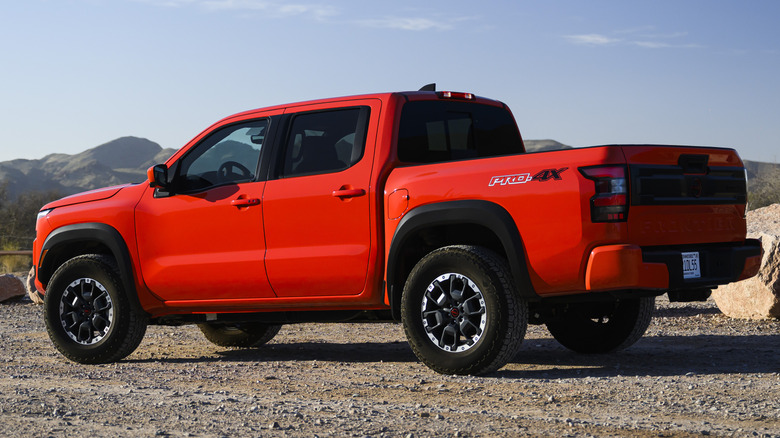
Meanwhile, the rugged Frontier PRO-4X starts at refreshingly affordable $43,615. The PRO-4X comes with Bilstein off-road shocks, which raise the ground clearance to 9.8 inches (rear differential) and 9.5 inches (front differential). The tough model also comes as standard with an electronic rear differential, skid plates, and the Intelligent Around View Monitor camera system.
Interior space and seating
Both the 2026 Frontier and 2026 Tacoma are available in extended-cab and double-cab configurations. However, the extended cab variants of these trucks vary significantly. The Tacoma XtraCab only uses the added space as a cargo area, while the Frontier King Cab has small rear seats. Admittedly, the legroom is tight at just 26.2 inches, but at least you have the option of carrying people for short distances.
Still, the slightly more expensive double cab versions have significantly more comfortable rear seats. The Frontier Crew Cab costs an extra $1,400 over the King Cab, while the Tacoma Double Cab costs an additional $1,660 over the XtraCab. Toyota's double-cab truck edges its rival in back seat legroom (33.7 vs. 33.2 inches) and hip room (56.3 vs. 53.7 inches). However, the Frontier has more shoulder room (58.3 vs. 57.8 inches) and head room (38.6 vs. 38.4 inches).
Both pale in comparison to other midsize trucks, though. For instance, the trail-loving Jeep Gladiator has significantly higher 38.3 inches of rear leg room and 42.8 inches of rear head room. The Chevrolet Colorado midsize offroad truck and its upmarket alternative, the capable GMC Canyon, also offer more leg room in the back at 34.7 inches.
The front seats of the Tacoma and Frontier are significantly more comfortable, though. The Tacoma offers 41.8 inches of leg room and 58.3 inches of shoulder room, while the Frontier has 42.3 inches of leg room and 58.2 inches of shoulder room. Both models have many useful storage bins around the cabin.
Interior tech
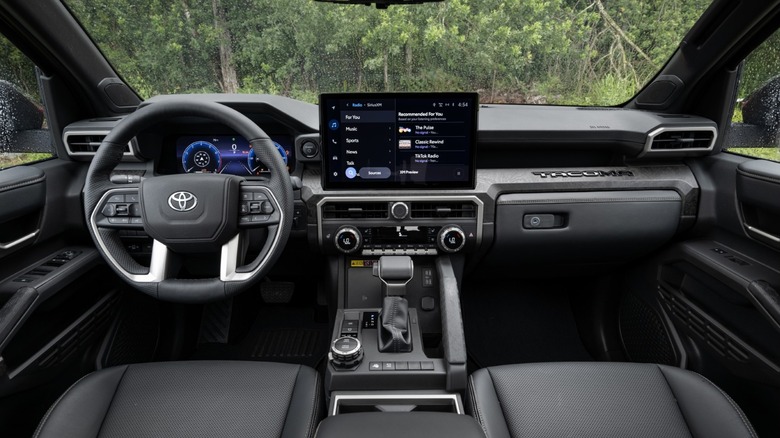
The base trims of the Tacoma and Frontier come with 8-inch touchscreen infotainment displays that support Apple CarPlay and Android Auto. However, only the Tacoma features wireless smartphone connectivity — the base Frontier S is a wired affair only.
Still, Nissan offers a larger 12.3-inch touchscreen infotainment starting with the $37,935 Frontier SV trim. Meanwhile, Toyota offers the massive 14-inch touchscreen as an option on the TRD Sport and TRD Off-Road, which start at a whopping $42,060 and $44,460, respectively. The system only comes as standard on the Limited trim, which starts at $55,215! Yes, it adds a JBL Flex detachable Bluetooth speaker to sweeten the deal and comes with a 12.3-inch digital instrument cluster, but it's still too expensive.
That said, Toyota's infotainment software is superior to Nissan's implementation. It has a clean design, well-defined menu structure, and a helpful digital assistant. Frontier's infotainment is fine but looks dated in comparison. Fortunately, both trucks have physical controls for the most used functions.
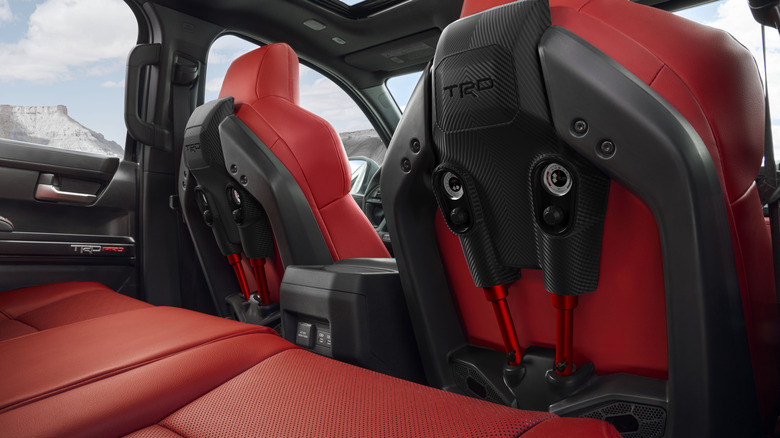
As for sound, the base Tacoma and Frontier come with four-speaker sound systems. The Frontier SV, PRO-X, and PRO-4X trims come standard with six speakers. In the Tacoma, six speakers are only available from the TRD Sport and TRD Off-Road trims onward. Tacoma's optional 10-speaker system is from JBL, while the Frontier has a Fender-branded stereo. A standout feature of the latest Tacoma is its IsoDynamic Performance Seats, available in the TRD Pro trim. These cool-looking chairs have a built-in suspension system that takes the edge off sharp, uneven terrains.
Safety tech and ratings
All 2026 Tacomas are equipped with Toyota Safety Sense 3.0 as standard, which includes a pre-collision system with pedestrian detection, lane departure alert with steering assist, full-speed range dynamic radar cruise control, lane tracing assist, road sign assist, automatic high beams, and proactive driving assist.
Meanwhile, a blind spot mnitor with rear cross-traffic Alert is standard on all Tacoma models except the entry-level SR, where it's available as part of an option package. The Frontier has these systems even in the base S trim, alongside lane departure warning, high beam assist, rear parking sensors, and intelligent cruise control. However, the Frontier lacks the Tacoma's steering assist functions. Thus, the Frontier's system is level 1 of automated driving, with the Tacoma being in the more automated level 2 tier.
As for passive safety, the Nissan comes with two dual-stage front airbags with knee bags, two side airbags for the front passengers, a rear side-impact airbag, and an airbag curtain for the two seating rows. The Toyota has a similar number of airbags, though in the XtraCab the curtain airbag only covers the front seats, because there is no bench at the rear. The airbag curtain in the Double Cab also covers the rear seats.
The National Highway Traffic Safety Administration has awarded the current-gen Tacoma a 4-out-of-5-star rating. The truck received three stars for frontal impact, five for side impact, and four for rollover resistance. The NHTSA also gave the Frontier an overall 4-out-of-5 rating, with Nissan's truck receiving three stars in the frontal crash, five in a side crash, and a lower three-star rating for rollover resistance.
Long term reliability ratings
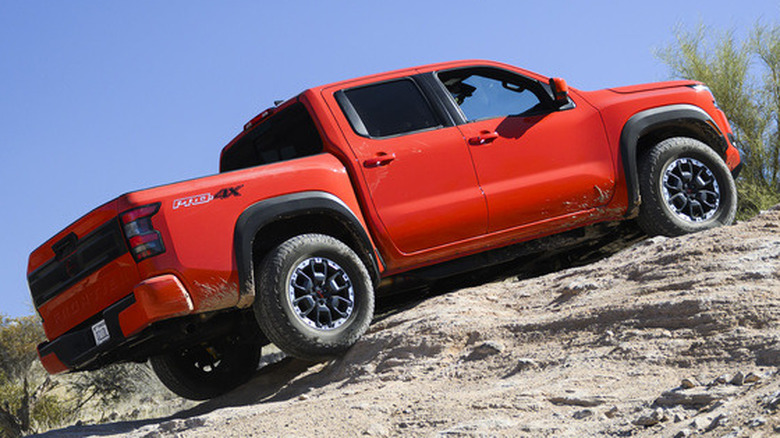
Toyota Tacoma owners rate older generations as very reliable, including the last generation equipped with the bulletproof 3.5-liter V6 (2GR-FE) engine. Toyota went the turbocharged four-cylinder route with the latest Tacoma, which usually results in worse reliability. However, the new engine has an aluminum block and head, alongside port and direct injection, which should minimize carbon buildup compared to an engine with just direct injection. And early in its lifecycle, the T24A-FTS engine had not had a recall, unlike its 3.5-liter twin-turbo V6 cousin, which has been a reliability nightmare.
RepairPal gives the Tacoma a 3.5-out-of-5 reliability rating, but that also includes the older V6-powered model. The Frontier, meanwhile, has a higher 4-of-5 rating on RepairPal. According to the platform, the Frontier has a lower probability of major repair of 12%, compared to 17% for the Tacoma. The VQ38DD V6 engine in the latest Frontier is known for being very reliable, though YouTuber I Do Cars uncovered what he calls a "fatal" issue with the water pump that could leak coolant in the crankcase.
Still, Nissan torture-tested the Frontier V6 for an equivalent of 130,000 miles of real-world driving and said it couldn't find any issue with the engine. The test included a 100-hour test at maximum load and maximum engine speed, and Nissan said the VQ38DD passed with flying colors. Like its Tacoma four-cylinder rival, Frontier's 3.8-liter V6 has an aluminum block and head, but it only uses direct fuel injection.
Resale value
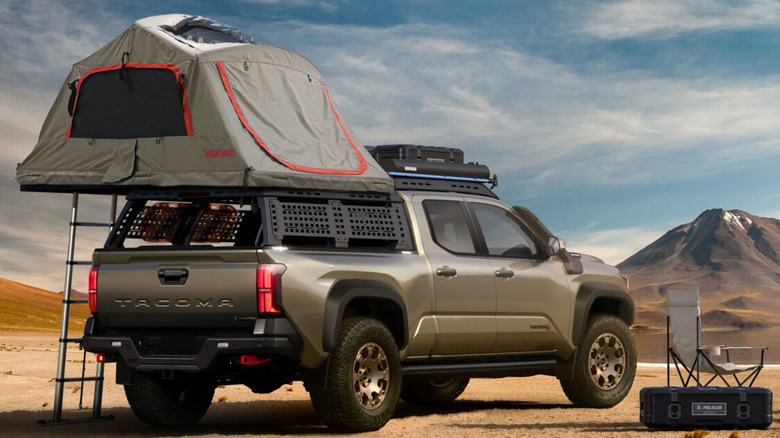
According to CarEdge, the Nissan Frontier will depreciate 37% over five years. The reliable V6 engine might help the new Frontier in the long run, but Nissan's truck still loses more value in the long term than its Toyota rival; CarEdge reports that the Tacoma depreciates only 22% over five years, among the lowest figures in the industry.
In fact, iSeeCars rated the Tacoma in fourth place among all cars in its 2026 five-year depreciation study. The Tacoma finished in first place among all pickup trucks, with an average five-year depreciation of just 19.9%, or a $6,426 difference from the manufacturer's suggested price. Meanwhile, the Frontier finished in sixth place among pickups with a depreciation of 35.5%, which accounts for $11,410 off the MSRP.
Apart from the Toyota Tundra (21.2%), no other pickup truck had a depreciation lower than 30%, showing that Toyota's trucks are still the most sought-after as used vehicles. So while the Frontier wins the upfront budget game, the Tacoma is more of a financial safe haven that should be cheaper in the long run.
The Tacoma and Frontier come with identical three-year/36,000-mile bumper-to-bumper warranties and five-year/60,000-mile powertrain warranties. However, Toyota offers complimentary maintenance for two years or 25,000 miles, and 24-hour roadside assistance. Nissan doesn't.
Ease of maintenance
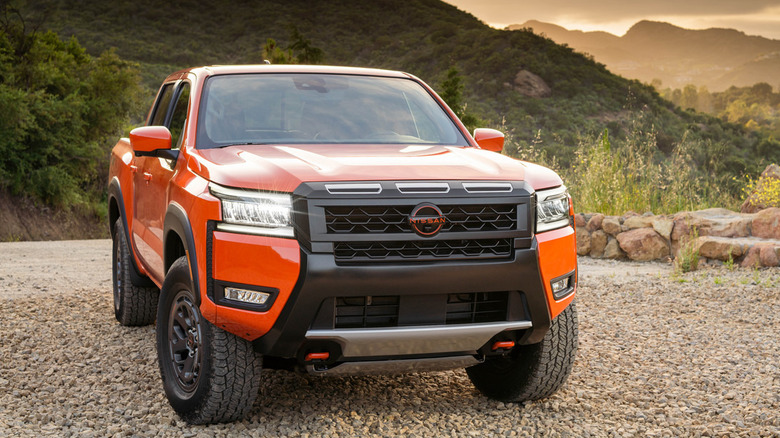
That the Frontier's V6 has no turbocharger and intercooler should, in theory, make it easier to maintain than the Tacoma's more complex 2.4-liter turbocharged engine. However, according to Team Oil Drop, the four-cylinder engine is incredibly easy to work on. The spark plugs are easier to reach than on the older V6 engine, and the spin-on oil filter is positioned right where you want it when changing the oil. The transmission and transfer case are easy to reach, too. As a bonus, the latest Tacoma has electronic power steering, so you don't need to worry about any power steering fluid.
However, that doesn't mean the Frontier is a headache to look after. A Workz Garage video showing a routine oil change on the 2025 Frontier makes it seem easy, too. Once you remove the protective off-road gear, the oil filter is easy to reach with a wrench, with a drip rail making sure it goes right into the container. Same for the oil drain plug, which is easy to reach from the underside. That said, replacing the spark plugs on a V6 engine is generally more difficult than on an inline-4.
As for expenditure, CarEdge estimates that the Frontier will cost around $9,190 for maintenance and repairs over 10 years. Meanwhile, CarEdge says the Tacoma should cost about $6,932 to maintain and repair.