

10+ Seat Vehicle Options When A 9-Seat SUV Won't Do
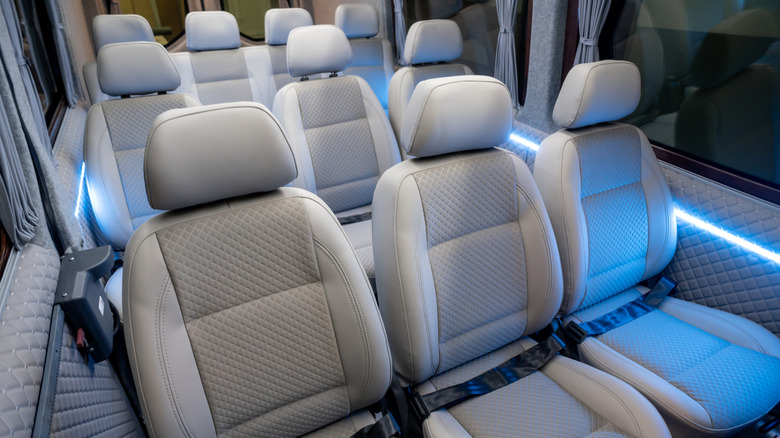
Despite their enormous size, even the SUVs with the most spacious third rows fall short when it comes to really maximizing passenger capacity. Those choices generally hold a mere eight people in total, and the sport‑utilities most commonly available on the market with room for nine are the Chevrolet Tahoe and Suburban. In today's marketplace, finding a ride with at least 10 seats basically means shopping for machines like a full-size passenger van, an international minivan, a stretched version of a smaller vehicle, or a bus — and, technically, if you need anything more than 10 seats, you're limited to the latter.
That's because the Federal Motor Vehicle Safety Standards define a bus as any "motor vehicle with motive power, except a trailer, designed for carrying more than 10 persons." The differences generally come down to different engineering and safety standards for vehicles with Gross Vehicle Weight Rating (GVWR) of less than 10,000 pounds vs. more than 10,000 pounds. On the topic of watching your weight, you may also have to consider GVWRs for the largest of these options. Here in the U.S., states may require a CDL to drive a vehicle that tops 26,000 pounds in that measure, and some big buses will exceed that limit. So be sure to check the rules of the road in your state — or any state you'll be driving through — for details on licensing requirements. And you can check below for five of our favorite alternatives with double-digit seating capacities.
Chevrolet Express
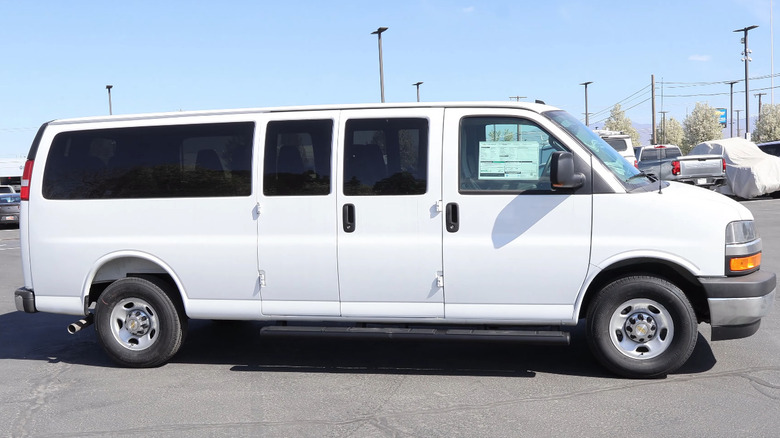
Looking for a brand-new vehicle built with old-school strength? Now, some people may be surprised it's still in production — and it is pretty much the same as the model that debuted 30 years ago — but the 2026 Chevrolet Express could be a great place to start. The van's starting price is $50,345 (including a $2,395 destination charge), and that gets you 12-passenger seating, air conditioning, and power accessories — and not much else. Some important upgrades are available, though, including modern ADAS systems such as forward collision warning, side blind-zone alert, and lane departure warning. On the other hand, the standard infotainment setup is a two-speaker AM/FM radio, and Bluetooth is optional. A touchscreen with Apple CarPlay, Android Auto, and a Wi-Fi hotspot is not standard. In fact, even steering wheel controls are off the menu.
Where the Express really shines is in the muscle department. The van is built on a truck-style ladder frame made from high-strength steel and offered in 2500 and 3500 configurations — similar to the Silverado HD 2500 and 3500. As a result, the extra-large Express, with an extended wheelbase, 15-passenger seating, and a 401-horsepower V8, can boast a GVWR of 9,900 pounds. Notably, that's in addition to up to 3,540-pounds of payload capacity.
Folks who prefer to put a Professional Grade spin on the Chevy's list of attributes can opt for the GMC Savana, too. Except for a few cosmetic details, it's essentially the same vehicle as the Express, right down to its starting price.
Mercedes-Benz Sprinter
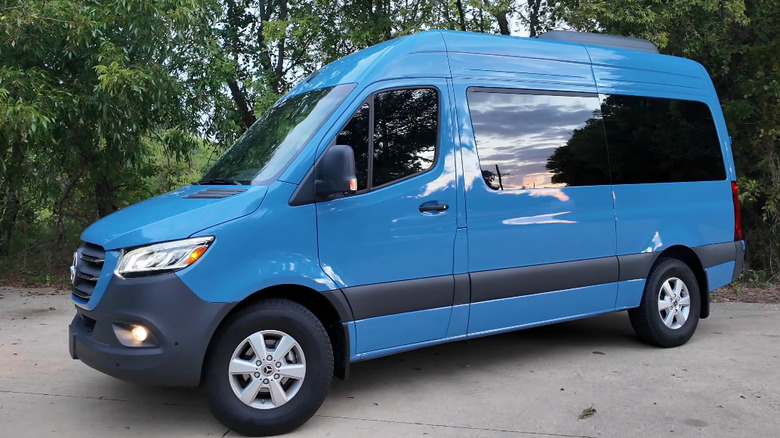
At the other end of the spectrum is the 2026 Mercedes-Benz Sprinter. To be clear, the next-generation model will be even BOuLDER, but the current version certainly lives up to its positioning as the Mercedes-Benz of full-size passenger vans — and that's especially the case with the Sprinter Select. To an already long list of standard features, it adds lux amenities like a heated comfort-style driver's seat, a leather-wrapped steering wheel, an upgraded overhead control console, and high-performance LED headlights with adaptive high beams.
Like the Express, the Sprinter is sold in 12- and 15-passenger layouts, on two separate wheelbases, but Mercedes-Benz goes its own way under the hood. There, the standard and only engine is a 2.0-liter turbodiesel I4 — again in two setups. The regular mill makes 170 horsepower and 295 pound-feet of torque, while the high-output motor delivers 211 hp and 332 pound-feet of torque. The Sprinter further extends its range with an available all-wheel-drive system that's lacking on the Chevy.
This is a high-tech passenger hauler as well. Beyond a smorgasbord of safety systems, Mercedes-Benz can make staying connected easy with an available MBUX infotainment system bundling a 10.25-inch touchscreen, a digital driver display, an intelligent voice-activated cabin assistant, Wi-Fi compatibility, Android Auto/Apple CarPlay, and a Wi-Fi hotspot. Of course, stepping up to a Sprinter does come with a price: the MSRP of the base van is $56,930, with the Select trim checking in at $64,780. Destination charges for either require an additional $2,295.
Checker Aerobus
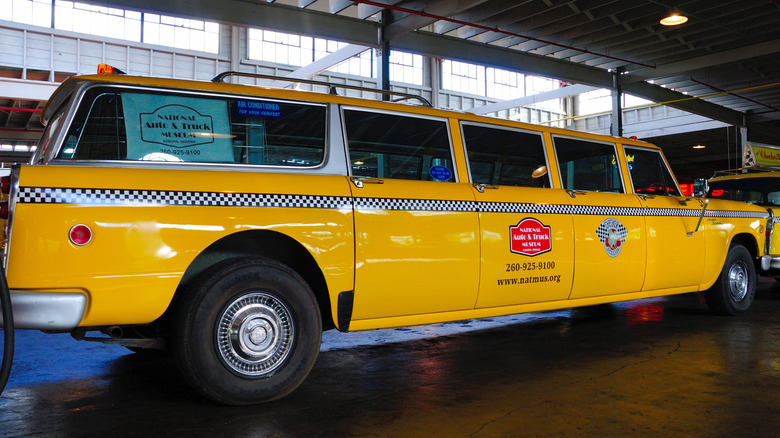
With all apologies to the Chevy Express, the Checker Aerobus stands out as a true blast from the past. A stretched version of Checker's classic taxi cabs and originally envisioned as an airport shuttle/low-cost limousine, the Aerobus was in production from 1962 to 1977. Examples still pop up on occasion, however — one sold at a Hagerty auction in the spring of 2026 for a relatively affordable $29,425.
True, you'll look in vain for any sign of modern goodies in these machines, unless they've been added from the aftermarket. But the Aerobuses more than make up for any lack of creature comforts with their unforgettable style. After all, the overall look isn't much different from that of the Checker A8, which premiered as a new taxi design in 1956 — except for their size, that is.
There were actually multiple variants of the Aerobus in the form of both sedan and wagon body styles that had been extended by either 34.5 or 69 inches. The former was for the three-row, six-door Aerocab, and the latter upsized the package to four rows, eight doors, and a seating capacity of up to 12. Plus, the wagon models had space left over to carry the passengers' baggage. The Aerobus was upgraded under the skin as well. Its appearance may be right out of the regular Checker lineup, but the Aerobus was distinguished from traditionally sized models with a unique frame and heavy-duty suspension specifically engineered for more robust use. One is still in use as a shuttle for some visitors to Glacier National Park, known for its famously scenic drives.
Hyundai Staria
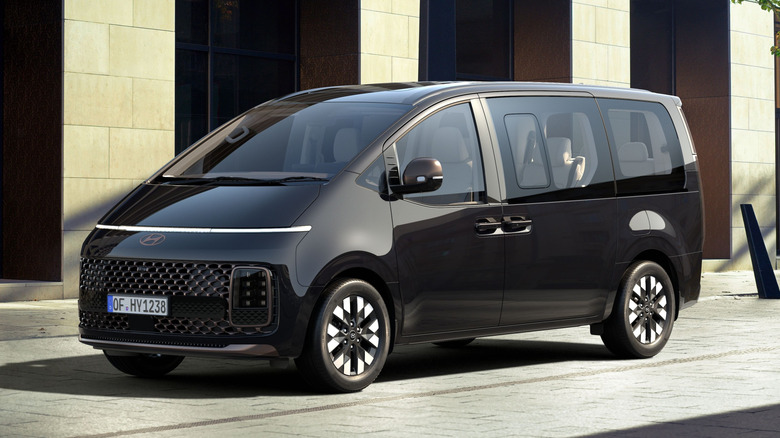
No matter how many great vehicles are sold in their own countries, auto enthusiasts tend to have a soft spot in their hearts for those that are not. For instance, Hyundai introduced its futuristic-looking Staria compact van back in 2021 that we thought would be a good fit here, but the automaker disagreed -– and hasn't changed its corporate mind in the years following. This means you'll have to find a way to import a Staria if you want one, although you will get an 11-seat minivan with an exotic exterior in the process. For what it's worth, there's an international 11-seat Kia Carnival on the same platform, albeit without the same far-out appearance.
As for the Staria, it makes good use of its interior space. There are 36 inches of legroom and 39 inches of headroom even in the fourth row. The third row of the Tahoe, by comparison, is listed at 34.9/38.2 — even though Chevy's big SUV is about 3.5 inches longer overall. The trade-off is that the Tahoe retains 25.5 cubic feet of cargo space behind the third row, while the Staria 11-seater appears to have about 0 cubic feet of storage behind its final row.
The Staria also doubles down on engine choices. Owners can choose between a 3.5-liter V6 with 268 horsepower and 244 pound-feet of torque or a 2.2-liter diesel serving up 175 horsepower and 318 pound-feet of torque. Even better: Hyundai is among the brands still selling manuals in 2026, and the Staria offers one.
AEC Routemaster
Indeed, the Hyundai Staria would be categorized as a bus in this country because it has more than 10 seats. With that in mind, why not consider the real thing? Yes, they can be expensive. Big-budget shoppers will discover that even a high-end pre-owned model, such as a 2024 Mercedes-Benz Tourrider Lux, is more than halfway to a million bucks — $519,000, to be exact. School buses can be a more affordable solution, although they might not bring back the best memories for everyone and haven't changed much since 1939.
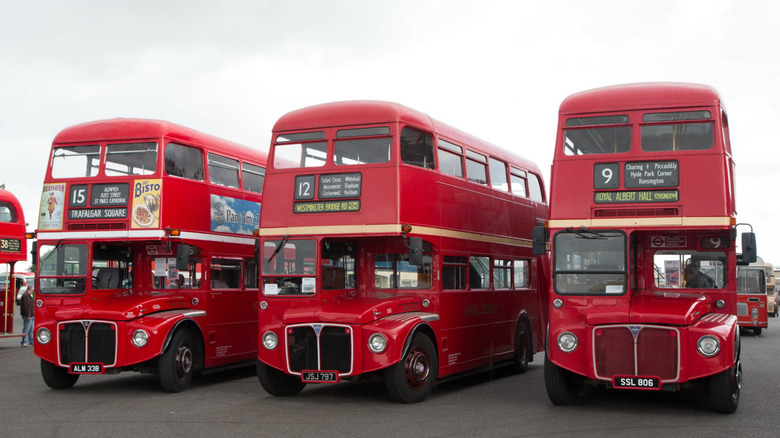
That's why we suggest an international icon called the AEC Routemaster. Jalopniks from the U.K. will likely be familiar with these long-lasting double-decker buses, which first went into service in London in 1956, remained in production through 1968, and were in regular use right up until 2005. Indeed, the last of the original Routemasters didn't stop picking up public passengers until 2021. Speaking of which, common variants of the bus could hold 64 to 72 people in total, with between 28 and 32 passengers on the ground floor and 36 to 40 in the penthouse.
The Routemasters were also fairly innovative for their time. Power steering, power-hydraulic braking, a fully automatic transmission, and an independent front suspension all made their bus-industry debuts on the vehicles. Nor are they all that expensive to buy. A pair of 1966 Routemasters recently went up for sale, with each listed at around $55,000.