

Do CVTs Still Deserve Their Reputation As Failure-Prone Transmissions?
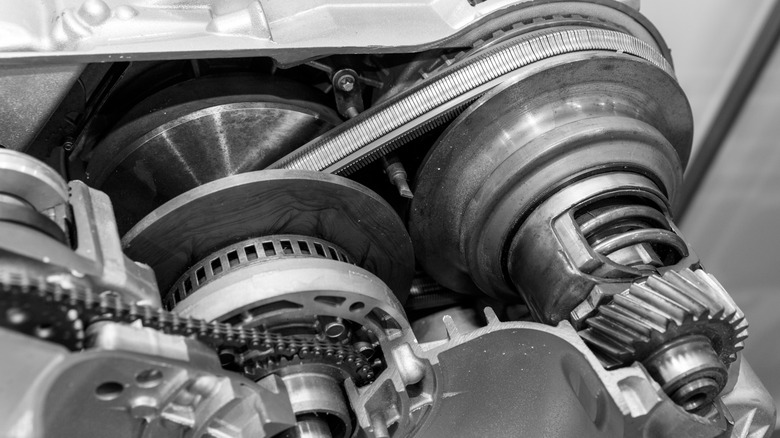
Watching Jason Fenske (from Engineering Explained) explain e-CVTs unearthed a profound appreciation for modern-day CVTs, or continuously variable transmissions. And to be fair, he has a point — the CVT hate is way overblown and borders on irrational. While the traditional belt-pulley CVTs are perhaps not as sophisticated as modern e-CVTs that rely on planetary gears and electric motors, the transmission technology — with its infinite gear ratios — has come a long way since you perhaps first saw it in the Subaru Justy.
There is a case for the CVT's reputation as a failure-prone transmission, as Nissans and Subarus from the mid-2010s were plagued by complaints about CVT failures, to the point that Consumer Reports cautioned car shoppers about certain used models notorious for their transmission woes. Although the frustration was curbed to some extent through class-action lawsuits and extended warranties, there is still skepticism surrounding Nissan CVTs, evidenced by these Nissan forum discussions and Reddit threads. It's worth noting that CVTs found in Hondas, Toyotas, and many modern Subarus are generally more reliable.
In fact, going through Consumer Reports' best cars of the year list for 2025 and 2026 reveals that many of these vehicles come equipped with either traditional belt-and-pulley CVTs or newer e-CVT setups, depending on their respective powertrains. While both lists were dominated by Honda, Toyota, and Subaru, the best small car of 2025 happened to be the Nissan Sentra, which comes with an X-tronic CVT. So, modern CVTs are not as unreliable as you may think. After all, CR's methodology factors in predicted reliability and owner satisfaction.
Modern CVTs are not bullet-proof, though

Understand that no matter how good transmissions get, they aren't immune to failures, especially if poorly maintained. As Consumer Reports points out, upkeep is crucial, and following the manufacturer's recommended fluid change intervals is essential for maximum longevity. If you understand how a CVT works, you'll know that the metal belt/chain and pulleys rely on the fluid for lubrication and cooling. Once that fluid degrades, you're looking at increased wear and heat buildup, which normally doesn't end well if ignored for far too long.
Typically, the recommended CVT fluid change intervals for cars range between 30,000 and 60,000 miles, depending on the make and model, among other factors. If you experience shuddering or delayed acceleration, slipping under load, or loud whining sounds, chances are your CVT fluid is due for replacement. But what if you have one of those sealed transmissions with lifetime fluid? First of all, don't fall for that marketing ploy, says Scotty Kilmer in his YouTube video. As Valvoline puts it, no fluid is immune to oxidation and thermal breakdown, regardless of how superior its chemical composition is. However, changing the fluid in these kinds of transmissions is not as easy as those that have a traditional dipstick. Something else worth noting is that ATF and CVT fluids are different — you don't want that mix-up. Unlike ATF, CVT fluids are often formulated with additional friction modifiers to ensure proper belt engagement.