

What Happens If The Battery Dies In A Car With No Manual Hood Release?

Few things threaten to ruin a driver's day faster than a dead battery. Whether you're headed to work in the morning, running errands, going out to the movies, or about to start a road trip, a dead battery will stop you, well, dead in your tracks. This has been a problem since Cadillac introduced the electric starter in 1912, and it's not going away any time soon. Even electric cars still rely on 12-volt batteries to operate, since this low-power battery is used to control many basic systems, especially while the car isn't in use.
So even with an electric car, a dead battery means no remote unlocking, no lights, no radio, and no power doors and latches. But what happens, you might ask, if you have a car with a power hood release and the battery dies? How can you get to the 12-volt battery to charge it? Much like stick drivers should know how to drive when their clutch pedal fails, drivers of gas and electric cars alike need to know how to access the battery without a manual hood release.
Unfortunately, some cars — like the Audi e-Tron GT in this video from ActuallyVen — don't make it easy for you to access the battery once it's dead. If you find yourself without a manual hood release and with a dead battery, you'll need to route power from another source to the release button long enough to pop the hood or get access to the manual release cable itself.
Check the owner's manual first

When you find yourself with a dead car battery and no way to get under the hood to jump it, the first step is to take a couple of deep breaths and try to keep calm. Yes, the situation is obnoxious, and yes, it may make you late to wherever you were going, but you're not going to solve any problems without being clear-headed.
The next step is to check the owner's manual. If you don't have access to the physical copy, you can typically find any vehicle's manual online by searching your year, make, and model with the keywords "owner's manual." Some vehicles' manuals, such as the Tesla Model 3's, will give you step-by-step instructions for getting the hood open. Despite Tesla's battery-related door malfunctions leading to several post-crash deaths, it at least offers instructions for what to do when the battery dies and you're not trapped inside. Detailed instructions on how to manually open the hood aren't guaranteed, though.
Hood hacking 101
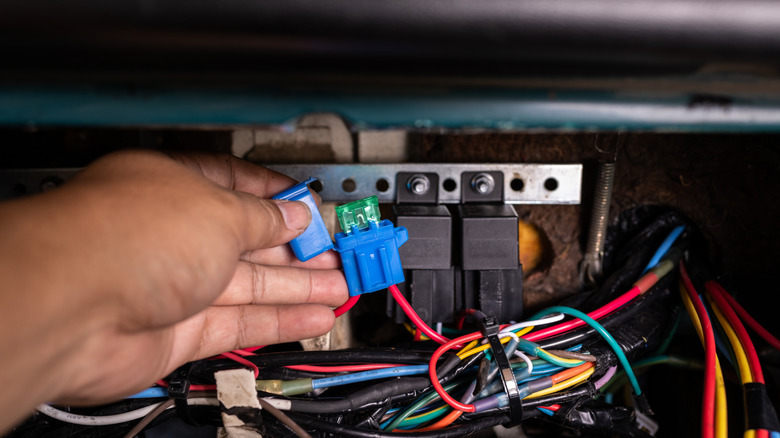
If the owner's manual isn't any help, you'll either need to take matters into your own hands or call for professional help, which will be more expensive but also safer. To get power to the hood release on your own, you'll either need to introduce power to the starter or to the release directly through the fuse box. Accessing the starter involves safely lifting the car and going in from underneath. Fortunately, there's almost always a fuse box in a car's cabin, making this the less labor-intensive route.
When you've located the starter or opened the fuse box, you'll connect the positive clamp of a 12-volt battery charger to the positive post, which will be indicated on the fuse box diagram. Then ground the charger's black, negative clamp by hooking it on any accessible bare metal, and let the charger do its thing. After a while, there should be enough power for the power release button to function properly and open the hood. If the car's alarms start going off, you know you're on the right track. Once you've popped the hood, safely disconnect the charger by removing the ground cable followed by the positive cable, then close up the fuse box.
It's also possible to manually access the release cable and pull it yourself, but this process is much more involved and is only recommended when all else fails and professional help is unavailable. However you manage it, once you're inside, you'll need to determine if you need a new battery or just a jump. But either way, you won't need to MacGyver your way under the hood again, as long as you keep the hood propped open. No matter what your next step is, that should save you a whole lot of time.