

Here's What Happens When A Hybrid Car's High-Voltage Battery Runs Out Of Power

You're driving on the highway in a hybrid car, and all of a sudden, your dashboard lights up, warning you that your high-voltage battery is dead. Maybe it's because you have been ignoring the "check hybrid system" warning for a while, or simply because curiosity got the better of you and you decided to find out how many miles you can truly cover before your battery dies out. Well, now you have found out, and your battery is dead. So what happens next? Is your Prius now just a very expensive paperweight? Can you just keep driving on the internal combustion engine alone? The answer is complicated, expensive, and involves a lot of software-related headaches.
The first thing you need to understand is that a hybrid isn't just a gas car with a battery support. Both are in a co-dependent relationship and need one another to perform optimally. In fact, hybrid cars continually charge their batteries while driving. The engine and regenerative braking will usually keep the high-voltage battery charged while driving. However, if the battery dies or fails, it will force the car into limp mode where the engine control unit (ECU) effectively cuts power and limits speed to protect the car's sensitive electrical components from further damage.
It's a bit different if you're driving a plug-in Hybrid (PHEV). With a dead high-voltage battery, you'd expect the car to seamlessly transition to gas-only mode. However, most hybrids — including PHEVs — use a motor generator instead of a starter motor to start the gasoline engine, and instead of the 12V battery used in smaller hybrids, this generator is powered by the high voltage battery pack. So, if a hybrid stalls, there is no way to start it again.
The 12-volt battery and transmission depend on the high-voltage battery pack
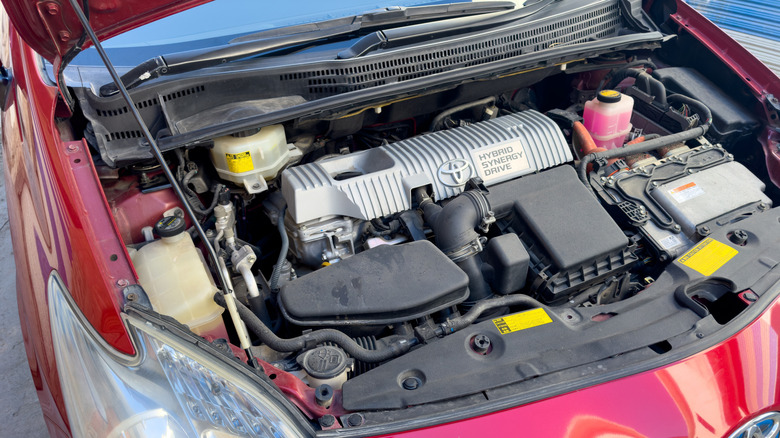
Your high-voltage battery has failed, and you're probably thinking that you still have the 12-volt auxiliary battery -– the one that runs your infotainment systems and lights. However, in a hybrid, the high-voltage main battery pack and the low-voltage 12V auxiliary battery are interconnected. While the 12V battery is needed to start the computers, it's the high-voltage battery that keeps the 12V battery charged through a DC-DC converter.
When the high-voltage battery kicks the bucket, there is no way to charge the 12V battery. It will run the car's electronics for a short while, but once it runs out, you lose power to your car's accessories — the power steering becomes heavy, you lose brake assist, and your dashboard goes dark. It is the point where the situation shifts from inconvenience to a serious safety hazard.
Theoretically, you should be able to drive your hybrid on ICE (internal combustion engine) power alone while the 12V battery still has charge. Here's the kicker, though. Some hybrids simply won't start or will move slowly because they need the electric motor for the initial grunt. If the battery can't provide enough juice, you are out of luck. The other reason you can't drive a hybrid on ICE power alone is that, in cars like the Toyota Prius, the gas engine and electric motor are linked via an eCVT, which is different from a traditional CVT. The car's computer uses electric motors to manage the gear ratios and provide torque. Without electricity, you can't power the motors, and the transmission is unable to send power to the wheels.
Repairing a high-voltage battery can be a financial nightmare
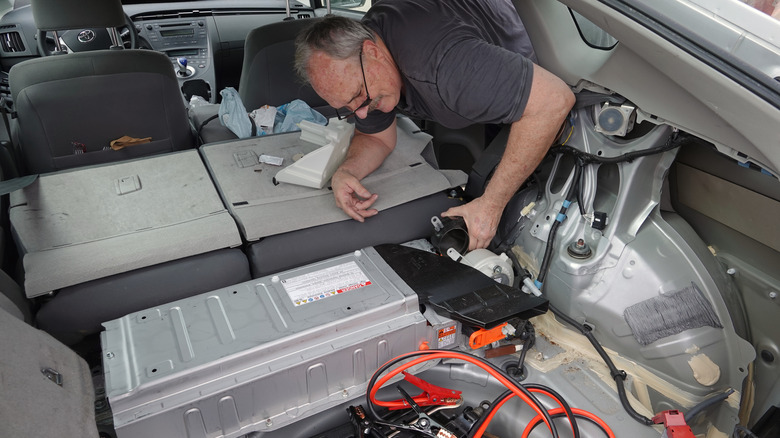
Somehow, you manage to tow your dead hybrid to the dealership (pro-tip: don't jump-start a hybrid car). Now the financial nightmare begins. Repairing a high-voltage battery isn't as easy as swapping a spark plug. You could be looking at a bill that could rival the price of a used car.
If the battery is truly dead, meaning the cells have failed, a full battery replacement is needed. A battery pack for a hybrid can cost anywhere from $2,000 to $8,000, depending on the make and model. That's a lot more expensive compared to a mild-hybrid car battery, and, for a car that's 10 years old, that could be more than the car is actually worth. You are essentially staring down a total loss scenario just because of a dead battery. While you do have the relatively cheaper option of using refurbished batteries or reconditioning the battery, these are labor-intensive and require specialized workshops.
However, if you luck out and your battery is simply deeply discharged, you might escape the four-figure financial nightmare, though it will still be expensive. A standard jump start usually won't fix a bricked high-voltage pack. If you own a PHEV, plugging in and charging the battery will usually solve the issue if the battery isn't bricked. Dealerships or specialized shops use a dedicated high-voltage charger to charge the battery pack from the grid. This service typically runs between up to $1,000 in labor and equipment fees. It's a steep price for a recharge, but a bargain compared to a $5,000 battery replacement.