

What Are The Biggest Differences Between Honda's Passport And Pilot SUVs?
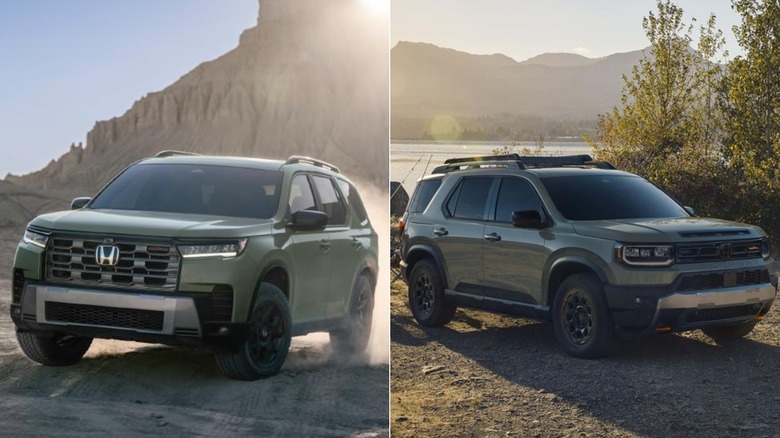
Honda is no stranger to cranking out stupid-popular SUVs. The CR-V alone has racked up over 15 million sales globally since its 1995 debut. Today, they're about as commonplace on U.S. interstates as shredded semi-truck tires and wild stories of road-rage buffoonery.
Comparatively, the Honda Passport and Honda Pilot have stayed under the radar. They've each staked a respectable claim in the midsize crossover market, but they're not quite as ubiquitous as the smaller Honda utes, and nor are they as visually flashy as segment rivals like the Kia Telluride. As a result, Honda's chonkier SUVs can come across as a bit anonymous in a crowded class.
Unless you've got a trained eye, it can even be tough to distinguish the two vehicles apart from a distance. This isn't too surprising, given that both SUVs share a platform, a ton of mechanical components, lots of tech and active-safety features, and some fundamental design cues. But the current-gen Passport and Pilot are still two different animals, despite their shared underpinnings. Each one caters to different needs and wants, and each is trying to tap into different demographics. So, what are the major differences between these two Hondas?
Pilot vs. Passport: Different specs, different vibes
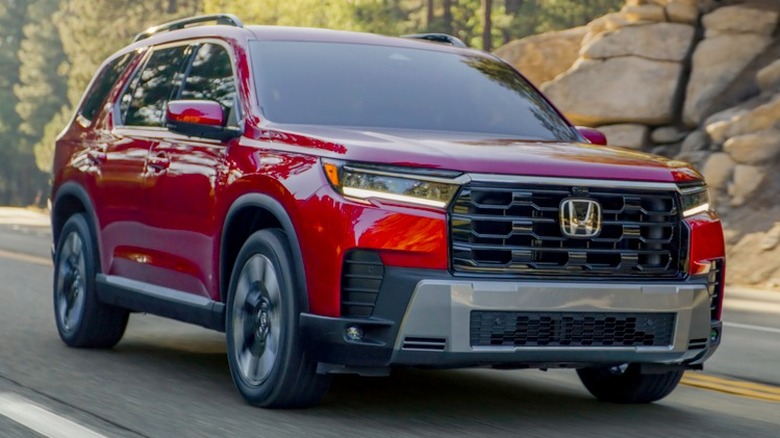
While the 2026 Pilot and 2026 Passport have a similar wheelbase, the Pilot measures 200.1 inches in length and the Passport is markedly shorter at 191.5 inches. Despite this, the Passport looks decidedly more aggressive and truck-like than the Pilot, thanks to a higher standard ground clearance, chunkier, blacked-out fender flares, a prominent hood scoop, wider C-pillars, and a blockier front fascia — all topped off with a massive "Passport" lettering stamped into the bottom of the rear liftgate. By contrast, the Pilot adopts a slightly sleeker appearance owing to a leaner, curvier profile, more angular headlights, and less in-your-face model badging. Interestingly, the the Pilot has a chunkier grille than the Passport, but otherwise, the latter model is more visually striking. Which one is better looking? That's your call.
Next, let's get into performance. The Passport comes standard with all-wheel drive and a 5,000-pound towing capacity, while the Pilot gets standard front-wheel drive and a base towing capacity of 3,500 pounds. That said, the Pilot can also pull 5,000 pounds if you pay extra for all-wheel drive. Owing to its shorter length, the Passport handles a bit better than the Pilot, but the Pilot's softer-tuned suspension makes it superior in terms of rider comfort.
In terms of fuel efficiency, the Pilot posts the best ratings of the two SUVs. It achieves an EPA-estimated 19 mpg in the city and 27 mpg on the highway with front-wheel drive (25 mpg on the highway with all-wheel drive). The Passport is rated at 19/25 mpg city/highway, but this also factors in the SUV's standard all-wheel-drive setup. If you select the more rugged TrailSport trim with either SUV, expect a less-impressive 18/23 mpg city/highway, per the EPA.
Which Honda midsize SUV is best for you?
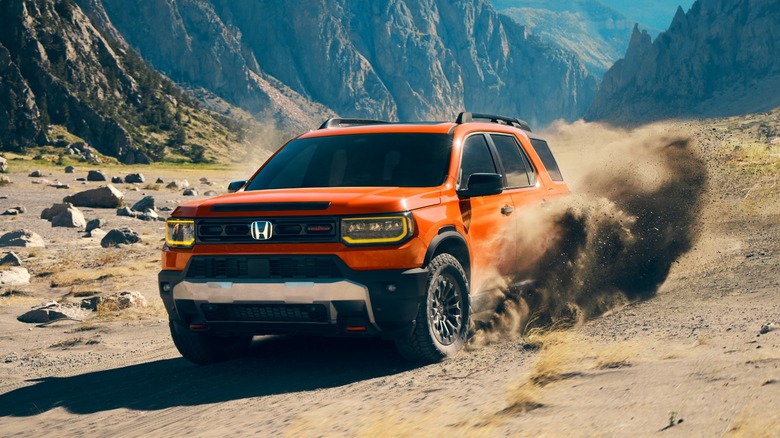
Inside, the Pilot and Passport share a similar center-stack layout, tech, comfort amenities, and styling — but the similarities mostly end there. For starters, the Honda Pilot provides seating for up to eight people across three rows, while the Passport can only handle five occupants at once. The Pilot also has more cargo room, offering up 18.6 cubic feet of space behind the third row, 48.5 cubic behind the second row and 87 cubes behind the front seats. The Passport serves up 44 cubic feet of cargo room behind the back row, which expands to 83.8 cubic feet with the back seats folded down.
Finally, we arrive at pricing. The 2026 Pilot starts at $42,395, which undercuts the 2026 Passport's base price of $44,950 slightly. On the other hand, the priciest Pilot ($55,195) tops the most expensive Passport trim ($53,850). So which one is best for you? While there's no substitute for checking out these SUVs in person to decide, we can draw a few conclusions based on how these two Hondas diverge.
The Honda Pilot, with its superior cabin and cargo space, and three rows of seats, is the better option if you'll regularly be ferrying around large groups of people and their stuff. With more crossover-like styling and a lower base price than the Passport, the Pilot is definitely the more suburbia-coded, family-centric SUV of this pairing. On the other hand, the Passport is great if you want a practical daily driver that's also capable off the beaten path. It doesn't provide as much interior space or as many seats as the Pilot, but if you prefer your SUVs bold, chunky, and off-road-ready (while still quite civil to drive on pavement), the Passport is probably the better bet.