

2027 Mercedes-AMG GT 4-Door Coupe EV Is A 1,153-HP Showcase Of What Electric Performance Cars Can Do
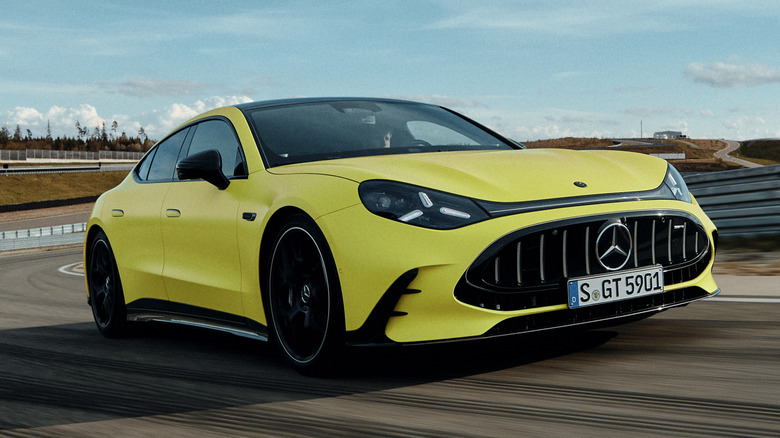
When Mercedes-AMG revealed the Concept GT XX last June, it said the four-door EV was a close preview in both design and actual performance and technology to the next-generation AMG GT 4-Door Coupe that was on the horizon. A month after the concept's reveal, it proved as much when real-life prototypes set a record for driving around the world in less than 8 days. Now we're seeing the fruits of AMG's labor, as Mercedes has unveiled the 2027 AMG GT 4-Door Coupe in all its glory and, uh, fishiness. Because it does kind of look like something that crawled out of the ocean. In a fun way, I think.
The electric GT 4-Door rides on the electric AMG-specific AMG.EA platform, has a tri-motor setup with up to 1,153 horsepower on offer, faster charging than any station in the U.S. can even deliver, wild active aerodynamics, a high level of customizability for the driving dynamics, and a system called AMGFORCE that "delivers a highly authentic, signature AMG V8 sound combined with an immersive haptic experience" that includes simulated gear shifts. There is truly a lot of substance here — essentially, the 2027 Mercedes-AMG GT 4-Door Coupe is a fantastical showcase of what electric performance cars are able to do right now.
Axial-flux motors are finally here
Mercedes has been talking about axial-flux motors for a few years now, acquiring British company YASA in 2021, and the new AMG GT is the brand's first production car to use them, with both the GT55 and GT63 getting one motor on the front axle and two on the rear axle, like the Lucid Air Sapphire. Compared to more typical permanent magnet synchronous motors in existing EVs, axial-flux motors are smaller, lighter, more power-dense and capable of repeated performance in quick succession. If you want to get really nerdy, here's what Mercedes' release says:
In an axial flux motor, the electromagnetic flux runs parallel to the motor's axis of rotation. In a conventional electric motor, it runs perpendicular to the axis. Key components of the axial flux motor are designed as thin discs: two rotors enclose the stator like a sandwich on the left and right. This arrangement – also known as an H-configuration – allows optimal coupling of the magnetic flux generated by the stator to the rotors. In the new Mercedes-AMG GT 4-Door Coupe, this combination at the front axle is approximately 3.5 inches wide; each of the two motors at the rear axle are approximately 3.2 inches wide.
The motors are integrated into a High Performance Electric Drive Unit (HP.EDU) on each axle. At the rear axle, the HP.EDU contains two axial flux motors, which are combined together with a compact single-stage planetary gearbox in a shared housing. The motors and gearboxes are oil cooled. The required Pump Control Unit, including hydraulic pumps and suction filters, is also integrated into the HP.EDU to save space. In addition, two water-cooled silicon carbide (SiC) inverters (one per motor) are used. The material properties of silicon carbide offer numerous benefits for demanding applications that require high voltages, high currents, high temperatures and excellent thermal conductivity. The axial flux motors reach more than 13,000 rpm at top speed.
The front HP.EDU comprises one axial flux motor, a spur gear transmission with integrated parking lock, a liquid-cooled silicon carbide (SiC) inverter and a Pump Control Unit. The front axial flux motor reaches more than 15,000 rpm at top speed. The front electric drive acts as a "booster motor," activated only when additional power or traction is required on the front axle. During steady state driving, coasting or under low load, the Disconnect Unit (DCU) decouples the front electric motor within milliseconds to maximize efficiency. During acceleration and recuperation, the DCU engages for optimal performance.
 Mercedes-AMG
The GT55 has a continuous output of 503 hp and 1,328 pound-feet of torque, with the peak of 805 hp coming in when launch control is used and the car has an 80% state of charge. It needs just 2.4 seconds to reach 60 mph and 8.7 seconds to hit 124 mp, both three-tenths slower without a 1-foot rollout. If that's not enough, the GT63 has 1,475 lb-ft of torque, 711 hp of continuous output and 1,153 hp of peak output. The GT63 will hit 60 mph in 2.0 and needs only 6.4 seconds to hit 124 mph, again both figures slightly slower without rollout included, making it comfortably Mercedes' quickest production car ever. Mercedes says the GT63 weighs in at 5,432 pounds, which is only a couple hundred pounds more than the current GT63 S E Performance PHEV.
Top speed for both models is 186 mph — that's how fast the GT XX was driving around Nardo. Mercedes says the car can handle more than 1,300 hp, so expect even more extreme models in the future. If you pull on both steering wheel paddles at once, a boost of 67 hp in the GT55 or 148 hp in the GT63 is deployed along with sharper throttle response, special sounds and tightening seatbelts. All that torque is fully variable between the axles, and the rear-motor setup means torque can also be distributed individually between each rear wheel. All of that torque control is done instantly and automatically based on the situation, driver behavior and weather, and the car can be driven in full rear-drive mode.
It charges very fast and goes pretty far
Both GT trims have an 800-volt battery pack with 106 kWh of usable capacity, developed with the Formula 1 team in Brixworth, England. The battery housing is part of the vehicle's structure for better crash safety, and the battery itself is integrated into the structure of the platform. It uses tall and slim cylindrical cells for faster and better heat dissipation, the NCMA cell chemistry was specially developed for this car, the new lighter cell housing is laser-welded aluminum, and it has a direct cooling system for each individual cell:
In total, 2,660 cells are used in the Mercedes-AMG GT 4-Door Coupe. The individual cylindrical cells are grouped into 18 laser-welded plastic modules. Here too, the focus is entirely on performance because the direct cooling of the cylindrical cells is integrated into the plastic modules to ensure optimum heat dissipation. A high-tech coolant based on an electrically non-conductive oil flows around each individual cylindrical cell, keeping it at the ideal temperature. The coolant passes through cooling channels in the modules, which are designed to provide uniform cooling for all cells. A special line system ensures all cells are evenly supplied with the cooling oil.
Heating the battery to its optimal temperature window happens quickly and precisely. Maximum power is available across a wide temperature range. The operating strategy is programmed so that maximum performance can be drawn from the battery, after which the direct cooling system reduces the temperature again. The intelligent thermal management controls the coolant temperature for each cell module exactly to the required value ("on-demand cooling"). As a result, even during spirited driving – with frequent acceleration (battery discharge) and deceleration (battery charging through recuperation) – the battery maintains its high performance capability. Effective direct cooling enables the battery, in combination with the cell design, to achieve its high continuous power density.
 Mercedes-AMG
All of that fancy battery cooling makes charging performance even better. Mercedes says the car can charge at more than 600 kW, something it has already proven to be possible in the real world with Alpitronic's latest fast-chargers — we've even seen the GT XX concept is capable of 1 megawatt charging, which there's no infrastructure for yet. That 600 kW is good enough to go from 10% to 80% in just 11 minutes, and 286 miles of range (on the European WLTP cycle) can be gained in 10 minutes of charging. It will come with an NACS port in the U.S., and the car can also be charged at 400-volt stations.
We don't have EPA range numbers yet, but on the WLTP cycle Mercedes says the GT55 has a range of 371 miles to 435 miles, depending on the wheel and tire choice, while the GT63 is barely worse at 370 to 432 miles. Mercedes also gives city ranges: 414-478 miles for the GT55 and 413-475 for the GT63. If I had to guess, I bet the longest-range versions of the GT will be rated at around 380 miles on the U.S. EPA cycle.
AMGFORCE sounds a lot more appealing than Salesforce
One of the new GT 4-Door's biggest showpieces is the AMGFORCE system that comes alive when the car is in Sport+ mode. (The other drive modes are Comfort, Sport, Race, Slippery, Eco and Individual.) The sound directly imitates that of the previous-generation AMG GT R coupe's twin-turbo V8, using more than 1,600 sound files with sample elements broken down into granular loops that are generated into a mix in real-time, matching how you're driving down to gear changes and "exhaust burble." There are more futuristic soundscapes in the car's other drive modes, and there are other noises like heartbeat pulses when you get in the car or lock it, a hum when charging and AMG One-inspired noises when using things like launch control and the boost. A Sound Slider function that can fine-tune what you hear.
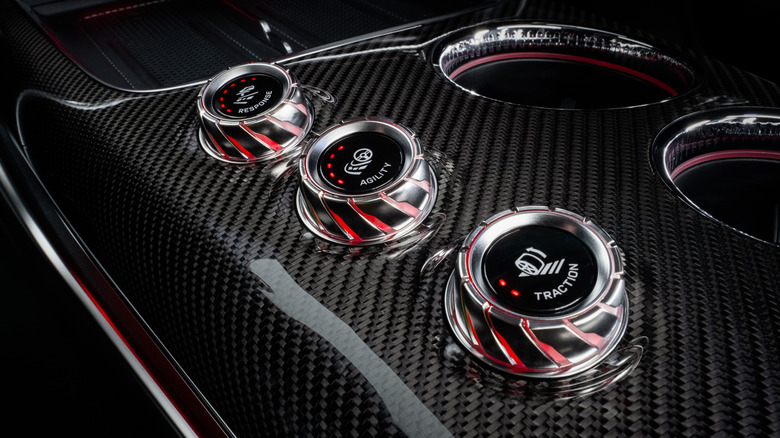
All of the dynamic systems are controlled by the AMG Race Engineer Core computer chip that Mercedes says is one of the most advanced and powerful on the market; the software was developed in-house by Mercedes. Standard on the GT63 are the Race Engineer Control Unit three chunky knobs on the center console that can heavily tune the car's driving characteristics. The Response Control knob adjusts the responsiveness of the electric motors and throttle pedal, going from "relaxed and comfortable to razor-sharp and highly dynamic." The Agility Control knob adjusts cornering behavior and agility around the vertical axis through variable torque distribution, from "slight understeer to neutral handling to controlled oversteer." Finally, the Traction Control knob does exactly what you'd expect. Each one of these controls is adjustable through nine different stages.
There's even more
So what else has this thing got? A multi-link suspension is used on both axles, with the front knuckles, links and uprights being made of forged aluminum. Air suspension with three levels of adjustability is standard on the GT55, but optional (and standard on the GT63) is AMG's Active Ride Control system that does without mechanical anti-roll bars, instead using active interconnected hydraulic elements in the dampers. An 8.2-liter pressure reservoir allows the car to quickly raise and lower, including automatically at speed, and there's minimal body roll and more precision when cornering.
Rear-wheel steering turns opposite of the fronts up to 6 degrees below 50 mph and parallel to the fronts up to 1 degree above 50 mph, controlled by a central electromechanical steering actuator. In AMGFORCE Sport+ mode, the rear-steer is quicker and more direct at low speeds. Carbon-ceramic brake discs are standard in front, but the rears are steel, which Mercedes says is "a needs-based and weight-optimized" setup. The company promises the brake pedal feel is consistently precise and adjustable no matter if braking is being done through recuperation, the physical brakes or both; levels of regen are toggleable with the steering wheel paddles independent of drive mode.
Beauty is in the eye of the beholder
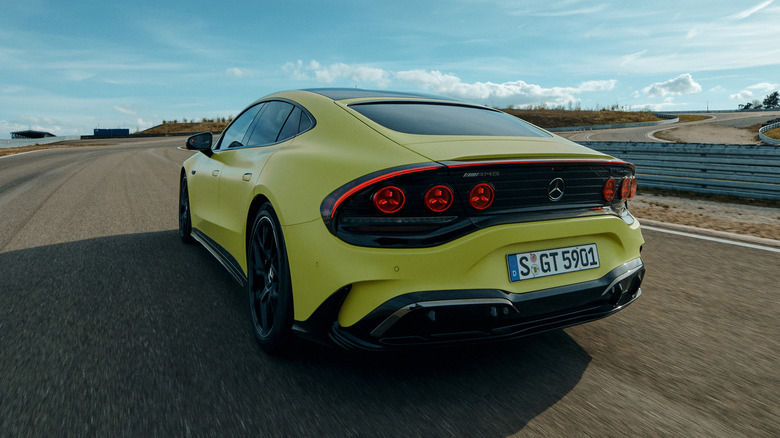
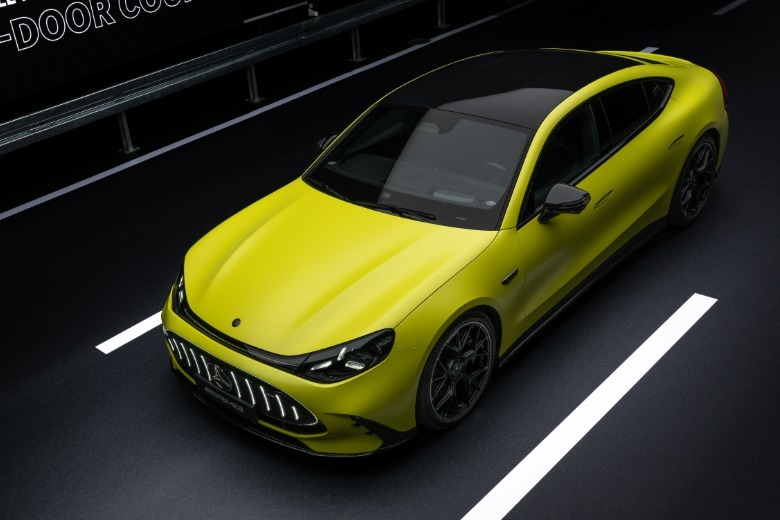
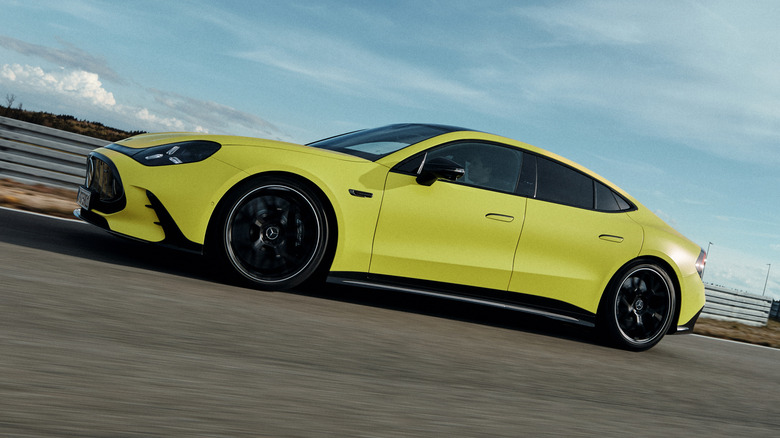
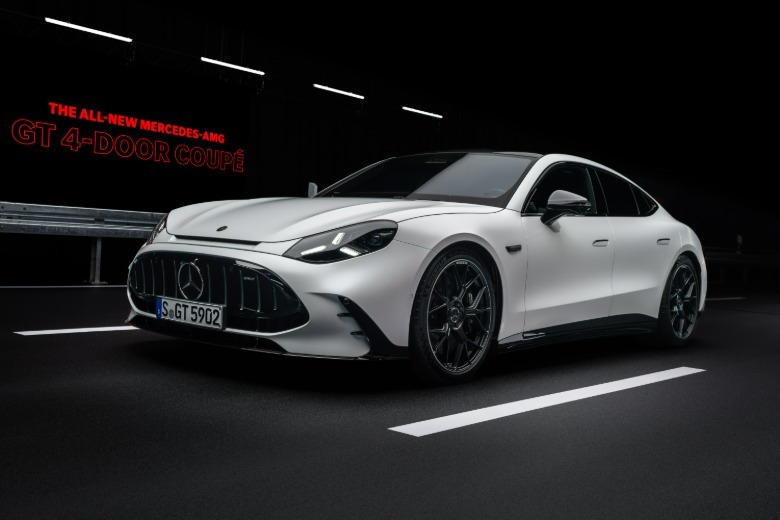
The Concept GT XX's styling was pretty controversial, and I'm betting the production car's will be even more so. Aside from a slightly taller greenhouse and a sharp rising line in the lower doors, everything between the wheels is pretty much the same as the concept. It's quite sleek and lovely, sitting 1.6 inches lower than the outgoing GT 4-Door, and Mercedes says it has a drag coefficient of 0.22, the same as a Porsche Taycan and Mercedes' much smaller CLA. The EV is almost two inches longer than the old car, with a 3.5-inch-longer wheelbase. Wheels measuring 20 or 21 inches are available, with the most aerodynamic choice being 21s that add 9 miles of range, and aero tires that bring that up to 19 extra miles.
 Mercedes-AMG
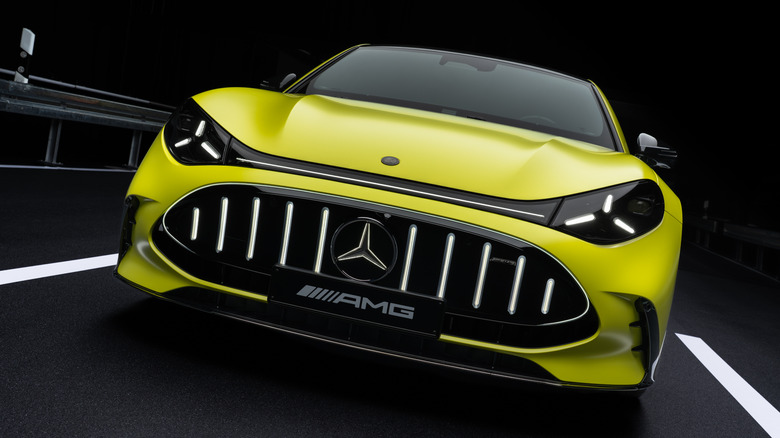
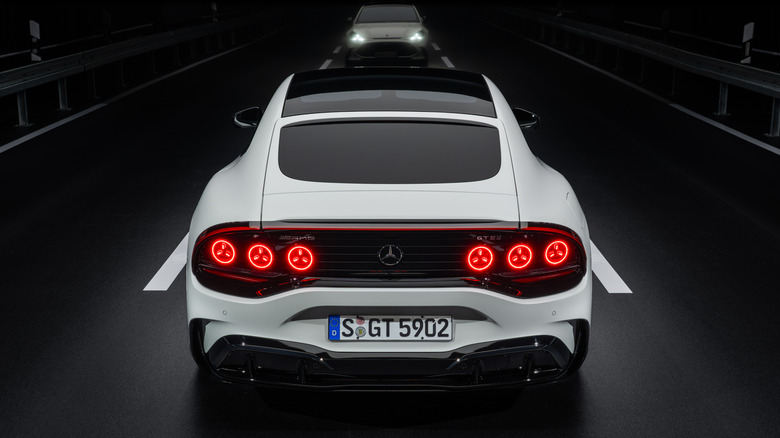
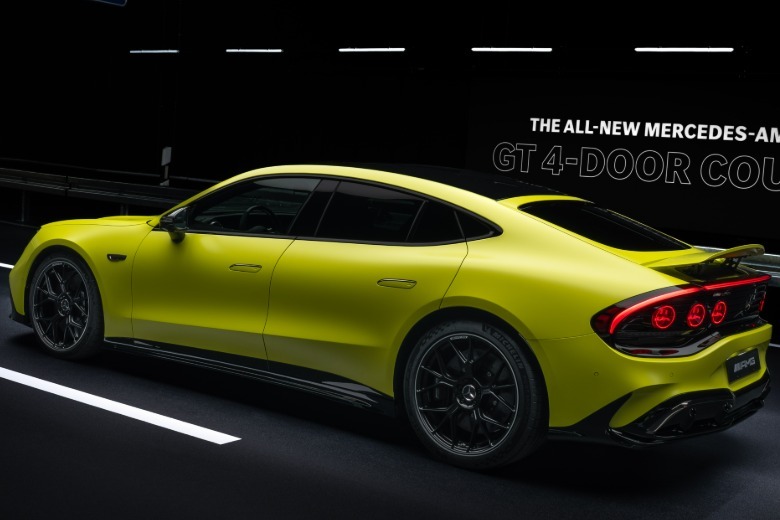
Instead of the concept's small vertical headlights, the production GT has a similar setup to the CLA, with three-pointed elements in larger housings. As standard there's a body-color panel with a faux vent connecting them, but you can option the car with a light bar instead. While the hood is more traditional and does without the concept's vents, the Panamericana grille is a lot more extroverted, and it has more prominent air intakes in the bumper. The "grille's" surround is illuminated, as are the vertical slats and the star logo in the center. Where the concept had a simpler rear end with digital rear panel flanked by a trio of round taillights on each side, the production GT has a rounder look. Similar three-pointed taillights are placed in a large straked black panel, with a line of light following the top half of the panel. It's unlike anything we've seen from Mercedes, including new models like the C-Class that have a similar black-panel motif.
 Mercedes-AMG
Then there's the Aerokinetics system that's certainly the most advanced active aero we've seen on a regular Mercedes road car. A large rear spoiler deploys above 50 mph and adjusts its angle based on speed and how you're driving, or you can leave it up when parked if you want to look like an ass. Airpanel louvers in the center front intake and on the corners of the bumper automatically open when specific temperatures are reached for more cooling — this is the first production Mercedes with a wheel-arch cooler. As a further option, you can get the Venturi Flow that adds two active elements to the underbody, one up front and the other in the center, which automatically lower at 75 mph and 87 mph, respectively, to create a strong low-pressure zone that "significantly" increases downforce. Also optional is a rear diffuser that extends out, similar to that of the concept.
Real space for tall humans
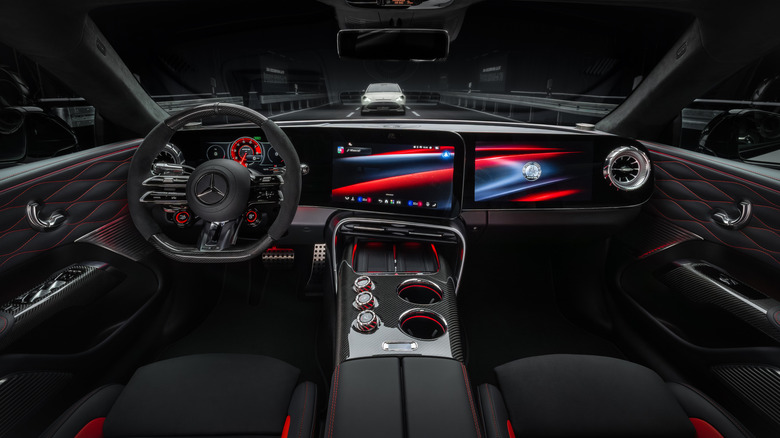
Mercedes already revealed the GT 4-Door's interior a couple months ago, so there's not a lot of new ground to cover here. It has a driver-oriented design with a trio of screens as standard — a 10.2-inch gauge cluster and 14-inch touchscreen under one panel, and a separate 14-inch passenger touchscreen — but still a lot of nice tactile elements like the turbine-like air vents and those control knobs. The steering wheel has revised Drive Unit buttons that use small screens and turning rings to cycle through various vehicle functions and controls.
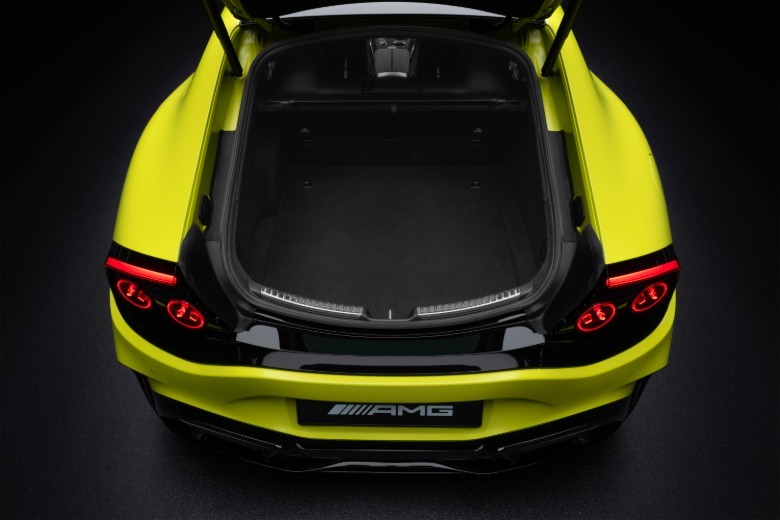
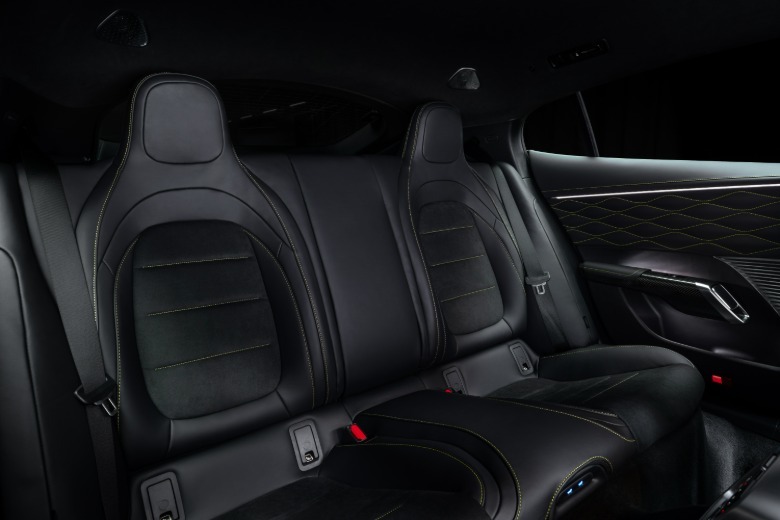
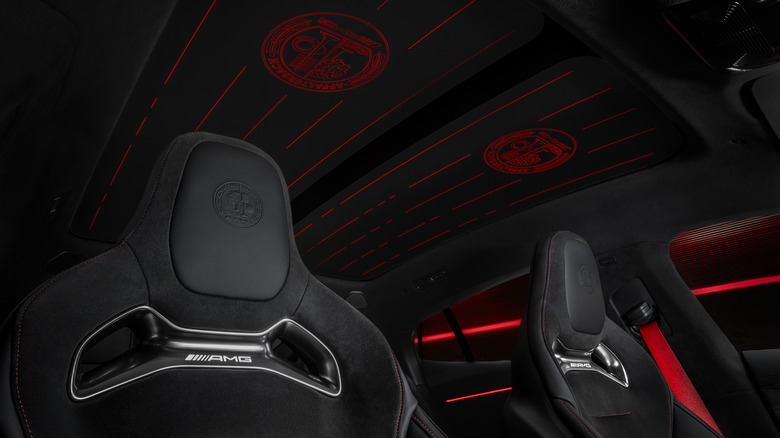
AMG Performance front seats with integrated headrests are optional, and while a two-seat rear configuration is standard you can get a three-across bench. Either way, the rear seatbacks fold down. "Foot garages" in the rear floor give passengers more legroom and a better knee angle, and Mercedes says there's plenty of headroom (my 6-foot-8 colleague Logan fits great back there, he says) even with the one-piece panoramic sunroof, which can be had with absurd Sky Control ambient lighting. The car's ambient lighting is pretty wild even without the sunroof bits, though. And speaking of space, there's a 1.4-cubic-foot frunk, and the liftback rear end opens to nearly 15 cubic feet of luggage room.
 Mercedes-AMG
All of the performance pages and screens you'd expect are on board, including a Warm Up page that shows information on vehicle and tire temperature. An AMG Set Up page lets drivers adjust all sorts of different things, from the aero bits to the sounds, and a "Pre-Check" function activates said aero bits so you can show off when stationary. Standard on the GT63 is the Track Pace telemetry system, which records over 80 different data points ten times per second and is integrated with the optional dashcam, also using the augmented reality head-up display to coach you to be a better driver. The car also has a Predictive Performance Manager that optimizes energy flow for better lap times between Endurance and Hotlap settings. For instance, it will save energy when driving downhill or in tight corners, to be used later when full power is needed.
On sale this year
In the car's reveal press release, AMG CEO Michael Schiebe is quoted as saying that the GT 4-Door Coupe EV's driving experience is "unparalleled: thrilling, intense, irresistible — typically AMG," and chairman of the board and Mercedes' overall CEO Ola Källenius said "I've driven the new AMG GT 4-Door Coupe myself many times – and it genuinely stands out. It pushes performance to new limits and delivers the emotion our fans expect." Of course, they would say that, but this really does seem like a big step forward for electric performance cars, one I can't wait to drive.
Mercedes says the GT55 will go on sale in the U.S. first, reaching dealerships later in 2026, with the GT63 arriving in early 2027. There's no word on price yet, even for Europe; with the current V8 GT63 4-Door starting at around $160,000, I have to imagine the GT55 EV will come in somewhere around that mark, if not higher given the level of performance here. We've already seen spy photos of even-sportier GT 4-Door Coupe EV models testing, so don't expect AMG to sit around on its hands for long — and even better, a lot of the GT's technology will be trickling down to more affordable AMGs.