

It's Useful, But Ditching This Accessory Can Make A Big Difference To Fuel Economy

Like a gondola on a sketchy carnival Ferris wheel, the price of gas seems to be stuck up high, with no clear pathway in sight to bring costs back down. So, it's not super-shocking that motorists are changing their driving habits to save at the pump. That could mean trading in the gas-guzzling family truck for an EV, taking up biking, or even forgoing a car altogether and entering the public transit fray.
If you drive your vehicle frequently, fear not — there are still a couple of ways to save money at the pump. Some of them, like making sure your tires are properly inflated and regularly changing your spark plugs, are pretty straightforward. However, there's also a common vehicle accessory that, if you have one, may have been degrading your fuel economy from the get-go — the humble roof rack.
Yes, roof racks can be useful for hauling camping gear, bikes, or whatever you can't cram into your car's interior cargo hold. Still, if you want to reduce fuel consumption, removing it from your vehicle can help keep your gas tank (and wallet) full. So how much does going rack-less actually help with fuel economy? As it turns out, it could be quite a bit. With apologies to the Griswolds, here's why a roof rack might not be the best road-going companion if you're aiming for peak fuel efficiency.
The roof rack: An unassuming fuel-economy assassin
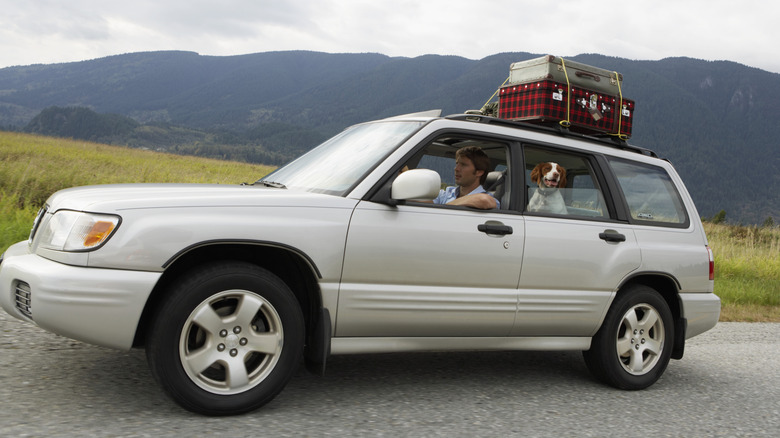
When it comes to roof racks messing with your fuel economy figures, there are two main factors at work: weight and drag. In general, adding weight to any vehicle will force the engine to work harder and sap more of that sweet, sweet petrol. Per the U.S. Department of Energy, a vehicle's fuel efficiency can drop by 1% for every 100 pounds added to it. Roof racks don't weigh much on their own; usually, a simple pair of aluminum roof rails is about 15 pounds, and up to 100 pounds for heavy-duty, full-platform rigs. Accessories like roof carriers — more on those later — add more weight.
In fairness, the labor of removing the rack might not be worth the fuel savings, especially if your accrued yearly mileage is low. However, if your ride serves as a daily commuter that racks up 15,000 miles annually, then that added weight will drain more of your wallet with every passing mile marker. The size, shape, and weight of your vehicle can also affect how dramatically extra pounds affects your fuel economy. But while a roof rack can definitely futz with your gas mileage, its most egregious petrol party foul is added drag — especially if you install a roof carrier or other accessories on top.
Roof racks and carriers can be a serious 'drag'

Even if your roof rack isn't adding much weight, it might be increasing your vehicle's aerodynamic drag. This is the opposite of what you want if you are trying to save on gas, because reducing a car's drag coefficient has a positive effect on fuel economy.
Max Schenkel, a GM technical fellow for aerodynamics, explained to Edmunds that reducing a car's drag coefficient by 0.01 can result in a 0.2 mpg boost in fuel efficiency. On the other hand, plopping a large, hard-shell cargo carrier atop your vehicle can cause up to an 8% loss in fuel efficiency when driving around town. That can increase to as high as 17% when driving at moderate highway speeds, and as much as 25% at 75-mph freeway speeds.
The fuel-draining effects of driving with a laden roof varies by vehicle type, but regardless of what you're driving, the end result is worse mileage. For example, a recent Consumer Reports test revealed that 2019 RAV4 SUV and a 2019 Altima sedan, each traveling at 65 mph and each topped with a roof rack, saw a 2% and 11% drop in fuel economy, respectively. With a roof carrier added on top of that, both models dipped further, with the percentages hitting 13% and 19% at the same speed. Ouch.
So, should you remove your roof rack and/or carrier when you're not using it? The short answer is yes. Unless you really need it for the road trip you have planned when fuel prices ease up – or the labor-to-savings ratio doesn't make sense for you personally — it's time to take that rack off. Your bank account will thank you.