

For Fans Of Antiquated Ways To Power Spark Plugs, Here's How To Set Ignition Points
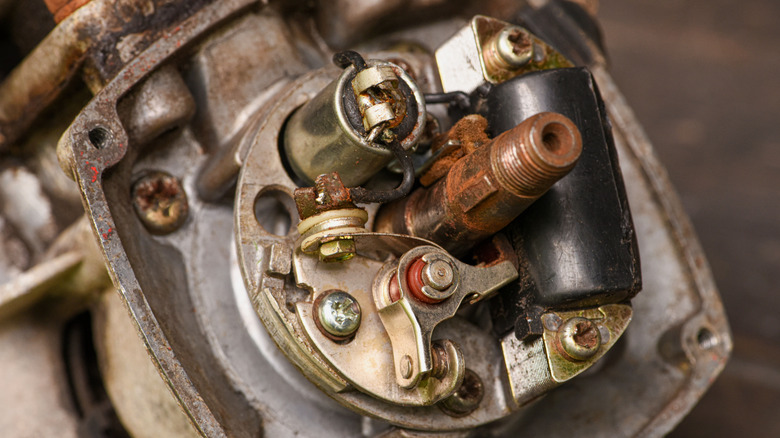
Before the days of electronic ignition, car owners and mechanics would have to set ignition points. The distributor's internals — which is where you'll find the points — need to be timed correctly for the plugs to receive a powerful and well-timed spark. Over time, the ignition points will stray from their ideal settings, so it is necessary to keep them correctly adjusted if you wish to avoid misfires. If you're used to sitting at the helm of a modern car, then setting ignition points might seem like a lost dark art or an act of mechanical wizardry. But it's a logical process that just requires a little patience and understanding.
First up, you'll want to disconnect the battery, grab a screwdriver, and get a feeler gauge ready. Next, you'll locate the distributor, remove the cap, and take out the rotor arm to expose the contact breaker points. Now, rotate the engine until the points are fully open, and use your feeler gauge to measure said gap. If one is available to you, a dwell meter can help with verifying the measurements.
To adjust the gap (in accordance with your vehicle manual), loosen the adjustment screw and gently move the points until they are reading correct on your feeler gauge. Tighten the screw, and then double-check the gap once more. Reinstall the rotor arm and distributor cap, and reconnect the battery. All that's left to do now is start the car and hopefully acknowledge a smooth-running engine.
Here's why ignition points are a thing of the past

The ignition system of today's cars is very different to the systems of old, no longer requiring small adjustments to keep it in good shape. When the swap was made from distributors to coil packs, there was really no need to go back. That is, unless you're a classic car enthusiast with a passion for keeping everything period-correct.
While the DIY approach does have its upsides — namely the ability to cure hard-starting issues and misfires with nothing more than a screwdriver and feeler gauge — the hands-off approach that modern ignition systems provide is certainly more desirable for most. In fact, many owners of classics prefer to retroactively install electronic ignition systems, which are a little more "fit and forget." They're perfect for those who prefer to actually drive these older models instead of just tinkering away with them.
It's easy for those with rose-tinted glasses to look back on ignition points and remember them fondly. For many, adjusting the points was among the first things you would learn to fix on your car, and it didn't force you to buy comparably expensive replacement items. And it's easy to think that many modern features only seem to make cars worse. But if you're forced to set your points in the freezing rain one morning while you're late for work and your car just isn't starting, you might agree with the idea that auto technology really has changed for the better.