

Why Can't Spark Plugs Fire When Completely Soaked?
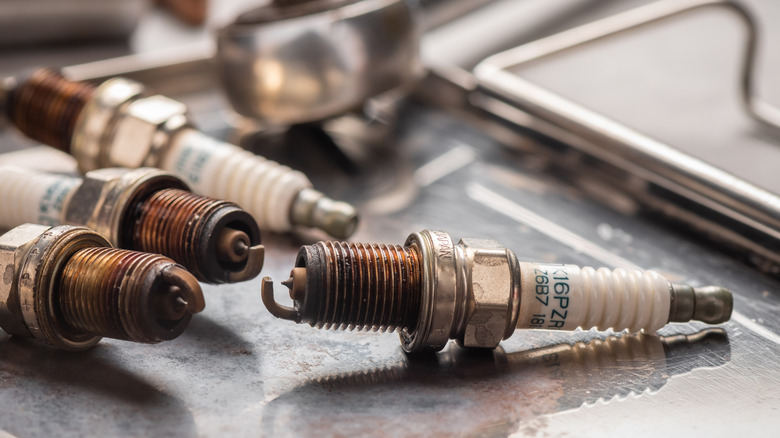
Spark plugs can get wet in a lot of ways. That's not to say it happens all the time, especially in newer engines, but it does happen. And when the plug is soaked, it's not going to fire. That's true whether your plug is soaked with water, gas, oil, or coolant. Of course, if your spark plugs have coolant on them, you've got bigger problems to deal with.
The reason wet plugs don't fire has to do with how electricity travels. It always follows the path of least resistance. Normally, the electricity flows into the terminal nut, inside the plug, through the center electrode, exiting the center electrode, then sparking across the gap to reach the ground electrode. It's that spark that ignites the air/fuel mixture.
The spark plug is designed so that this is the shortest path. On the outside, the ceramic insulator separates the terminal nut from the metal shell, to keep the electricity from traveling that way. But if the plug is soaked on that end, a path can form between the terminal nut and metal shell, which means electricity will not travel inside the plug and out through the other end where the spark is supposed to happen.
On the other end, the shortest route of least resistance is the gap between the center electrode and ground electrode. But if fluid is covering the center electrode, the electricity has a detour, and won't spark. This is one of multiple things that can cause a misfire.
How do spark plugs get soaked in the first place?
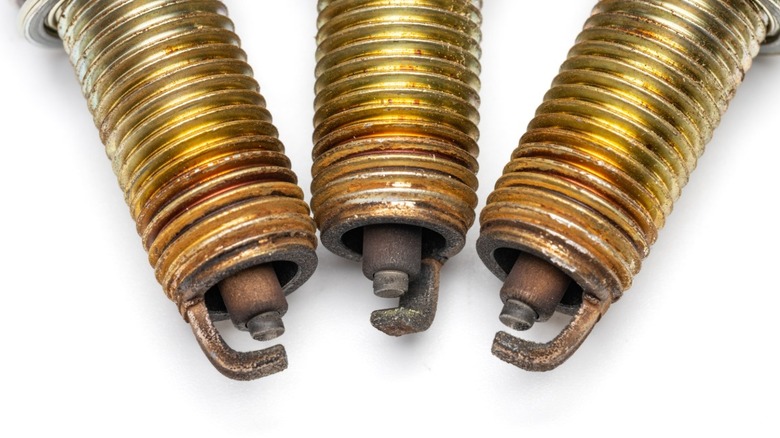
What causes spark plugs to get soaked? Wet fouling by gasoline is more common in older engines that still have carburetors instead of fuel injectors. It's easy to flood an older engine in cold weather, for example, when drivers repeatedly try to start their cars, often pumping the accelerator. In newer cars, gas can foul the spark plugs if there is a leaky fuel injector or a cold start injector valve that won't close.
Water can soak a spark plug, as well. It can happen when you wash your engine, run through standing water, or if it rains. Humidity can cause condensation inside the plug wells. In older engines, water can get in through the distributor cap and through the wires. It's one of several reasons automakers switched from distributors to coil packs, but water can still seep into the plug well.
Oil is never supposed to get into the plug well. If it's found there, that's a sign of other issues, including damaged piston rings, worn valve seals, malfunctioning PCV system, or turbocharger seal failure, among other things. In fact, there are many, many ways that oil can get into the spark plug well, and none of them are good. But it's really serious if coolant has fouled your spark plugs. That could be a sign of a leaky head gasket or intake manifold.
What can you do about soaked spark plugs?
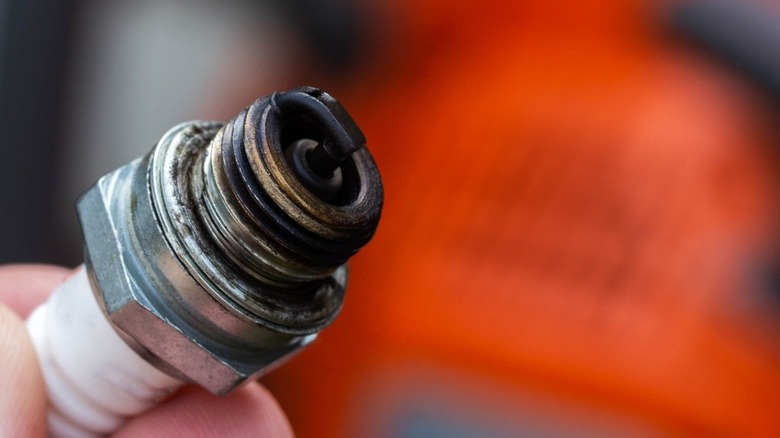
So, what should you do if your spark plugs are soaked? If they are soaked with water, you can just wait until they dry to start your car again. Waiting is also a good strategy if you've temporarily flooded the engine. You could also try spraying some starting fluid in the throttle body. Interestingly, modern engines with fuel injectors have what's called a "flood clear" mode. To activate it, you hold the gas pedal all the way down to the floor while trying to crank the engine. This stops the flow of gas to the engine while it tries to start, drawing more air in, which will dry the plugs.
Of course, you could just pull the spark plugs out. At that time, you will need to decide whether to replace the spark plugs or clean up and dry the used ones, using a wire brush or sandpaper. You could also let the plugs soak in vinegar for several hours. Whether you're replacing or re-using them, make sure to gap the plugs before putting them in. Even though they come pre-gapped from the factory, it's always important to gap spark plugs yourself before installing or even re-installing them, since the gap can degrade over time. In some cases, especially if the plug is soaked in oil or coolant, you'll want to fix whatever is causing the problem in the first place. Soaked spark plugs won't fire, but it's not a permanent problem.