

Used Plug-In Hybrids Are The Unexpected Solution To Both Rising Gas And Car Prices

A combination of recent economic and political factors has put car shoppers in a tough place. You know things are bad when even dealers think new cars cost too much. And once you've got a vehicle, gas prices are shaping up to be far worse than what people went through in the record-breaking year of 2022. All-electric drivers aren't in a good spot, either, as a $5 billion EV charger program is in danger, dealing another blow to folks hoping for improved EV infrastructure. But there is one specific class of vehicle for sale today that offers lower pricing than new cars, uses less gasoline than traditional rides, and — when push comes to shove — can skip EV charging entirely. Yep, we're talking about pre-owned plug-in hybrids.
As a quick refresher, you can start by thinking of traditional gas-only cars that rely on the engine for motivation, with a relatively small 12-volt battery that's mostly just used for ignition. Then, as you move up the electrification ladder, the engine gets smaller and the battery gets bigger. A typical hybrid car adds a larger battery that can deliver enough energy to reduce the engine's load, but usually not enough to actually drive the car.
A plug-in hybrid, while still keeping an internal combustion engine, gets an even bigger battery — one that's large enough for some amount of EV driving in addition to its gas-only range. However, the battery is also large enough that it needs to be plugged in to charge, instead of recapturing energy solely through regenerative braking (as in a hybrid). Finally, EVs ditch the gas engine entirely and rely on huge, rechargeable battery packs that can sometimes weigh as much as an entire small car.
Plug-in hybrids can help lower gas bills by not using any
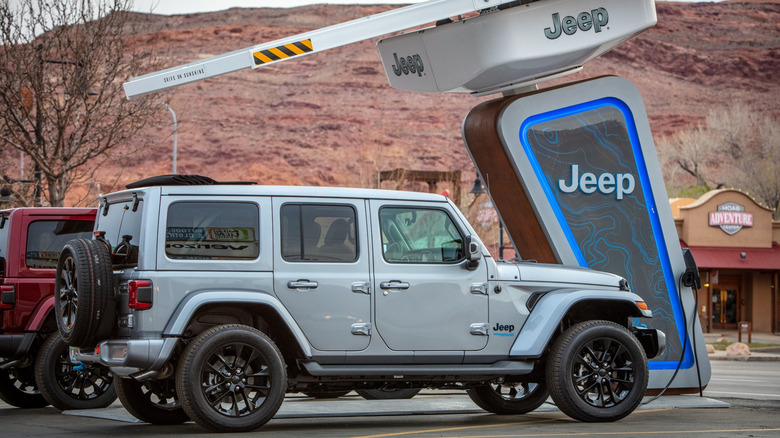
Let's begin by looking at what was one of the country's most-popular PHEVs when it was new: the Jeep Wrangler 4xe. Stellantis might have cancelled all of its plug-in hybrids for 2026, but the '25 4xe can really put a spotlight on their efficiency benefits. This particular model, with a 2.0-liter four-cylinder turbo engine and a 17.3 kWh battery, has nearly the exact same EPA rating for combined travel as a comparable gas-only Wrangler: 20 vs 21 mpg, respectively. The key difference is that the 4xe also has an EV driving range of 21 miles, and with that, it consumes no gasoline at all. In other words, according to the EPA, a plug-in Wrangler will save the typical driver about $2,750 in gas bills over five years versus the conventional Wrangler.
A more efficient vehicle — such as the Mercedes-Benz GLC 350e 4Matic — saves even more money. The plug-in GLC comes with a turbocharged 2.0-liter four-cylinder motor like the Wrangler 4xe, but it also welcomes a larger 23.3 kWh battery. The result is an all-electric, no-gas range of about 54 miles. Plus, the 350e hits 25 mpg combined in gas mode, slipping just one mpg under a comparable GLC 300 4Matic. The bottom line for the Mercedes-Benz: The plug-in GLC can reduce your five-year gas costs by approximately $5,500 compared to non-pluggable version.
Depreciation can be your friend when buying a PHEV
As many owners discover, brand-new electrified vehicles aren't always that good at retaining value. Some market-watchers have caught EVs depreciating by $600 a day. And when you get to plug-in hybrids, it turns out that their depreciation rates are pretty similar. Getting back to the Wrangler 4xe, a 2021 entry model with an MSRP of $47,995 is now worth roughly $22,700 (according to Kelley Blue Book). It works out to a five-year depreciation rate of 52.7% and means the '21 plug-in Wrangler can be a couple thousand dollars cheaper to purchase than the average used car. For what it's worth, it's more than $13,000 cheaper than the least expensive new 2026 Wrangler, too.
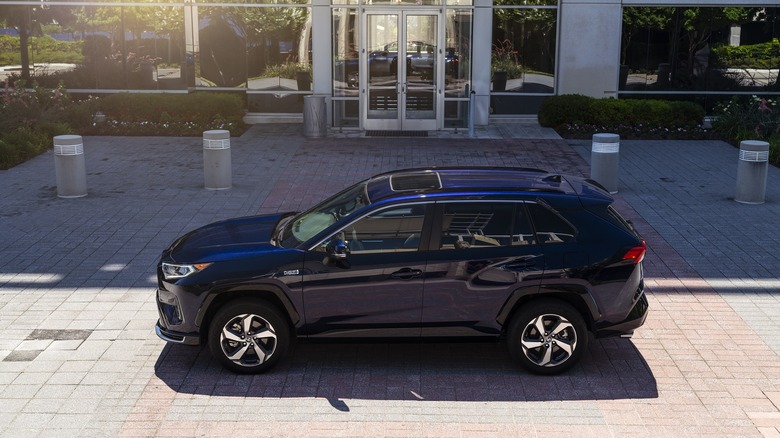
The pricing difference for pre-owned PHEVs is clear even at Toyota, a brand well-known for resisting depreciation. Consider the 2021 RAV4 Prime, which was the first pluggable version of the popular SUV and went on sale starting from $38,100. Fast-forward five years, and the resale value for the vehicle has fallen by nearly 35%, to $24,800. The 2026 model will set you back $41,500, and that's before the delivery fees.
Just keep in mind that plug-in hybrids may save you money, but they won't necessarily help you save the environment. At least one notable study says plug-in hybrids are nearly as dirty as gas cars. Such research revealed that PHEVs produce close to five times more emissions than expected, which could harm more than just your wallet.