

Here's How Ridiculously Hard It Was To Change Spark Plugs In A Chevy Monza V8
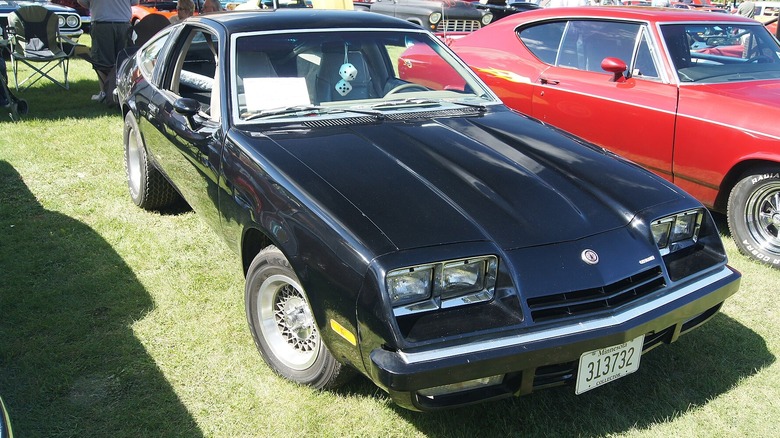
Congratulations! It's 1975 and you've just brought home a brand-new Chevrolet Monza optioned with a 262-cubic-inch V8. While a few years ago GM V8s pushed 300 horsepower or more, this one offers just 115. That's okay, you tell yourself. Gas is expensive and new federal regulations are helping to improve fuel economy and clean up the air. At least it's easy to maintain, right? Wrong! Get out the engine hoist, because this is not one of those spark plug myths you need to stop falling for: It's time to change the plugs on your Chevy Monza.
The mid-1970s threw challenge after challenge at the auto industry. New federal safety regulations mandated 5-mile-per-hour bumpers, and strict enforcement of the 1970 Clean Air Act forced tailpipe emissions to be cut in half by 1975. This all came amid an energy crisis that led to rising gas prices and the establishment of Corporate Average Fuel Economy rules designed to improve the efficiency of cars and light trucks.
This was a problem for Chevrolet's newest model. Since early in the Monza's development, GM had planned to use a new Wankel rotary engine. While there are pros and cons of rotary engines, in the first half of 1974, just months from the beginning of production, it became apparent that the spinning triangle would not meet current emissions and other standards. The plan was paused, and later scrapped altogether.
The Monza was instead reengineered to host traditional GM power plants. Options would include the Chevrolet Vega's four-cylinder, a Buick V6, or a new-for-1975 4.2-liter V8, the smallest small-block offered by the Bowtie. Despite being itsy-bitsy, it still proved too big to be convenient in the Monza's engine bay.
How to change the spark plugs in a V8 Chevrolet Monza
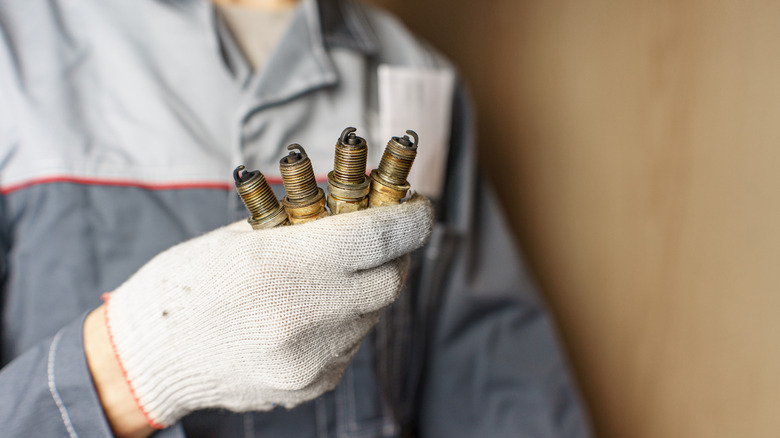
What do a Ferrari 355 and Chevrolet Monza V8 have in common? The engine had to be unmounted to perform basic maintenance. About five months after sales of the Monza began in August 1974, an Associated Press article published in the New York Times highlighted a flaw with Chevy's new V8-equipped hatchback — the entire engine had to be lifted to change one spark plug. A GM spokesman told the AP that plug number three sat too close to the steering column, making its removal difficult without raising the engine a half inch.
GM said Monzas checked at the proving ground didn't require such drastic measures to perform the maintenance, so a "production variance" was the issue. While the original parts had an estimated life of 22,500 miles, when it came time for new spark plugs, GM's recommended procedure included lifting the car to loosen the engine mounts, then returning the car to the ground and using an engine hoist to raise the engine a half inch. Now the troublesome spark plug could be replaced and the entire operation had to be done in reverse.
The allotted time for this job at a dealership? Just 1.3 hours. In that time frame, the mechanic also had to replace the other seven plugs, which could be done without much fuss. In the mid-1970s, a mechanic would have 36 to 48 minutes to swap plugs on other GM V8s. This means they had about 30 extra minutes to lift the Monza's engine, change the part, and put it back together. So while the Monza, built through 1980, may have styling influenced by Ferraris, it doesn't seem likely GM was trying to set any maintenance trends for future Prancing Horses.