

Chevy Introduced Turbocharging To The Masses With A Car Ralph Nader Hated
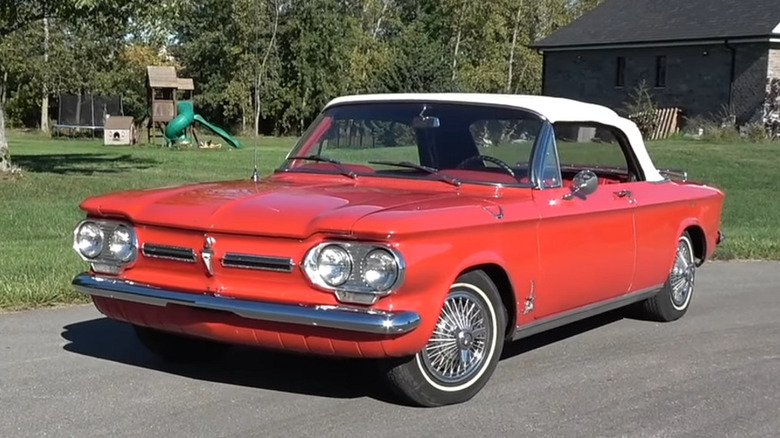
Talk about coincidences: General Motors brought turbocharged cars to the mainstream in 1962, when it introduced two completely different vehicles, with two different turbo systems, within just a few weeks of each other. And their suspensions were different as well, with one that Car Throttle described as "wobbly, uncomfortable, unresponsive, and downright unstable." But oddly enough, Ralph Nader picked the car with the other setup to open his book "Unsafe at any Speed."
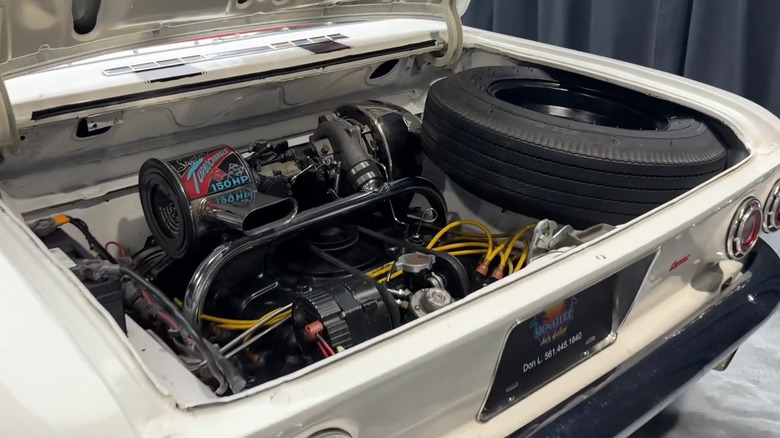
Of course, we're talking about the Chevrolet Corvair and the Oldsmobile Jetfire, both launched with forced induction for the 1962 auto-show season. The Corvair premiered in March in Chicago, while the Jetfire in New York in April. However, the Jetfire's forced-induction system turned out to be a dead-end — partly because it was a complicated system that required drivers to use an engine additive to keep all parts playing nice with each other. The Corvair relied on more of a purely bolt-on solution, with a fairly simple turbocharger sourced from a subsidiary of TRW.
Anyway, what really drew Nader's ire was the Corvair's suspension. The basic issue, according to Nader, was that Chevy cheaped out on the car's rear suspension, knowing the Corvair would experience severe — likely dangerous — oversteer because it was so much heavier than the European rear-engine models that were its inspiration. And by the time that the federal government ruled that Corvairs were no more dangerous than other cars of the era, it was already too late to save the sinking ship. Not even the weirder amphibious Chevy Corvair could do that.
How the Corvair came to be turbocharged in the first place
Although the Chevrolet Corvair launched in 1960, well before the oil issues of the 1970s, it already marked a turn toward the lighter, more compact cars that were found in Europe — and that were already attracting the attention of the service people who had seen them firsthand during the war. In fact, it's generally accepted that GM got the idea for the Corvair's configuration after seeing the success of rear-engine rides, with flat motors, from foreign automakers such as Porsche, Tatra, and Volkswagen.
That gets us to the birth of the first Corvair, the 1960 edition, packing a standard 2.3-liter flat-six that was good for a meager 80 horses. Despite the fact the Corvair was originally slated to use a four-cylinder engine, Chevrolet thought the prospective motor would be too coarse for American tastes. This led to the decision to use a naturally balanced, smooth-running flat-six instead, which would put the Corvair on track for a sportier approach to driving.
The car simply wasn't as efficient as rival four-cylinder compacts, so the brand brought out the Chevy II in 1962 to act as its traditional compact model. As a result, this move opened up the ability for the Corvair team to focus more on performance, laying the foundation for the turbocharged Corvair Spyder the same year. By the time the second-generation Corvair broke cover in 1965, it could serve up 180 horses and 265 pound-feet of torque in a lightweight package that rode on a brand-new suspension setup — negating many of Nader's complaints. The second-gen Corvair was even deemed athletic enough to serve as the foundation for the first Chevrolets upgraded by Don Yenko, known for building especially rare and valuable Chevys from the muscle-car era.
Did Ralph Nader really kill the Corvair?
To be clear, by the time Nader's book came out in 1965, the Chevrolet Corvair being sold at local dealerships was a far different and much-improved machine than the one Nader had written about. But it was also already a few years past its peak in terms of sales. According to Automobile-Catalog, Chevy had sold more than 315,000 Corvairs in 1961. And although the second-gen models helped sales stay north of 200,000 up through 1965, the Corvair's volume had cratered to only 18,703 two years later.
Nader's book certainly didn't help, and as we've seen, it wasn't the last time faulty reporting sabotaged a vehicle's sales — you can blame "60 Minutes" for destroying the Audi 5000. Yet there may have been an even bigger factor at play. Yes, the Corvair had become a pretty credible all-around sports car by the mid-1960s, but more U.S. buyers — and automakers — had different ideas about what should go into a high-performance machine. The muscle-car era was off and running, and the Ford Mustang was leading the sales charge.
The Mustang's first year saw an incredible 418,000 models roll off the Ford assembly line and onto American roads, leaving the Corvair in its dust. The Chevrolet Camaro came on line as a direct competitor to the Mustang in 1966, essentially kicking the Corvair to the curb. Today, you can pick up examples like the same year's Corvair Monza for a mere $15,000.