

Just When You Thought The Chevy Corvair Couldn't Get Weirder, Here's The Amphibious One
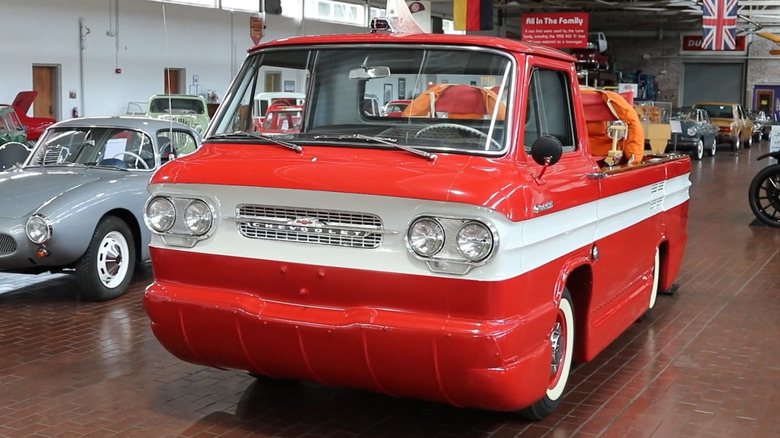
Great things can happen when motivated employees come up with a great idea, put it into practice, and then take it to the bosses. That's pretty much how Gmail was invented, and it's also how we ended up with a single amphibious Chevrolet Corvair.
Unlike Chevelles, Camaros, and Corvettes of the 1960s, Chevy's Corvair doesn't enjoy huge levels of love even today. It lacked the muscle of these more iconic nameplates, but it did play an important role in period, offering an all-American alternative to imports like the Volkswagen Beetle. The German compact clearly inspired GM, as the Corvair too was rear-engined, and made use of an air-cooled engine. A flat-6, to be specific, which in its first guise produced a largely inadequate 80 horsepower. Later releases grew in capacity and output, with a final turbocharged model arriving on the scene some years later, with a much-improved 180 horses under the hood. Engines were either hooked up to a four-speed manual, or two-speed automatic transmission.
Where the Corvair certainly did impress though, was with its versatility. Unlike the Beetle, Chevy's model could be had as a sedan, coupe, wagon, van, or even pickup truck. However, two Pontiac engineers, Richard E. Hulten and Roger D. Holm, thought something was missing from this lineup — an amphibious pickup-based Corvair, which they dubbed the Corphibian. They formed their own company, Hulten-Holm Co., and developed a fully functional prototype on their own time, with the idea of presenting and selling the idea to Chevrolet.
Here's how it was made
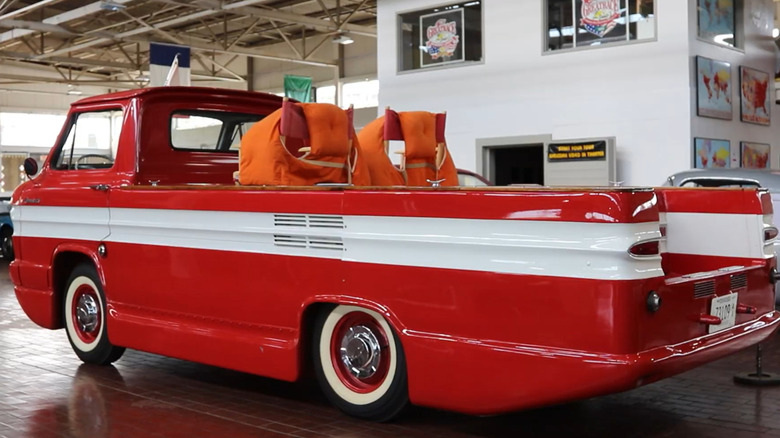
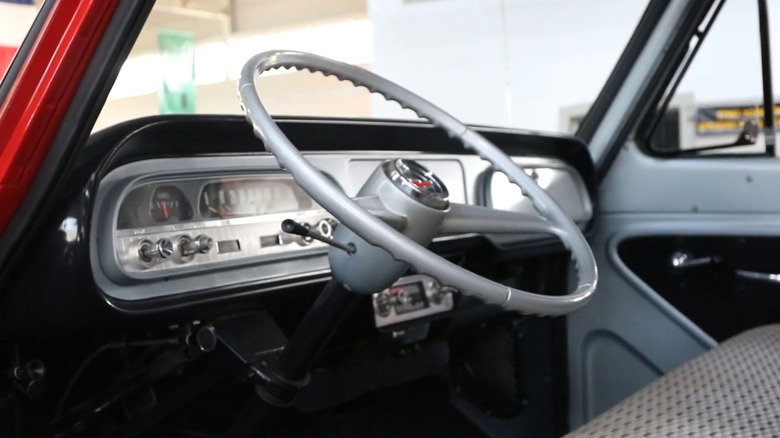
While the case for producing an amphibious Corvair certainly can be (and was) questioned, it's difficult to challenge the engineers' approach and execution. They nailed the name, and the design was well thought out. It featured an extended bed and fiberglass hull, fiberglass being light, rustproof, and extensively proven in boating. Most controls are located in the bed, including drive engagement, steering, and forward and reverse settings. The throttle, though, could be controlled from either the bed or the cab. Usefully, the Corphibian sits high enough in the water for the doors to be opened, so occupants could move from cab to bed while on the water.
Many other amphibious creations, like the performance-oriented TVR Scamander, look bizarre, while the Corphibian could easily pass for just another pickup. Underneath the largely standard-looking bodywork is familiar Corvair territory, with the standard flat-6 and Powerglide two-speed automatic transmission motivating the Corphibian when on land. In the water, two propellers take over propulsion.
Period footage shows Hulten and Holm testing the Corphibian on a Michigan lake in 1961. Remarkably, it drives straight into the water, just as easily as you might merge onto a freeway. The driver then opens the door, climbs onto the bed, and takes hold of the bed-mounted marine controls. The two did plan to open the truck cab up somewhat, for a more nautical look, and to allow an easier cab-to-bed move. But the Corphibian ended up a one-off, with no further modifications.
Hulten and Holm's Corphibian has survived the test of time
Having transformed their bold vision into a bold reality, and actually put it to test in the water, Hulten and Holm decided it was time to put their creation before GM executives. Ideally, the big bosses would see it was a great alternative to the German-built Amphicar, which hailed from the same era.
But GM's bosses figured the market for such a vehicle would be fairly limited, and passed on putting the Corphibian into production. Perhaps they were short-sighted, as 3,878 Amphicars ended up being made, with 3,046 of them imported into the U.S. Clearly, there was a market of sorts for wet-dry transport in America, and the Amphicar, too, launched in 1961. If the Corphibian had been put into production quickly, it probably would have stood a good chance of stealing many of those 3,046 sales. After all, it would have been American-made and from a known, trusted brand.
Nevertheless, the mass-produced Corphibian wasn't to be. But the one example ever produced still exists today, wearing its red and white paint job, and sportingthe all-important dual propellers and marine gear mounted in the bed. While it never became the commercial success Hulten and Holm would have loved, it sits as a cherished and fascinating piece of automotive history, well-preserved and on display to the public in Nashville, Tennessee's Lane Motor Museum.