

2026 Dodge Charger Sixpack R/T 4-Door Aims For Broad Appeal, And Kind Of Succeeds
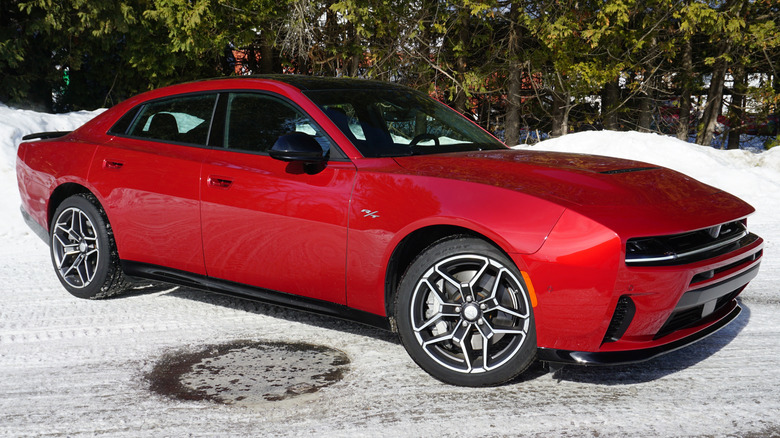
It's no secret that the new Dodge Charger's sales have been far less than stellar. In all of 2025, the automaker sold just 7,421 electric Charger Daytonas and 2,141 gas-powered Chargers (some of which were surely leftovers from the previous generation). Together, that's less than a third of the Chargers it sold in 2024, and it left Dodge looking for a volume seller in the lineup of its once-ubiquitous muscle car. That's where the Charger Sixpack R/T 4-Door comes in... theoretically.
That kind of success is going to be a mighty tall order, as even in its cheapest form the Charger Sixpack R/T is not exactly a cheap car, but Dodge is hoping to win people over with clever packaging, practicality, solid performance and all-season drivability. At least, that was the aim. In actuality, what I found on my third first drive of the new Dodge Charger was a car that threads the needle between making a lot of sense and being pretty damn confusing.
Full Disclosure: Dodge flew me up to Vermont, put me up in a lovely hotel, fed me some great food and gave me some of its Eau de Toilette cologne (more on that soon), all so I could test out the Charger Sixpack R/T.
Sixpack Lite
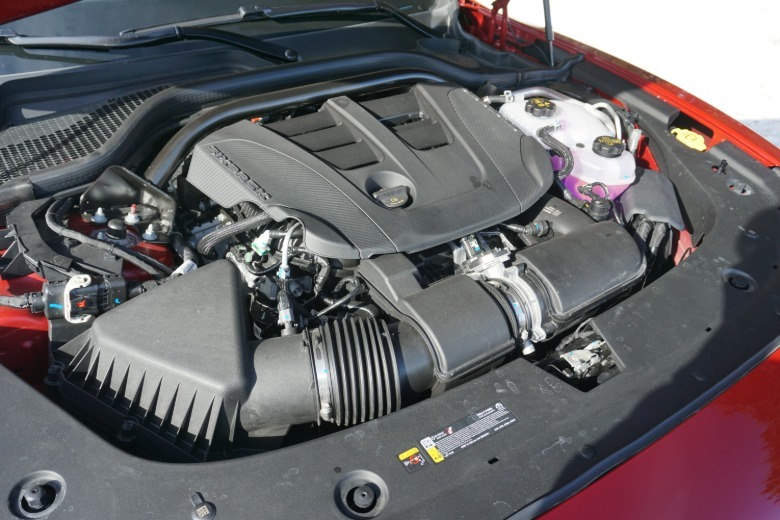
By my count, Dodge currently offers six different versions of the Charger between various gas and electric, R/T and Scat Pack, and two- and four-door combinations. It can be a bit overwhelming, for sure, but the important thing to know is that the Charger Sixpack R/T 2-Door and 4-Door are the cheapest ways to get into the lineup, powered by the same motor version of Stellantis' Hurricane twin-turbocharged 3.0-liter inline-six. In this application, the engine puts out 420 horsepower and 468 pound-feet of torque, which is enough to send it from zero to 60 mph in 4.6 seconds with the help of a ZF eight-speed automatic transmission sending torque to all four wheels, according to Dodge. With the gas pedal mashed, it'll cross the quarter-mile in 12.9 seconds at 107 mph and go on to a top speed of 127 mph.
Those numbers are admittedly strong, and Dodge will tout that it's got the most standard horsepower of any muscle car, but it doesn't meet the highs of the Scat Pack's performance — not that you should expect it to. That car makes 550 hp and 531 lb-ft of torque from the same Hurricane six, which drops the 0-to-60 time to 3.9 seconds. Dodge hasn't said explicitly if there's any difference in the actual engine's internals, but its 50mm turbos are 4mm smaller than the Scat Pack's, and they work together to produce 22 pounds of boost, 8 less than the Scat. However, because the turbos are smaller, they spool up faster, so there's actually quite a bit less turbo lag. That's a good thing and a bad thing, because I found myself bouncing off the R/T's absurdly low 5,200-rpm redline pretty often — something that wasn't as much of an issue in the Scat Pack with its 6,200-rpm redline.
 Andy Kalmowitz / Jalopnik
While I'm sure some folks out there who are real patriots will bemoan the fact that the R/T doesn't have the 5.7-liter Hemi V8 anymore, let me crush your feelings with some cold, hard facts. The R/T's inline-six produces 50 more horsepower and 73 more lb-ft of torque than that old 5.7-liter truck engine. It also propels the new Charger to 60 mph half a second quicker than the old car and helps it cross the quarter-mile 0.6 seconds quicker than before. Still, real patriots will like the fact that the gas mileage isn't very good: 17 mpg city, 26 mpg highway and 20 mpg combined, according to the EPA. The future is now, old man.
Sadly, the future doesn't sound nearly as good. Dodge made a bit of a strategic error by having Durango Hellcats around for us to try out, too, and there's no getting around the appeal that a big V8 brings to the table. The Hurricane sounds neat, in a Nissan VQ/BMW I6 sort of way, but it's not going to replace what the V8 brought to the table.
A traditional drive
While the Charger Sixpack R/T might not have a traditional muscle car engine, it certainly has traditional muscle car driving tendencies, meaning you can't really feel anything through the wheel, it'll understeer if you overcook it on a tight turn (and it'll oversteer if you drop the hammer, even with all-wheel-drive engaged), and it's far happier cruising at six-tenths down a sweeping backroad than it is on something super tight and twisty. There and on the highway, it became a big, comfortable cruiser, not unlike the Chargers that came before it.
 Andy Kalmowitz / Jalopnik
In any case, there are five drive modes to choose from to help tailor the experience: Auto, Eco, Wet/Snow, Sport and Custom. They're all pretty damn self-explanatory, and don't worry, the steering never gets more communicative. However, in Sport and Custom, you can disable the front wheels and go RWD only, which makes everything very silly. When you add in disabling traction control, you can get a hell of a lot of use out of that 420 horsepower and have a goofy-ass good time in this big 4,741-pound sedan.
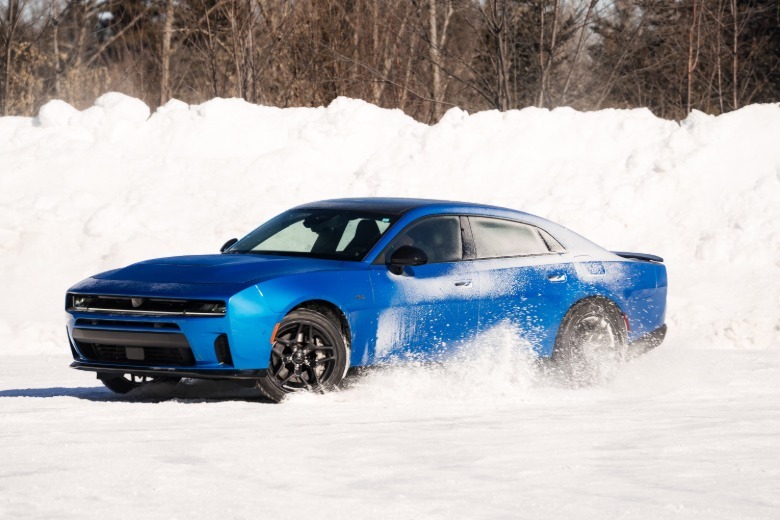
Dodge was kind enough to take us to the Team O'Neil Rally School in New Hampshire, where we were able to put the Charger Sixpack through its paces on some snow and ice. With Pirelli snow tires, this thing was honestly very impressive. Sure, it felt heavy (because it was), but as long as weight was kept on the front axle, it was pretty easy to control and slide around on a skid pad. The AWD system also did a nice job of helping launch the car out of sticky situations.
 Dodge
Dodge
My one real qualm with the way the Charger Sixpack R/T drove was its suspension. Not the fact it was a bit wallowy in the corners — that's to be expected. My issue lies with the fact that over crappy pavement, it was too bouncy for my liking. I know it's the dead of winter and the roads of northern Vermont and New Hampshire aren't exactly pristine, but I expected something a little cushier out of a car with a 121-inch wheelbase. It felt like I was being pogoed over every bump I encountered, and that left me a bit underwhelmed.
Four doors make the difference
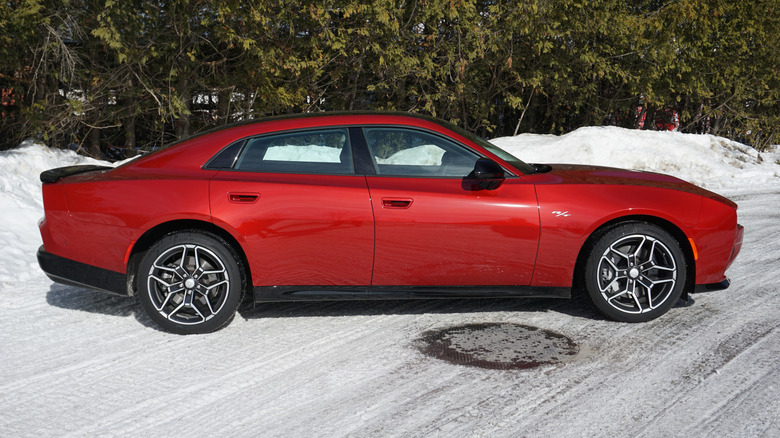
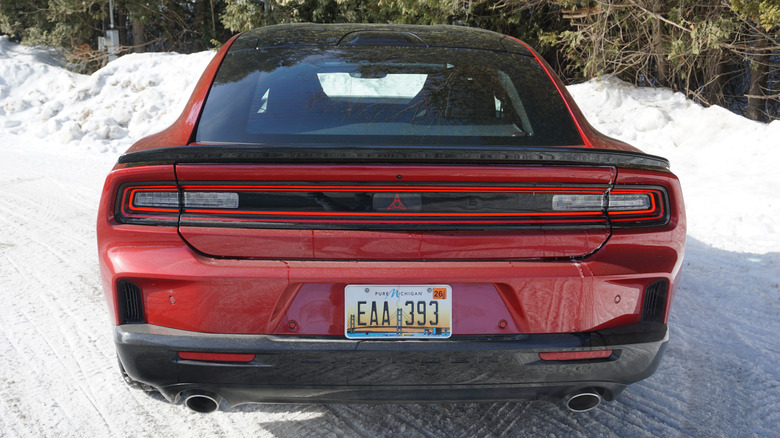
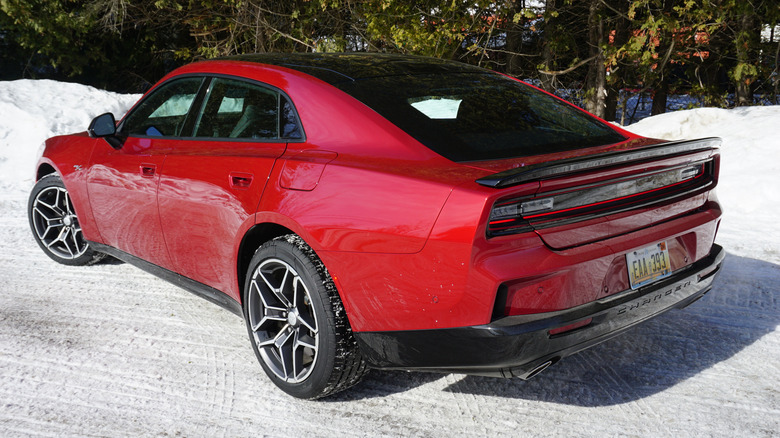
It's very hard to tell all of these Chargers apart, whether Sixpack or Daytona, R/T or Scat Pack. Dodge said it did this on purpose, building the car with a common body structure to allow for powertrain flexibility (just wait for the V8 I know is coming in my heart). Anyway, the easiest way to tell is by looking out back. The Sixpack comes with dual exhaust pipes in both R/T and Scat Pack trims, and the Daytona, well, doesn't. The only real tell between the R/T and Scat Pack is the badges on the fender. Other than that, it's a difficult job to discern between the two.
 Andy Kalmowitz / Jalopnik
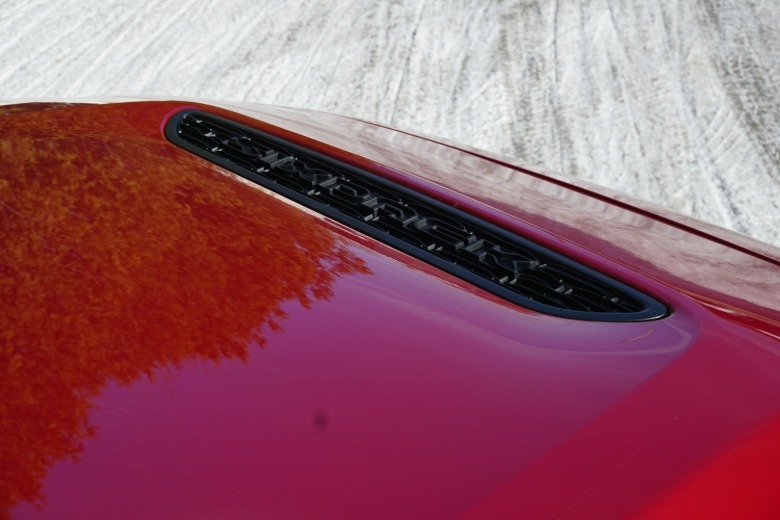
Up front, there are changes, of course, to accommodate the engine versus the Daytona. The R-Wing pass-through is now gone for obvious reasons. In its place, the Sixpack gets a taller hood with a bit of a power bulge in it, on the backside of which is a false vent with "SIXPACK" written on it. From some angles, you can see it from the inside, which is sort of neat.
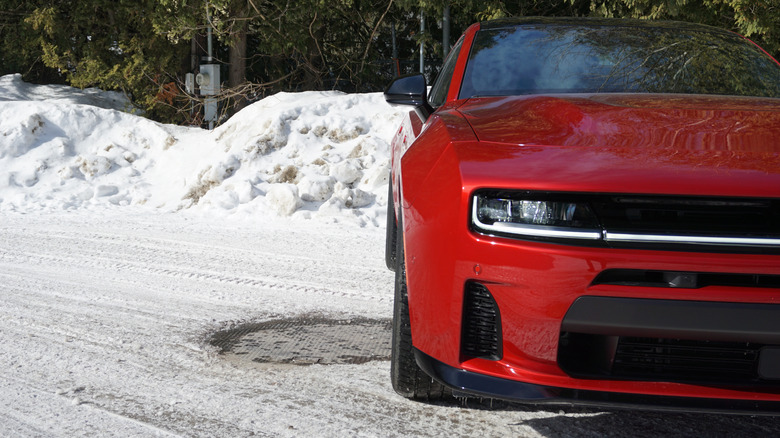
Dodge went to work with a Sawzall on the front bumper to get more air into the engine bay and other parts of the car. Engineers opened up the lower fascia and grille, and cut a mail slot between the two to ram as much air into that engine as possible. Because it's such a heavy car, Dodge added brake duct cooling lanes along the right and left sides of the bumper to keep brake temperatures under control. I'd imagine those can get pretty hot when driving like a lunatic.
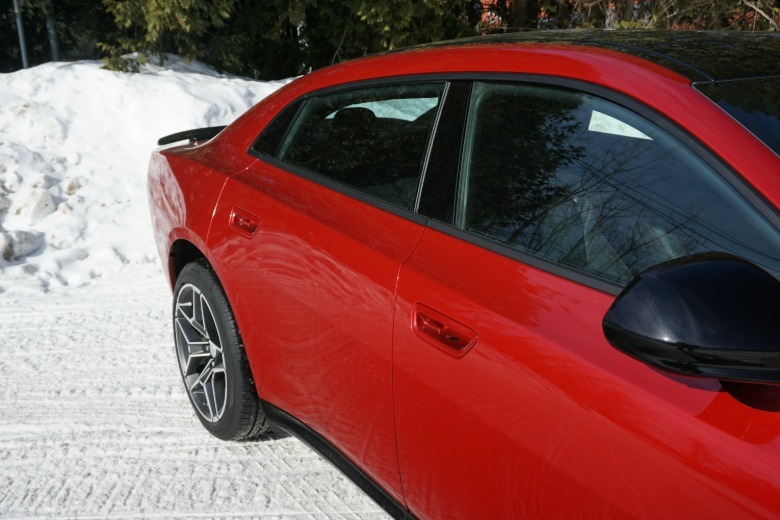
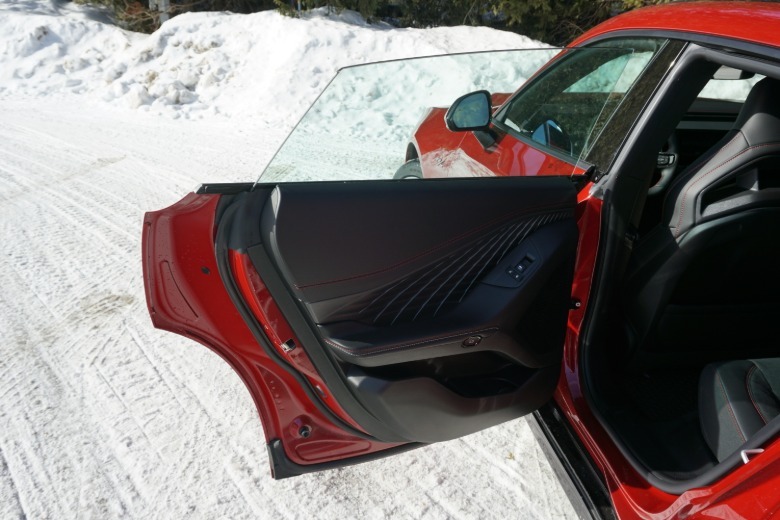
I will say that spending time with the 4-Door has reaffirmed my belief that it's better looking than the 2-Door. Sure, they share the exact same body structure, length and wheelbase, but having that second set of doors in the rear helps to break up the visual bulk that the 2-Door's rear quarter-panel has to contend with. Plus, the sedan keeps the frameless windows of the coupe, which is a touch that I absolutely love, and the massive liftback trunk is still left intact.
Same as it ever was
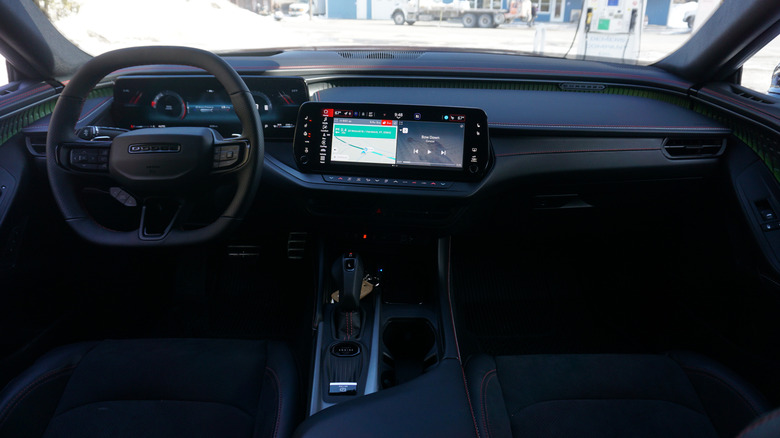
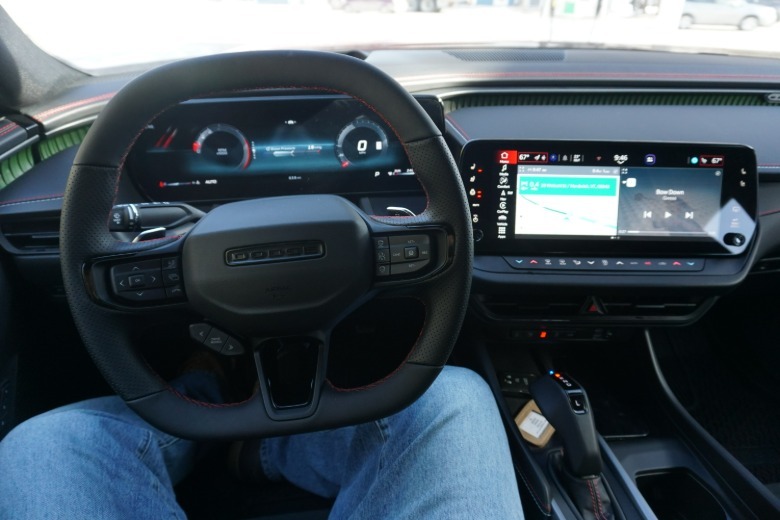
Looking inside the Sixpack R/T, it's pretty much impossible to tell the difference between it and the Scat Pack and the Daytona EVs. It's not anything close to a luxury car, but it's a hell of a lot better than the old Charger and Challenger it replaces. In front of the driver and above the squared-off steering wheel is a massive 16-inch digital gauge cluster (a 10.25-inch unit is standard), which may actually be too big to be useful, as either side of it gets cut off by the steering wheel like the gauges on an old Porsche 911. Right above it is a fairly comprehensive head-up display.
 Andy Kalmowitz / Jalopnik
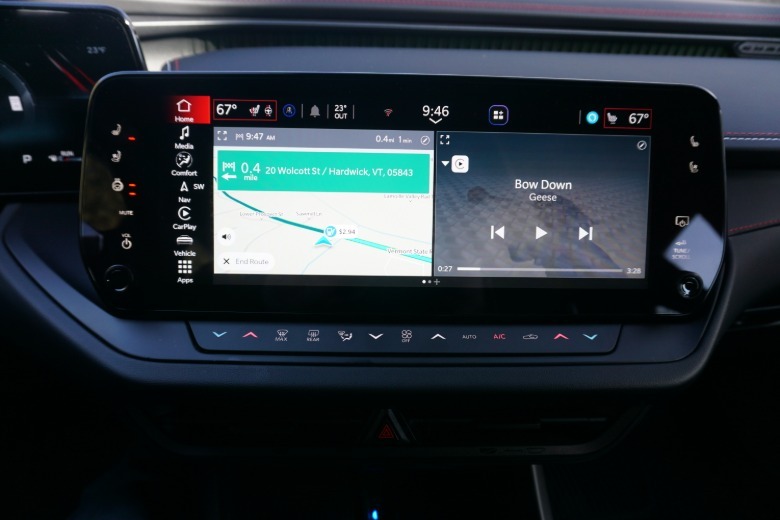
In the center, there's a 12.3-inch infotainment display running Stellantis' Uconnect 5. All in all, the screens are fairly simple to navigate and customize, but there's a bit more lag in the systems than I'd really like, especially in the gauge cluster. Each side of the center screen is flanked by capacitive touch buttons for heated/cooled seat controls, and as was the case with every other new Charger I've driven, it took quite a few presses to get them to actually register my commands. At the very least, there are physical volume and tuning knobs and a handful of other HVAC buttons below the screen.
Even though the R/T is the base car, it can still be optioned with all of the safety features found in the more-expensive Scat Pack and Daytona, including things like a surround-view camera, adaptive cruise control, blind-spot intervention and lane-keeping assist. These systems work really well together, and the' Level 2 driver-assistance system punches far above its weight class than you'd think for a piece of tech from Stellantis.
 Andy Kalmowitz / Jalopnik
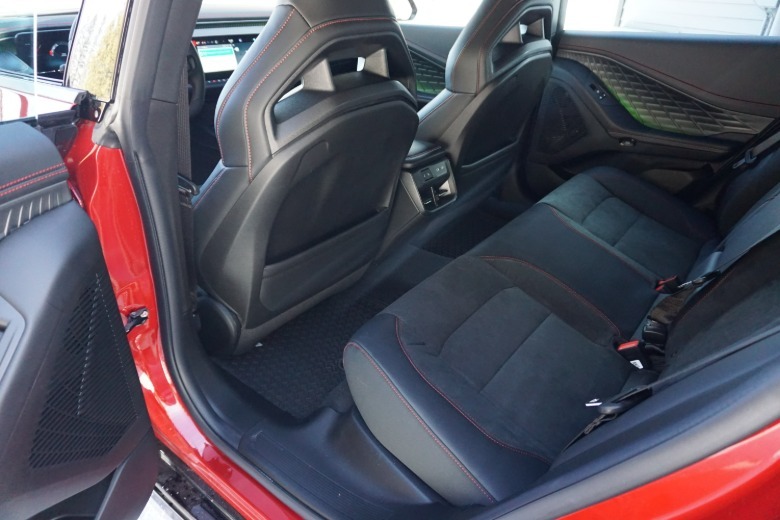
Also punching above its weight class are the extremely adjustable and supportive high-back bucket seats, which can be found up and down the Charger lineup. Of course, they're optional, and I didn't get a chance to check out the base seats, but they look so cool, I don't think they're an option you can skip. While the 121-inch wheelbase doesn't seem to make that much of a difference on the road, it certainly pays off when it comes to interior space.
 Andy Kalmowitz / Jalopnik
The rear seats don't have much going on other than the fact that they're heated and have some charging ports and air vents. At least there's a metric shitton of room back there — 37.2 inches of legroom to be exact. That 4.1-inch improvement over the old car, combined with 36.9 inches of rear headroom, means I can fit very comfortably behind myself, and I'm 6-foot-1. If I turned myself and four passengers into goo, I'd be able to fit 103.1 cubic feet of us inside the Charger Sixpack, and that's before we even talk about the car's best feature: the liftback.
Dodge says you can put 22.8 cubic feet of whatever the hell you want back there. If that's not quite enough, drop those rear seats and it expands to 38.0 cubic feet. You'll be hard-pressed to find a sedan with more room than that.
R/T for thee
Pricing is where the Charger Sixpack R/T starts to get a bit screwy. The 2-Door starts at $51,990, including destination, and the 4-Door will set you back $53,990 — each rear door costs an extra $1,000, I guess. Those prices aren't terrible, but if it were my money, I'd spend the extra $5,000 on the Scat Pack and get the better High-Output engine with bigger turbos, more power and a much higher redline. What Dodge really needs to do if it actually wants a volume seller is to throw a Pentastar V6 in this thing, but I've got no clue if that'll actually happen.
In any case, prices can balloon pretty quickly once you start adding options. My test car was pretty well equipped, but far from fully loaded. Still, adding the $695 Redeye paint color, $4,995 Customer Preferred Package 21A (which gives you things like ventilated seats, heated back seats, the 16-inch gauge cluster, head-up display, paddle shifters, a 360-degree camera, power liftback and wireless charging pad, among other things) and the $2,995 Performance Handling Group (which adds the great bucket seats, a spoiler, line lock, launch control, drift mode, a performance suspension, all-season tires and Brembos) on top of the $51,995 starting price of the R/T brought its MSRP to $62,675.
That's a lot of cashola, especially when you consider that just a few years ago, a special-edition Dodge Challenger with a 6.4-liter Hemi V8 only cost $66,000. I'm sure this car will help Dodge with some of the sales woes it's faced since reinventing the Charger with electric and inline-six power. I just worry that it's not quite base enough to convince people it's a good value while also not quite performance-oriented enough to win over muscle car enthusiasts.