

12 Non-Corvettes That Are Powered By Corvette Engines
The Chevy Corvette has been a flag bearer for the American automotive industry ever since the first-gen model launched in 1953. Even today, the common man's supercar pushes the performance boundaries. The latest Corvette ZR1X packs 1,250 horsepower of twin-turbo V8 hybrid goodness, enough to embarrass exorbitantly more expensive hypercars.
But one oft-forgotten aspect of the Corvette is how good of a donor car it is. Yes, it often debuted GM's latest V8 monsters, but those were later used in other models. Since the 1990s, the Corvette V8 has been used in all sorts of vehicles. Family sedans and station wagons, SUVs and muscle cars, even real hypercars and modern-day hot rods.
Clearly, producing the most affordable supercar wasn't enough for GM. The automaker wanted to further democratize insane horsepower figures and breathtaking speed. And, frankly, we love them for that. So let's celebrate GM's contribution to the enthusiast community by having a look at some of the sleepers powered by Corvette engines.
1994-1996 Chevrolet Impala SS (5.7-liter LT1)
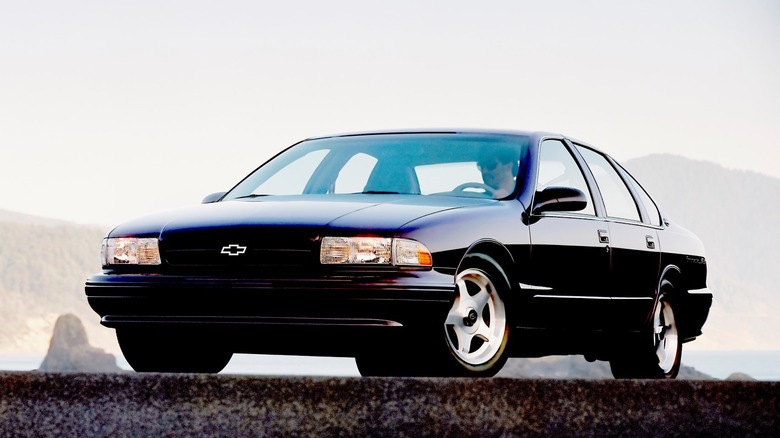
If you want a car that would perfectly fit the definition of a sleeper, look no further than the 1994-1996 Chevy Impala SS. Chevy enthusiasts will point out the slick 17-inch wheels, lip spoiler, and lower ride height, but it's otherwise a regular-looking Impala — one that looks like it came out from a noir movie, that is. Initially, Chevy only offered the Impala SS in black. Then, in 1995, it added two monotone body color options: Dark Cherry Metallic and Dark Grey Green.
There is nothing monotone about this Impala's 5.7-liter V8 from the C4 Corvette, though. It's a detuned version of the LT1 engine, but it still produces a healthy 260 horsepower and a meaty 330 pound-feet of torque paired to a four-speed auto. Yeah, a manual option would've been great, but at least GM's 4L60E transmission could lock its torque converter for quicker gear changes. The combo propelled the Impala SS from 0 to 60 mph in 7.3 seconds.
But the Impala SS wasn't just a straight-line wonder. To tighten up the handling, Chevy's engineers borrowed from the Caprice 9C1's playbook and lowered the suspension by utilizing De Carbon shocks. The Impala SS also received Z-rated performance tires for higher grip and larger 12.1-inch disc brakes. It's a heavy sedan sitting on a ladder frame chassis, so you still shouldn't expect miracles, but well-maintained models are often sold for well over $20,000 today.
1994-1996 Buick Roadmaster Estate (5.7-liter LT1)
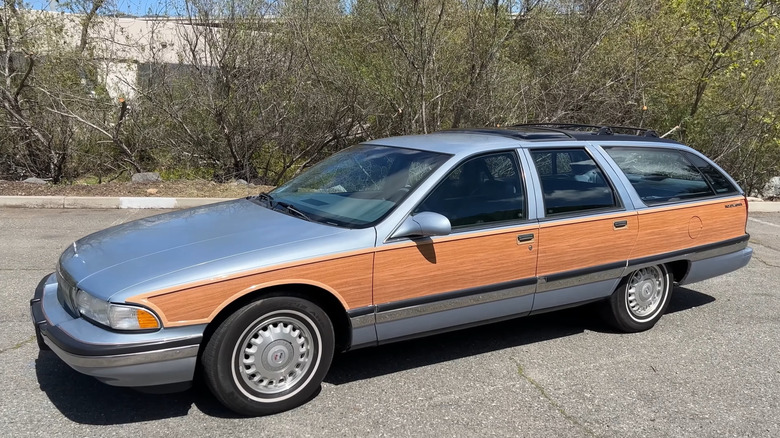
The Buick Roadmaster Estate houses the same 5.7-liter LT1 engine as the Impala SS, producing 260 horsepower and 330 pound-feet of torque. It sprints to 60 in 8.6 seconds when equipped with the standard four-speed auto. Not fast by today's metric, sure — but this is a heavy station wagon we are talking about. For its era and size, it's more than quick enough.
However, the Roadmaster Estate isn't just a performance sleeper; it's also a truck/SUV sleeper. Thanks to the body-on-frame chassis, the Roadmaster Estate can tow up to 5,000 with the trailering package. For comparison, the latest Toyota Tacoma Hybrid is rated at up to 6,000 pounds. Other optional features included a limited-slip differential and a self-leveling air suspension on the rear axle that kept Roadmaster's posture, even with a heavy trailer attached.
The Roadmaster Estate's massive 55-cubic-foot trunk is also a solid substitute for a pickup truck bed. It's so big that Buick offered a rear-facing third row, bringing the total seating capacity to nine people. The max trunk capacity of 92.4 cubic feet is also exceptional for a family vehicle.
1993-1997 Chevrolet Camaro Z28/Pontiac Firebird Trans Am (5.7-liter LT1 & LT4)
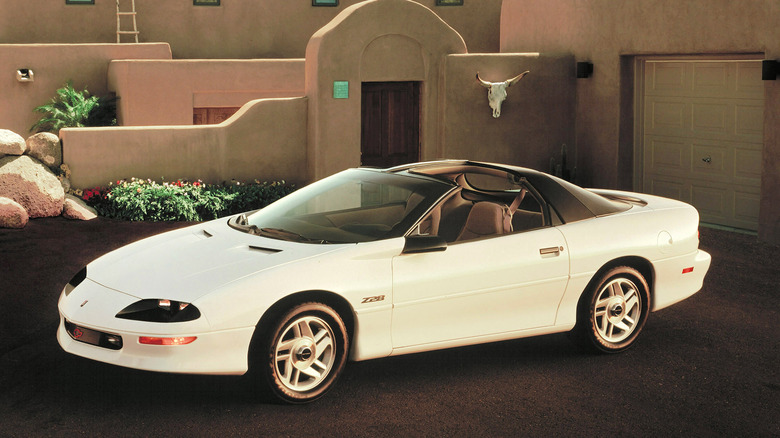
GM was on an LT1 spree in 1994. Apart from its large family cars, the American giant brought the Corvette engine to two enthusiast-grade machines: the Chevy Camaro Z28 and Pontiac Firebird Trans Am. Both based on the same F-body platform and with sleek, fighter-jet designs, GM's 1990s muscle cars immediately drew attention.
But, come on, we all know GM's plan was to bully the fox-body Mustang. The brand did that so convincingly that it wasn't fair on Ford's muscle car. In a 1994 Car and Driver comparison, the fourth-gen Camaro Z28 thrashed the Mustang GT in every performance metric. Its Corvette-derived 5.7-liter LT1 produced 275 horsepower and 325 pound-feet. The Mustang GT only had a 4.9-liter V8 with 215 horsepower and 285 pound-feet. 0-60 times were 5.4 and 6.1 seconds, respectively. And the gap expanded further; the Mustang GT needed 44.7 seconds to reach 130 mph while the Camaro Z28 accomplished it in 26.6 seconds.
The Camaro Z28 also out-cornered and out-braked its fierce rival, too. And unlike GM's family cars, you could get both the Camaro Z28 and Pontiac Firebird Trans Am with a six-speed manual. Buyers could also choose between coupe and convertible models. In 1997, Chevrolet took a step further and introduced the highly-limited LT4-powered Camaro Z28 SS. Again sourced from the Corvette, the improved 5.7-liter V8 produced 330 horsepower, blowing previous models out of the water entirely.
2004-2006 Pontiac GTO (5.7-liter LS1 & 6.0-liter LS2)
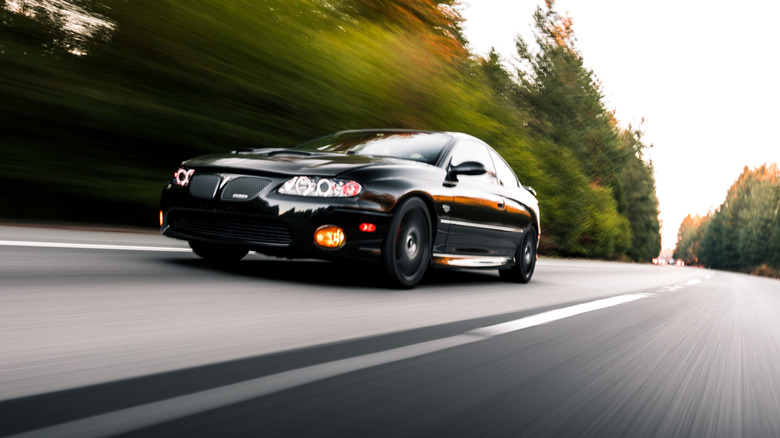
The 2004 Pontiac GTO wasn't as attractive as the Firebird Trans Am. The proportions are all right, but overall, it looks a bit bland. Still, the Australian-built muscle car, which was sold as the Holden Monaro in the land down under, was anything but bland in the performance department; it was the ultimate mid-2000s sleeper. The muscle car's Corvette-sourced 5.7-liter LS1 V8 was good for 350 horsepower and 365 pound-feet of torque, enough for a 0-60 time of just 5.3 seconds in Motor Trend's testing — and that's with all-season tires.
The magazine also praised the driving dynamics, saying the Pontiac GTO felt "so poised, so well-balanced, so confidence-inspiring when you're in full-hustle mode." It also came available with a six-speed manual from Tremec for an even more engaging driving experience. A four-speed auto was available as well; this is an American muscle car, after all.
But that was just the beginning. For the 2005 model year, Pontiac already upped the ante with the improved 6.0-liter LS2 V8 engine from the C6 Corvette for 400 horsepower, 395 pound-feet of torque, and 0-60 in 5.1 seconds. Again, a six-speed manual was an option for enthusiasts, though Pontiac only equipped the GTO with all-season rubber. Put high-performance summers on it, and it will certainly be quicker. Unfortunately, the Pontiac GTO was discontinued after just three years on the market, hinting at Pontiac's ultimate demise a few years later.
2004-2007 Cadillac CTS-V Gen 1 (5.7-liter LS6 & 6.0-liter LS2)
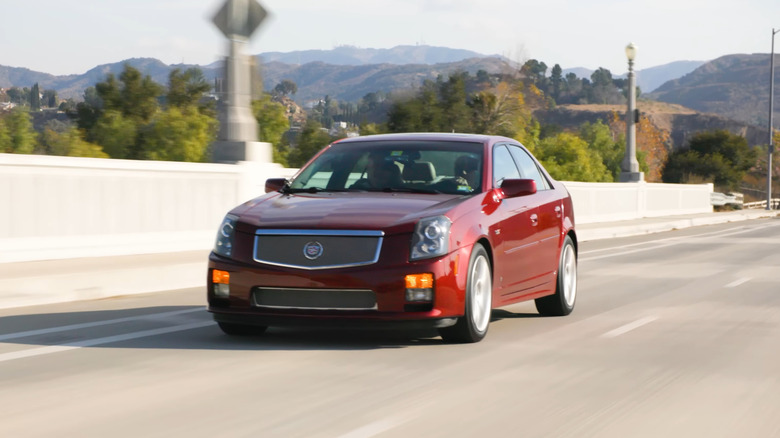
A track-ready engine from the C5 Corvette Z06, a six-speed manual transmission, and a Nürburgring-honed chassis. When it arrived, the CTS-V was like no Cadillac before it. With its angular, futuristic design and powerful internals, the model was aimed directly at rivaling German performance sedans.
To say that the first-gen CTS-V arrived with a bang would be an understatement. It packed the 5.7-liter LS6 V8, good for 400 horsepower and 395 pound-feet of torque. In a comparison test to its German rivals, Car and Driver measured a 0-60 time of just 4.8 seconds and a top speed of 161 mph. Thanks to the balanced chassis, though, the CTS-V was also able to prove itself on the Nürburgring Nordschleife, where it posted a time of 8:19.
Two years down the line, Cadillac replaced the LS6 with the LS2 engine. The new 6.0-liter V8 produced the same horsepower and torque, but the latter was available lower in the rpm range — 4,400 rather than 4,800. The 2006 CTS-V also received a stronger rear differential to better handle the engine's immense torque output. Today, first-gen Cadillac CTS-Vs go for around $20,000, which isn't a bad price for the performance on offer. The futuristic design that starred in 'The Matrix Reloaded' still looks kind of sick today, too.
2008-2009 Saab 9-7X Aero/Chevrolet Trailblazer SS (6.0-liter LS2)
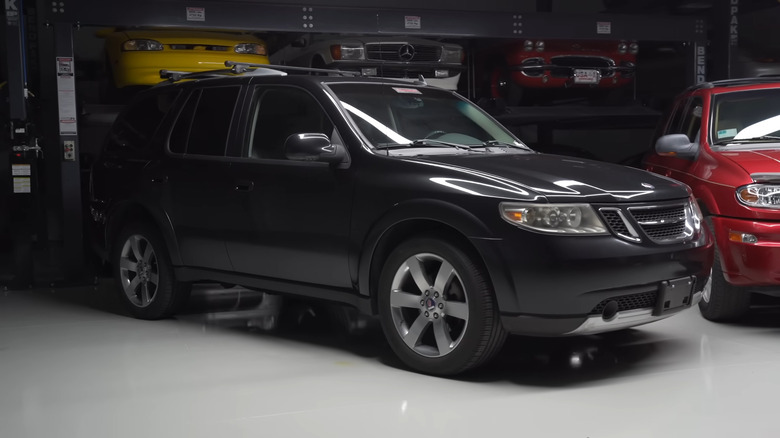
Back in 2005, the XC90 SUV became Volvo's first production vehicle with a V8 engine. The Yamaha-honed 4.4-liter V8 pushed the boundaries with its compact footprint and an excellent 315 horsepower. Predictably, this sparked a countermove from Volvo's perennial hometown rival. Saab's response was the 9-7X Aero, a super-SUV with the 6.0-liter LS2 V8 engine. With 390 horsepower and 395 pound-feet of torque on tap, the 9-7X Aero could easily outrun the XC90 on top of being able to tow a whopping 6,600 pounds. Thanks to the enhanced traction from the AWD system, it also sprinted to 60 in just a little over five seconds.
But wait, how did a Corvette engine end up in a Swedish SUV? Simple: It shared the underpinnings with the Chevrolet Trailblazer SS. In fact, many other GM SUVs were also based on the same platform, like the Isuzu Ascender, Buick Rainier, Oldsmobile Bravada, and GMC Envoy. Only the Saab and Chevy versions received the Corvette engine, though.
Both SUVs also had lowered suspension with Bilstein dampers, a stronger rear axle, and thicker anti-roll bars. They also rode on 20-inch wheels with performance tires for higher grip and curb appeal. Still, their four-speed automatic transmissions and body-on-frame chassis slightly limited their performance abilities. Not that there's much to complain about with a fast, rugged SUV that can tow massive trailers.
2005-2006 Chevrolet SSR (6.0-liter LS2)
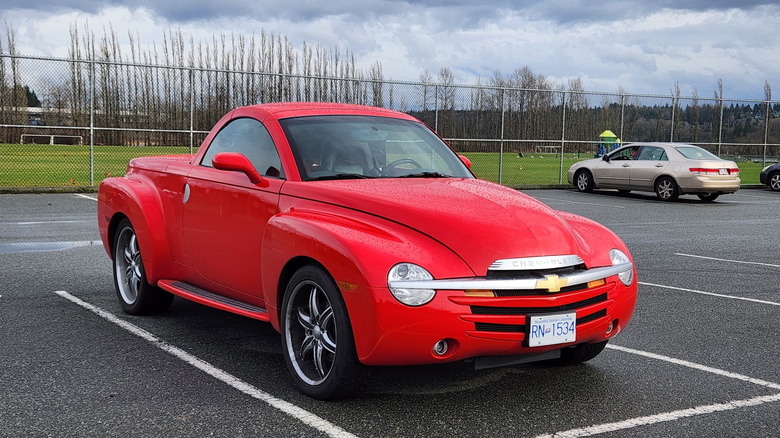
Is it a truck, or is it a sports car? Both and neither. The Chevrolet SSR sits on a ladder frame chassis, just like a pickup truck. Good luck doing utility with it, though. Its bed is too small for anything serious, and the low ride height limits you to smooth roads only. The SSR also weighs a whopping 4,760 pounds, so no, it isn't a sports car, either. The original 300 horsepower 5.3-liter V8 lacked the punch needed to move such a heavy frame with any real authority. The four-speed auto further limited performance, so the 0-60 sprint lasted 7.8 seconds.
But the SSR recipe became way more palatable once Chevy equipped it with the 6.0-liter LS2 engine. Now with 390 horsepower and 405 pound-feet of torque on tap, the 2025 Chevy SSR needed just 5.3 seconds to reach 60 mph. It was also available with a Tremec six-speed manual for a more engaging drive. The improved SSR was still as heavy as before, but it gained retuned steering to sharpen up the experience.
In the end, you could say that the Chevy SSR was both a pickup truck and a sports car. A modern reincarnation of the hot rod, if you will. It might have been short-lived, but it's an interesting prospect as a classic car, with prices ranging from $20,000 to almost $40,000 for pristine, low-mileage examples.
2010-2017 Hennessey Venom GT (Twin-Turbo 7.0-liter LS7)

With a top speed of 270.49 mph, the Hennessey Venom GT became the world's fastest production car in 2007. It beat established machines like the Bugatti Veyron and the Ruf Porsche 911 Twin Turbo. Hennessey Performance also broke the 0-300 km/h (0-186.4 mph) record with a time of 13.63 seconds and the 0-200 mph record with a time of 14.51 seconds.
To achieve these insane figures, the hypercar manufacturer opted for a chassis sourced from the featherlight Lotus Exige. Instead of the Exige's V6, though, Hennessey Performance slapped the 7.0-liter LS7 V8 from the C6 Corvette Z06. Of course, the LS7's 505 horsepower wasn't enough to beat all those records on its own. So, the Venom GT also received two turbochargers, which bumped the output to an insane 1,244 horsepower and 1,155 pound-feet of torque. Did we mention the Venom GT weighs just 1,244 kilograms (2,743 pounds)? One horsepower per kilogram is absolute madness in our book.
It took Chevy 16 years to match Venom GT's output with 1,250 horsepower from the Corvette ZR1X hybrid powerhouse. But that's nothing compared to Hennessey Performance's latest hypercar, the Venom F5 Revolution Evo, boasting a 6.6-liter twin-turbo V8 that produces 2,031 horsepower and reaches an estimated top speed of 318 mph. It should be noted, though, that the Evo's engine was made in-house rather than being taken from a Corvette.
2014-Present Equus Bass 770 (Supercharged 6.2-liter LS9)
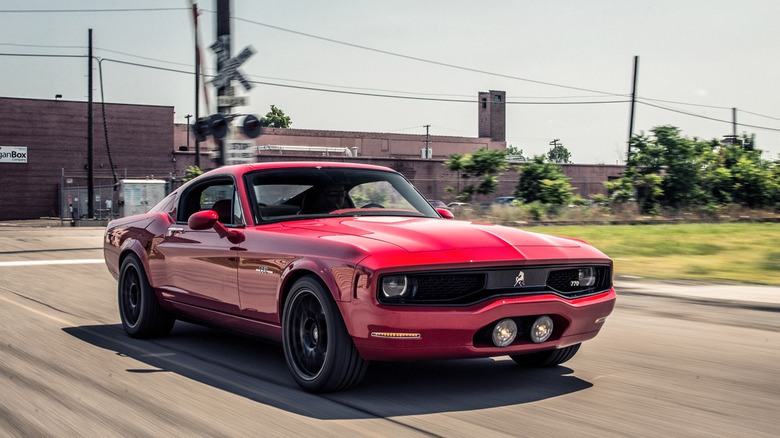
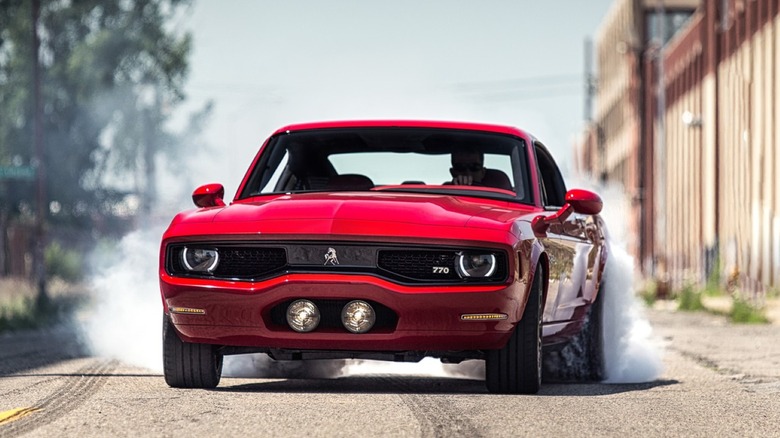
Timeless looks with classic muscle car vibes and limitless power from a supercharged V8. That's what you get from the Equus Bass 770 – a modern boutique muscle car that plays the nostalgia card almost too perfectly. It's like the greatest muscle car hits from the 1960s and 1970s blended into a sleek, aggressive, fastback stunner. It wouldn't even look out of place on our list of the greatest 'coke bottle' style muscle cars of all time.
And it's not just Equus Bass' design that's intimidating. Under the hood, it packs the supercharged 6.2-liter LS9 engine from the C6 Corvette ZR1, which produces an astonishing 640 horsepower and 605 pound-feet of torque. The V8 is paired to a dual-clutch six-speed manual mounted on the rear axle for better weight distribution. According to Equus (as reported by Top Gear), the combo propels the Bass 770 to 60 in a brisk 3.4 seconds. Top speed: 200 mph.
Unlike the muscle cars of yore, though, the Bass 770 isn't built just for straight-line speed. Its chassis is made from aluminum and carbon fiber for lightness and stiffness, resulting in a weight of just 3,459 pounds. In addition, the engine is mounted in a front-mid configuration, which should enhance handling. So, with all these impressive specs, why are you not seeing it more often? That's because it starts at an eye-watering $250,000, with options pushing that price to over $500,000.
2017-2024 Chevrolet Camaro ZL1 (Supercharged 6.2-liter LT4)
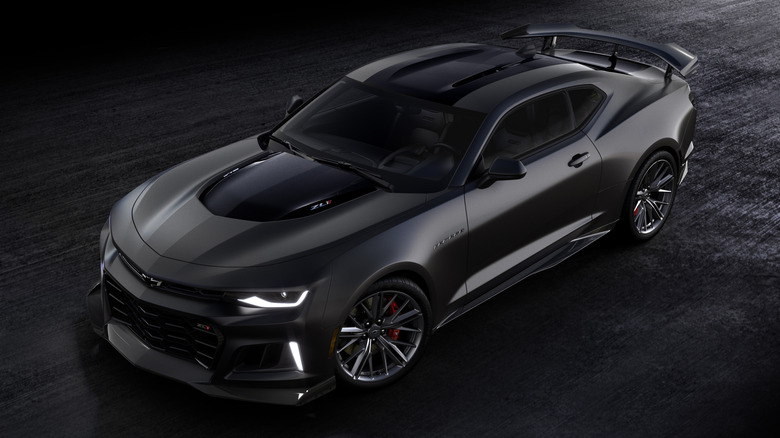
Want the same performance as the Equus Bass 770 but at a fraction of the cost? Get the last Camaro ZL1. It packs the newer LT4 engine from the C7 Z06 Corvette, which produces 650 horsepower and 650 pound-feet of torque for a top speed of 190 mph. 0-60 takes just 3.1 seconds with the 10-speed auto and the six-speed manual takes 3.4 seconds.
Yes, the Camaro ZL1's acceleration is neck-snapping. The same can be said for the adjustable suspension in the 1LE package, which is designed specifically for track use. It's stiff, but it does turn the ZL1 into a track weapon. The package also brings aerodynamic improvements to the table with the front splitter and dive planes alongside the huge rear wing. Together, they create 300 pounds of downforce at 150 mph. Extreme performance summer tires are part of the 1LE package, too.
But the Camaro ZL1 story is also a bittersweet one. After all, the nameplate faced its end with the 2024 model year. Sure, the ZL1 Collector's Edition allowed Camaro to retire with a bang, but this doesn't change the fact that this lineup is no longer sold in dealerships.
2022-2026 Cadillac CT5-V Blackwing (Supercharged 6.2-liter LT4)

The Cadillac CT5-V Blackwing is another enthusiast-grade GM car that's about to be discontinued, with the 2026 model year being its last. It's a shame, because the Cadillac CT5-V Blackwing is a super sedan for people who like driving. It has a crisp chassis with quick turn-in and excellent balance. The steering is surprisingly engaging, too. The CT5-V Blackwing even comes with a six-speed manual, showcasing Cadillac's commitment to producing fun-to-drive cars, but a 10-speed auto is also available for those that might find the experience a bit overwhelming.
See, the CT5-V Blackwing packs the supercharged 6.2-liter LT4 engine from the C7 Corvette ZR1, producing a whopping 668 horsepower and 659 pound-feet of torque. In Car and Driver's tests, this was enough for a 0-60 time of just 3.5 seconds. This much performance paired with a manual might prove challenging for most people — not that we're complaining. The CT5-V Blackwing is one of the last non-electrified super sedans. The Germans continue to push horsepower figures even higher using hybrid power trains, but at what cost? With a curb weight of 5,251 pounds, the 2026 BMW M5 looks like a tank next to the 4,092-pound Blackwing. Let's hope Cadillac takes notes for whatever model replaces it.
2023-Present Cadillac Escalade-V (Supercharged 6.2-liter LT4)
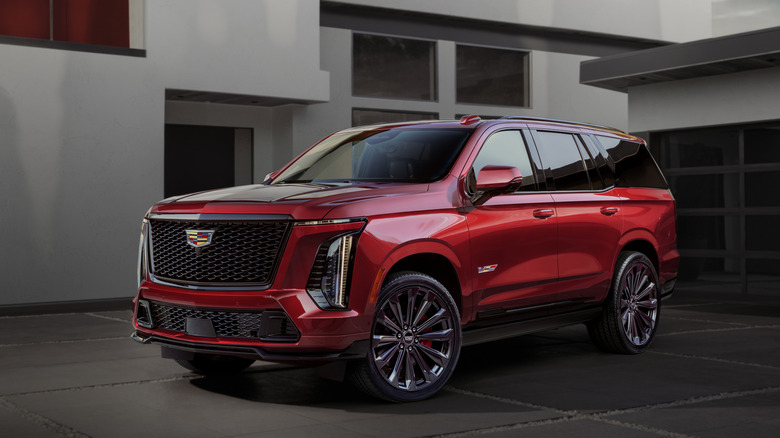
Oh, did you think the BMW M5 is heavy? Think again; the Escalade-V dwarfs any other performance vehicle with a curb weight of 6,352 pounds. It's a boat, all right, but it's a boat that sprints to 60 mph in a ridiculous 4.4 seconds. Interestingly, the Cadillac Escalade IQ EV is almost as quick, reaching 60 mph in 4.7 seconds despite weighing an insane 9,120 pounds.
Still, the Escalade IQ offers no alternative for the thunderous sound of the supercharged 6.2-liter LT4 V8. And there's more appeal than just the aural extravaganza. In the Escalade-V, the Corvette-sourced monster is equipped with a massive 2.65-liter R2650 TVS supercharger, so it produces 682 horsepower and 653 pound-feet of torque. It's paired exclusively with a 10-speed auto, which is the right transmission for such a large and heavy performance SUV.
Unsurprisingly, the Escalade-V isn't the sharp driving tool the CT5-V Blackwing is. Sure, it comes with Magnetic Ride Control 4.0 and Air Ride Adaptive Suspension as standard, but the weight takes its toll in the driving department. It's still impressive for its size, though, and that size allows the Escalade-V to seat seven passengers — and their cargo — in absolute comfort.