

Five Iconic Poster Cars That Just Aren't That Good
Think back to all the cars you had on your wall when you were a kid. Those posters held such promise. The freedom of the open road, the howl of wind whipping through the lowered window, and the feeling of incredible speed all on your bedroom wall. You didn't really know what driving a poster car feels like, but maybe you thought of it like your first kiss. You weren't quite sure how it was going to go, but it was probably going to be the best feeling in the world, right?
Unfortunately, like your actual first kiss, some of the most popular poster cars of all time were sloppy, unwieldy, uncomfortable, and better left to the darker corners of your memory palace. Some cars are incredibly exciting to look at, but a bit bogus to actually drive. The DeLorean DMC-12, for example, was a poorly-built and ridiculously slow pile of junk. The first few years of Dodge Viper production are incredibly cool cars, but they're hot and loud and don't have a roof or windows, which is unforgivable for a car that costs as much as the Viper does. Most supercars that end up on bedroom wall posters, especially the ones from a few decades ago, are pretty awful to drive in one way or another.
So, let's go through a list of some of the coolest-looking cars that you definitely want to look at on a poster on your wall, but you're better off never driving — the four-wheeled dreams that are better left to the dream world, instead of reality. Of course, feel free to drop some of your best recommendations for bad-to-drive poster cars in the comments section, and we'll have a hearty conversation about it.
C3 Corvette
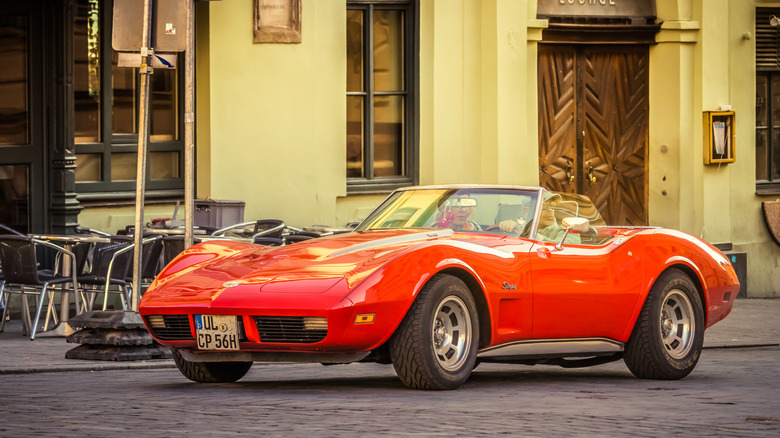
We're starting off strong with one of the most iconic cars of all time: The third-generation Chevrolet Corvette. This is one of the best-looking cars ever made. With gorgeous swooping bodywork and a deeply raked windshield, it's the ideal sports car shape. It even has an American V8 under the hood to make the right sounds and burn rubber when it needs to. There is so much to love about a C3 Corvette. The Apollo astronauts drove C3 Corvettes, for God's sake!
Unfortunately, like almost everything American designed in the 1960s, the C3 Corvette drove like a dang truck. The handling is not nearly as good as the promise of the shape of the car. The rear suspension has a weird transverse leaf spring setup and was designed to be way too stiff because the geometry was wrong to begin with. Don't get me wrong, a properly set up Corvette can go like stink, but to get that speed, you'll be replacing a lot of components GM used for cheap and easy production.
The early C3s are certainly better than their later counterparts, which ride way too floaty, lose a lot of the beauty with unattractive plastic bumper covers, and are choked by poorly-engineered early smog equipment. Every year that went on, the C3 got progressively worse than it was before. You would think development would fix things, but this was a rotten egg driving experience that continued to get even more stinky.
Ferrari Testarossa
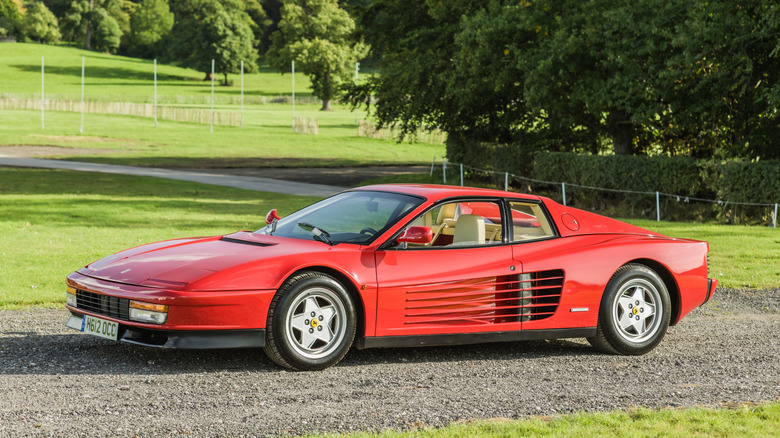
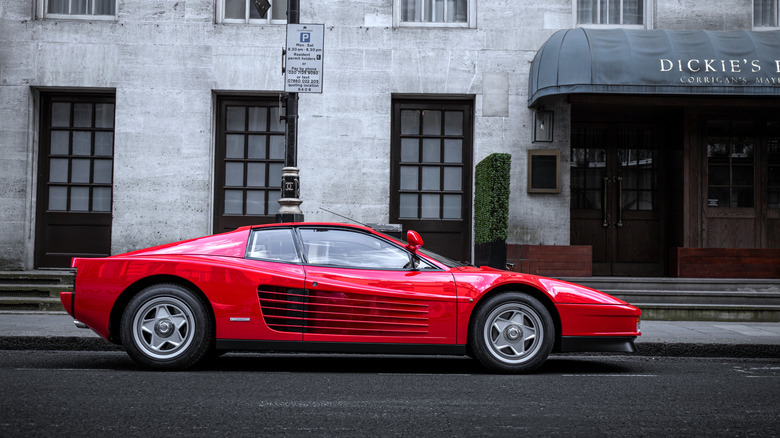
This one might ruffle some feathers, but the ultimate bedroom wall poster car, the iconic straked Ferrari Testarossa, is not good, nor is it fun to drive. This is a long-legged Grand Touring-style car with about as much sporting intent as a contemporary Mercedes SL-class. Despite the big and heavy car's proportions and highway mile-eating capacity, the passenger cabin is too tight for normal-sized people to stay in there for very long. It's made for people to cross continents in, but you'll have to get out to stretch every 100 miles if you are over five-foot-nine.
The Testarossa is also kind of underwhelming from a performance standpoint, at least by 2026 standards. The 375-to-385-horsepower 4.9-liter flat-twelve engine was pretty powerful for the 1980s, but it couldn't touch 200 miles per hour, and barely cracked 100 mph in the quarter mile. Add in the soft and wallowy suspension, and this wasn't really the kind of car you drive because you enjoy driving. This wasn't a fun roads kind of car, it was a long and flat highway kind of car.
Perhaps the Testarossa's biggest sin was its exhaust note. Ferrari is known for building high-revving and sonorous engines, but the flat-twelve was maybe the worst-sounding Ferrari in history. In the lower RPM range, it sounds like the engine is gargling a box of rocks, and while it gets a little better as the revs climb, it's still not as nice as anything else the company has built.
Vector W8
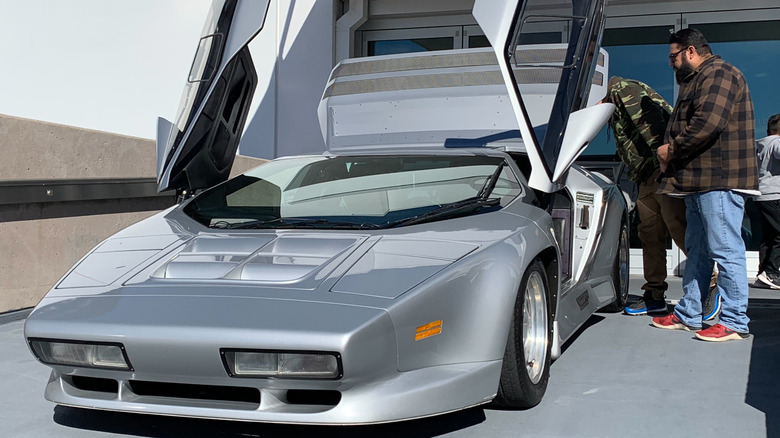
I don't think there's a car on earth with a cooler look and a more disappointing ownership experience than the Vector W8. You would think that a 6.0-liter twin-turbocharged all-American V8 mounted in the middle of a wedgy supercar like this would be a recipe for incredible success. Unfortunately, the start-up nature of the company meant that quality was poor, fit and finish was worse, and nothing ever worked quite like it should. The look in the cockpit is fighter jet core, but the car was hardly airworthy.
In its day, Vector claimed the W8 could run 242 mph, but nobody has ever actually had the guts to test that claim. Built from 1989 through 1993, Vector actually finished only 17 of these cars before the company was taken into receivership. Not only were the cars kind of awful to drive, but the company was insolvent. That's always a recipe for disaster.
To top it all off, the chain-driven three-speed General Motors Turbo-Hydramatic 425 transmission (cribbed from the 1960s front-wheel drive Oldsmobile Toronado) that delivered power from the massive engine to the wheels was about as uninspiring as it possibly could have been. Man, this car had so many promises, and kept none of them.
Hummer H2
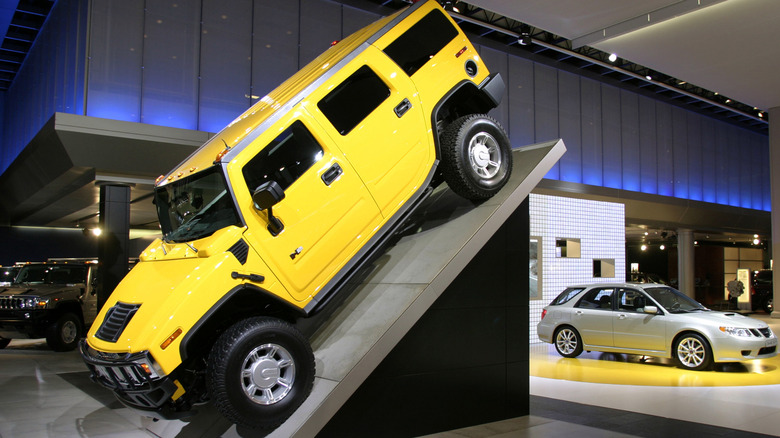
Do you remember the level of unbridled optimism that Americans had in 2002, when the Hummer H2 launched? Money and love were free in equal parts, everything was bright and colorful, the internet was still in its infancy and showed such promise, and technologies were developed every single day that improved the lives of normal people at a rapid pace. No wonder nostalgia for that era is all the rage in 2026, huh?
It was because of all that optimism and free money that General Motors pushed the large and in-charge Hummer H2 into production. Based on the already quite large Suburban platform, the behemoth Hummer brought passenger comforts to the rugged off-road look of the military-minded H1. It was about as in-your-face as SUVs got, and driving one of these down the road practically made you a one-man cult of personality. Arnold Schwarzenegger had one, and he's a big tough guy, so if I want to be a big tough guy, I should get one, too! Make way for me and my giant yellow rolling mech suit.
The H2, unfortunately, turned out to be one of the most disappointing cars in the world. Aside from the terrible visibility and massive impractical size, it often delivered 10 miles per gallon or fewer. In 2002, when gasoline was as cheap as $1.50 per gallon, that sort of fuel economy might've been alright, but when the petroleum price topped $4 just a few years later in the summer of 2008, poor fuel economy became a much bigger problem. Suddenly, you had a giant yellow albatross around your neck.
Fisker Karma
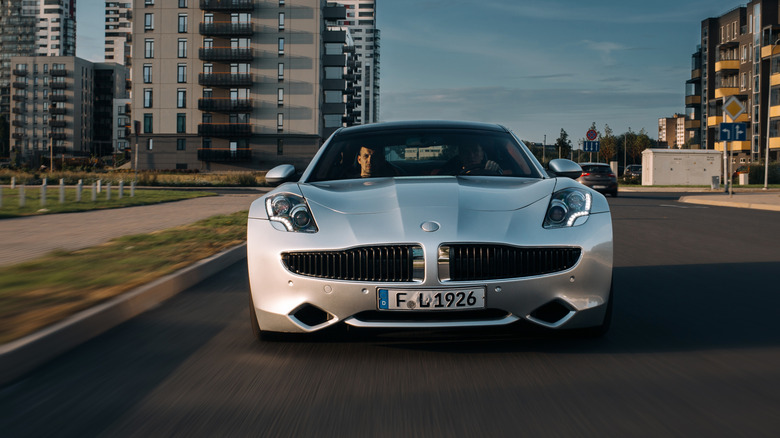
Henrik Fisker is one of history's legendary car designers. Penning the BMW Z8 alone would be enough to give him that sort of status, but he also defined the Aston Martin look for decades. Then, things all started to go wrong when he started designing cars for his own company. Here's the thing: the guy didn't forget how to design cars. It could be argued that the plug-in hybrid super sedan known as the Fisker Karma is the most incredible clean sheet design of his career. Unfortunately, it was kind of a piece of junk.
While the Karma was quick and looked cool, it was impractical, with poor use of space and almost no luggage hauling capacity. Early production cars delivered to the press had multiple failures, and the fuel economy wasn't very good for a car aimed at eco-conscious elites. Within a couple of years, the company was bankrupt, and the cars were pulled from sale. A fire risk recall and poor sales were blamed for the failure, but it was more than that. It was a car that showed such promise from a design standpoint, but it was underbaked when it was delivered to the public.
This is one of those cars that wrote aesthetic checks that it mechanically couldn't cash. There are many such cases, of course, but none so egregious as this one. We all wanted the Karma to be as great to drive as it looked. It could have been the antithesis of the Tesla Model S — you know, like, actually cool. Unfortunately, Fisker had multiple failed attempts with the Karma, the Revero, and eventually the Ocean, and we all know how that last attempt went.