

How To Find (And Fix) An Engine Vacuum Leak Yourself
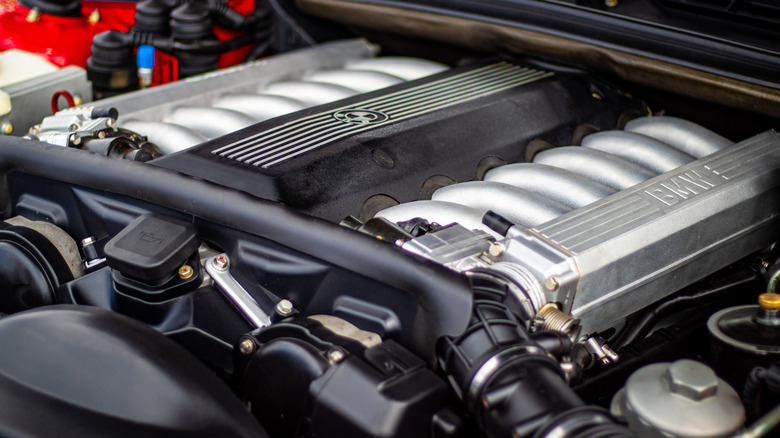
Among the many pesky issues that can confound do-it-yourself mechanics, one of the most simple yet elusive that impacts overall drivability is the common vacuum leak. This is especially true if you're wrenching on an American, Asian, or European car that's a bit older, the reason being that vacuum lines and connections simply wear out as years pass by and mileage accumulates. This author is all too familiar with the perverse use of vacuum under the hood of their B5-generation 2002 Audi S4.
But what is vacuum? In laymen's terms, it's the negative air pressure inside the intake manifold, produced when a piston is on the downstroke, intake valve open, exhaust valve closed, and throttle either closed or partially open. Vacuum lines feed this natural wonder to all parts of an automobile to perform a myriad of tasks, such as providing power brake assistance or actuating emissions equipment.
Because there are so many uses for it, it can be tough to find and fix an engine vacuum leak yourself. But luckily, there are a few handy tricks that take minimal involvement and investment to root them out and fix them for good.
Why are vacuum leaks a pain in the neck, and how do you find them?

The most common symptom of a vacuum leak is poor drivability. This ranges from unsteady RPMs at idle to the engine cutting out randomly, especially when the car isn't moving or when you are taking off from a stop. This is because the engine is running leaner than necessary and letting in unmetered air.
If you have a nicer OBD-II scanner that shows short- and long-term fuel trims, this can indicate a vacuum leak. If it's adding a lot of fuel at idle, which then reduces when the revs are brought up, that's a good place to start. But these scanners aren't in every wrencher's loadout; there are some other more basic methods.
First, find the vehicle's vacuum diagram and simply inspect every line and connection for signs of wear. Get in there with a flashlight, wiggle lines, and look for cracks or breaks. Additionally, if clamps look a bit worse for wear, they might need replacing as they may no longer be keeping their connection tight. With the engine running, you may even hear an audible, high-pitched hissing — wiggling lines could help pinpoint its source. Additionally, inexpensive OBD2 code readers can point you in the right direction by saying what isn't functioning properly.
Another strategy that you might see online involves using map gas or carb cleaner and spritzing around the intake manifold while the vehicle is running. If the idle changes or the engine seems to cough a bit when these are applied, that could point to a leak. However, because flammable gas and liquids don't play nice with a hot engine, this isn't a method we recommend. Thankfully, there's a better way.
Use an automotive smoke machine to diagnose leaks
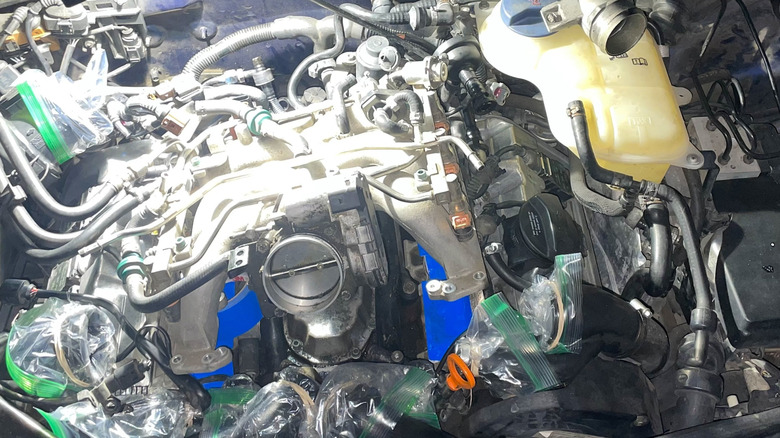
A safer option is to use a smoke machine with the engine off, as demonstrated by the Buddy's DIY YouTube channel. These are easy to find for short money at many auto parts retailers. With this contraption, you plug the throttle and then feed smoke in, often via the plug itself, wait a few minutes, and look for where the smoke seeps out. The smoke is produced by heating mineral oil and won't adversely affect the vehicle — just be sure to let the smoke vent out completely before firing the engine up.
Remedying vacuum leaks by replacing the lines is generally simple. However, removing components to get to them can be tricky, such as removing the intake manifold. Once in there, an ounce of prevention is worth a pound of cure — if you've already removed the intake manifold for a different job, such as replacing intake manifold gaskets, inspect the vacuum lines and replace as necessary.
Some lines may be simple rubber hose rated for automotive use, and, luckily, such material and stainless steel hose clamps can be had for very cheap. Just be sure to measure (or, at least eyeball) the replacement hose to ensure it has the same internal diameter. Other lines may be vehicle-specific, so figuring out what the part is called and then searching for a replacement from a reputable retailer may take some effort.
How to find and fix an engine vacuum leak yourself takes a bit of patience, time, and know-how, but can be quite rewarding. Especially if it means no more bouts of the engine randomly dying.