

The Chevy Camaro IROC-Z Is An Absolute Icon Of The '80s: Here's Why
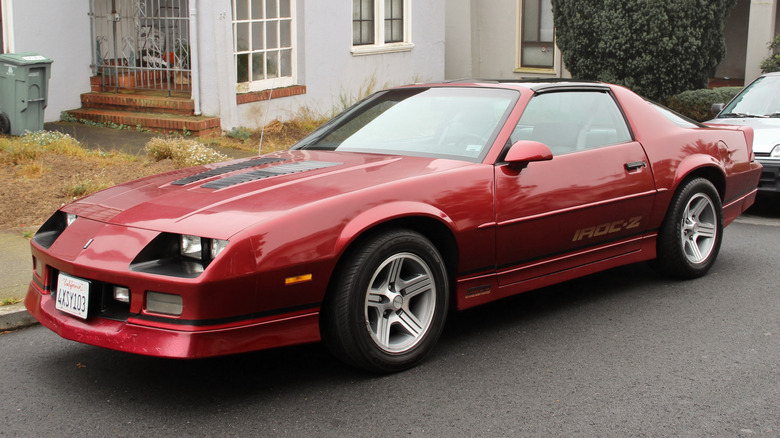
Filling out the Mt. Rushmore of 1980s icons is no easy task. Gordon Gekko? Ronald Reagan? Madonna? One — or both — of the Michaels (Jordan and Jackson)? Nor does it get easier in the automotive realm, since you had rides ranging from the Buick Grand National GNX to the Lamborghini Countach, the latter backed by the kind of unhinged testing shown on vintage "60 Minutes" episodes. Or how about the 1985 Chevrolet Camaro Z/28 IROC Edition that honored the International Race of Champions (IROC) motorsports series?
Don't roll your eyes, the IROC Camaro was the real deal, with the looks, performance, and on-track racing cred needed to help pull Chevrolet — and the rest of the industry — out of the Malaise Era. That was the period roughly from the oil crisis of 1973 to the early-to-mid 1980s when U.S. automakers, caught flat-footed by oil shortages, resorted to power-sapping efficiency measures. It took years for automakers to figure out how to boost power to match the new demand for fuel economy, and the IROC-Z Camaro and its crosstown rival the Ford Mustang GT, were among the cars leading the way.
Yes, the Grand National did its share by showing off a 200-hp turbocharged V6 in 1984, but 1985 marked the first time the Camaro and Mustang were each able to deliver more than 200 ponies since the Malaise Era kicked in — helping ignite the modern horsepower wars in the process. By the time the sixth-generation Camaro went out of production in 2024, it was making 650 horses in its ZL-1 trim.
An introduction to IROC competition and cars
The idea behind the International Race of Champions was to answer another age-old question: Who is the best driver in the world? But rather than a subjective popularity contest, the answer here would come directly from the track, where top racers from multiple disciplines — NASCAR, Formula 1, IndyCars, sports cars, and more — would battle each other in identically prepared cars that would allow each driver's individual skills to tell the story.
The first IROC series was won by the legendary Mark Donohue — also winner of the 1973 Can-Am championship — with drivers competing in Porsche Carrera RSRs. The Chevrolet Camaro became the car of choice for 1974, and while the party line here is that the Camaros delivered the same performance for less cost than the Porsches, it's worth noting that one of IROC's founders, along with a former football player and a Hollywood promoter, was a longtime friend of the Chevy brand Roger Penske.
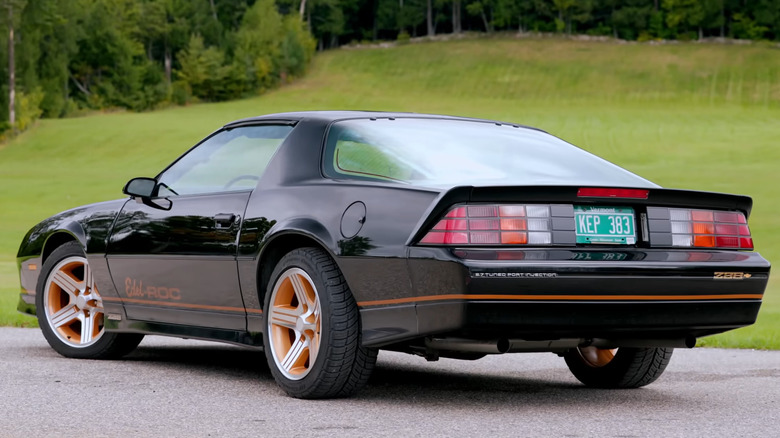
The Camaro would remain the IROC car from 1974 to 1980, when the series went on a short break. It returned to the role again from 1984 to 1989, when the IROC Z ruled the road. The fact that the series was televised tied right into Chevy's goal of racing on Sunday to sell on Monday, too. The IROC series itself would continue until 2006 supported by Dodge Daytonas, Dodge Avengers, and the Camaro's corporate cousin, the Pontiac Firebird. That said, Chevrolet did return to its sponsorship role for the 2025 IROC reunion at Laguna Seca — where today, the likes of Mclaren, Czinger, and Koenigsegg battle for lap records.
IROC on the road
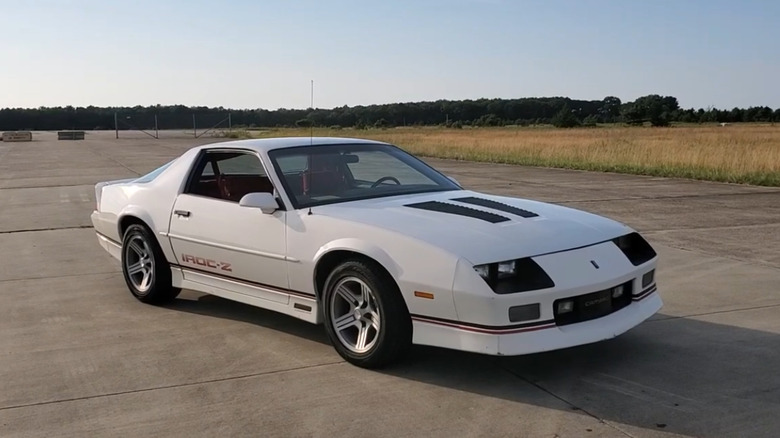
For gearheads looking to get in on the action, the IROC upgrade began as an option package for the regular Camaro Z/28, with many of the enhancements aimed at improved handling. The result was a lowered ride height and suspension revisions front and back, spanning from reinforced front frame rails to rear Delco-Bilstein shocks. Even the jounce bumpers were replaced. (Sometimes called bump stops, these are the bits of rubber that help prevent metal-on-metal contact when the suspension compresses to its limit.)
The muscle for this muscle car actually came in two choices, though with only one engine. The entry point was a 305-cubic-inch L69 V8 capable of 190 horsepower and 240 pound-feet of torque, backed by a four-barrel carburetor. The same motor could also be had with the same Tuned Port Injection system borrowed from the Chevrolet Corvette. Remember, carbs had a longer life than you may have thought. The last carbureted engine sold new in America didn't come until 1994.
The move from carburetors to more modern fuel injection moved the output needle as well, as cars with this version of the V8 could see 215 horsepower and 275 pound-feet of torque. It was enough to make the 1985 IROC-Z the first Camaro capable of breaking 7 seconds on the way from 0 to 60. For some context here, that's about the same amount of time it took the 1986 BMW M3 to get to 62 mph. One downside to driving the Camaro, however, was that despite Chevy offering only a five-speed manual for the carbureted engine, you could only get the more powerful, fuel-injected engine with a four-speed automatic.
Looks that thrill
The street-ready IROC-Z is a sleek and modern-looking machine that was based on the third-generation Camaro introduced in 1982 –- meaning it already had a more sophisticated appearance than prior-year Camaros even before adding any special details. For example, some experts noted inspiration from iconic Italian designer Giorgetto Giugiaro, who cast a long shadow in the industry — see, for instance, the rad wheels from Concept Car Studio.
In addition, John Cafaro, a long-time Chevrolet/GM stylist who worked on the third-gen Camaro, modeled the car's front end after the ones on Porsche's slant-nose racecars. At the rear, the car's large, curved glass hatch added an eye-catching touch and a noticeable increase in practicality. The IROC's lightweight aluminum wheels garnered attention as well, and using 16-inchers marked it as one of the first American cars to have wheels that size for standard equipment.
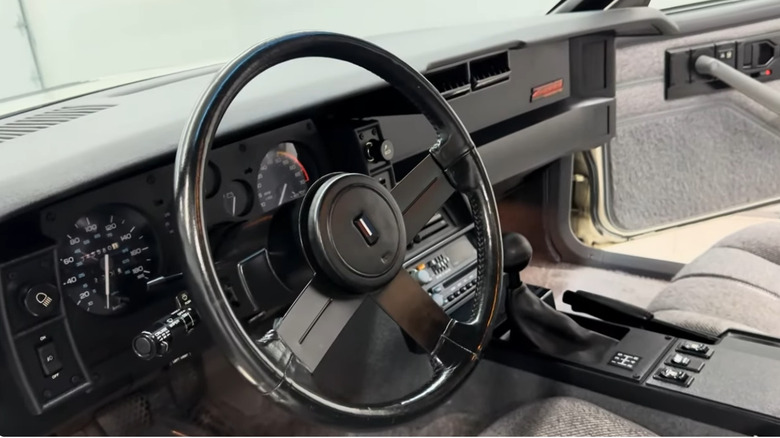
The original 1985 IROC option package then added a long list of appearance upgrades, both functional and cosmetic. In the mix here were extended rocker panels, a larger front air dam, fog lamps, hood louvers, and plenty of racing-inspired graphics — highlighted by the stylized "IROC-Z" lettering along its lower door edges. Nor did the cabin go untouched. Reclining bucket seats — with available six-way power for the driver — were paired with a leather-wrapped steering wheel and a revised instrument panel that added a tach. The result was a more enthusiast-focused vibe set off by what were premium features for the time including air conditioning, power accessories, cruise control, and split-folding rear seats. And yes, this icon of the 1980s could be distinguished by another of the decade's iconic style cues: T-tops!