

The 3 Semi Truck Brands Owned By Volvo
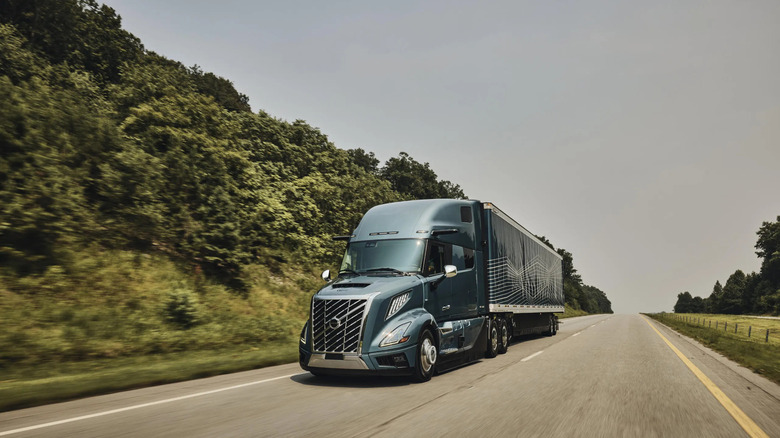
Most Jalopnik fans know Volvo as the brand behind RADwood-era classics like this 1991 Volvo 240 DL, or, more recently, EVs ranging from the low-cost, high-quality 2026 EX30 to the flagship EX90 that puts safety and luxury at the forefront of the ownership experience. And, as our Erin Marquis reported when learning that anyone can drive Volvo's VNL, the brand also makes semi trucks. Well, it's not exactly the same brand.
The Volvo Group, headquartered in Gothenburg, Sweden, owns the Volvo semi brand — as well as Renault Trucks and Mack Trucks — and it's completely different from the Volvo brand selling passenger cars and SUVs. Of course, that wasn't always the case. Volvo introduced its first series production car, the Volvo ÖV4, in 1927, and the company's first truck, the LV Series 1 came the following year. The Volvo Group Volvo operated both passenger car and truck operations from the late 1920s up until 1999, when it sold the car business to Ford. The Blue Oval team then bundled the brand into its Premier Auto Group for a number of years before selling the Volvo Car Corp. to its current owner, the Chinese company Zhejiang Geely, in 2010.
Today, Volvo Trucks remains a core part of the Volvo Group along with not only Mack and Renault Trucks, but a number of other transportation-adjacent brands. Those brands include Volvo Penta for marine/industrial powerplants, Rokbak for articulated construction-style haulers, Nova Bus for buses and similar vehicles, and Prevost for North American bus/motorhome customers.
Volvo Trucks
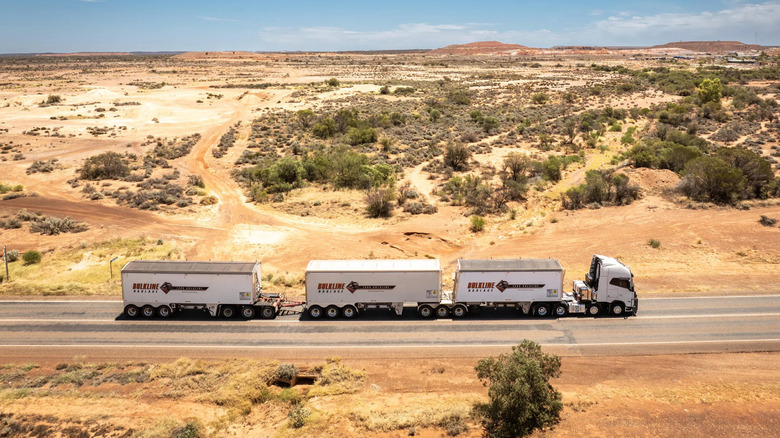
That original 1928 Series 1 was much more like a modern flatbed-style truck than a semi. Yet, with its 28-horsepower four-cylinder engine good for a payload rating of more than 3,300 pounds (1,500 kilograms), and a design tailored to Sweden's often harsh weather conditions and rugged early roads, the Series 1 got the business off to a quick start. In fact, demand was so high that the original production run of 500 trucks had to be complemented by a second batch in short order.
As far as modern semis go, these are considered Class 8 trucks in the U.S., and the first Volvo truck to qualify for that classification was the 1955 Volvo Titan. Volvo's HD truck efforts would also see a joint venture with General Motors that lasted from about 1986 to 1997.
The 2026 Volvo truck lineup includes models that run on diesel, gas, electricity, and CNG, with the FH16 leading the way. Featuring a 17-liter inline six-cylinder engine making up to 780 horsepower and more than 2,800 pound-feet of torque (3,800 Nm), the FH16 showed its strength by pulling what's currently the biggest load a semi truck can tow: At an exhibition in 2021, an FH16 with crawler gears pulled more than 826 tons. In the real world, the FH16 is rated to pull close to 360 tons, which is still not too shabby since it works out to roughly 720,000 pounds –- perhaps the biggest load a semi truck can tow. For comparison, the Ford F-150 sets the towing benchmark for light-duty full-size trucks at 13,500 pounds.
Mack Trucks
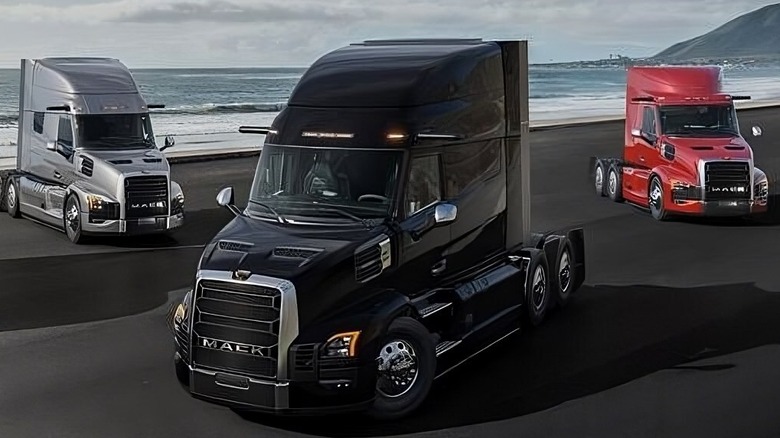
Volvo finalized its ownership of Mack Trucks in 2001 — but it took sort of an indirect route to ownership. What happened was that Renault Véhicules Industriels, the industrial division of Renault the automaker, began buying up Mack stock in the late 1970s and eventually took over complete ownership in 1990. Approximately a decade later, Volvo bought RVI and, with it, the Mack brand.
It no doubt seemed like a good way to grab a firmer foothold in the U.S. truck market at the time. Three brothers — John M., Augustus F., and William C. Mack — got Mack Trucks off the ground in 1900 by building the brand's first engine-powered vehicle, which was actually a bus, not a truck. (Mack had built horse-drawn carriages in the 19th century.) The company extended its product range to trains in 1905, manufacturing both locomotives and rail cars, and it eventually produced its first truck in 1907. Leveraging Mack's beginnings, its early delivery vehicles, driven by 50-horsepower motors, were built on repurposed bus chassis.
The Mack bulldog was born from the brand's service in World War I, when it earned that canine nickname from British soldiers, and the name of the company officially became Mack Trucks in 1922. It had been called the Mack Brothers Co. up until that point. Unfortunately, and despite the launch of its all-new Mack Pioneer semi in 2025, the brand has run into a few bumps in the road under the Trump administration: Mack announced significant layoffs last spring and says tariffs are to blame.
Renault Trucks
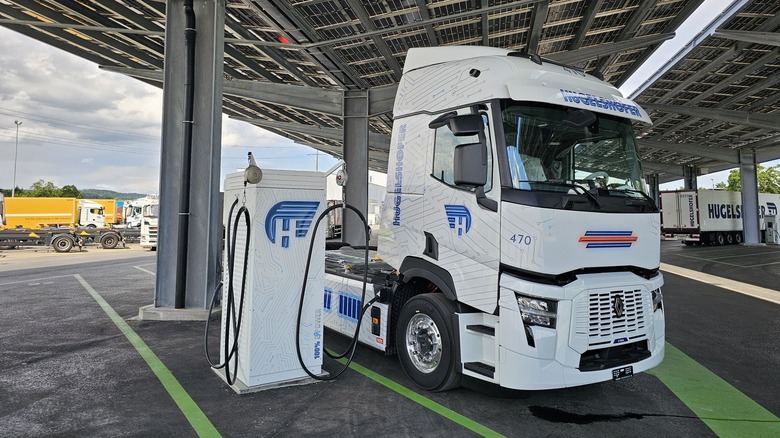
Remember back when we looked at every brand inside the Renault-Nissan-Mitsubishi Alliance? Notably absent was Renault's commercial truck division — Renault Véhicules Industriels — which had been sold to the Volvo Group right around the same period the Alliance was formed: That happened in 1999, while the sale of Renault's truck business to Volvo was finalized in 2001.
Before then, however, Renault Trucks would be involved in plenty of mergers on its own. The story begins in 1899 when the brothers Louis, Marcel, and Fernand Renault formed Renault Frères to focus on building cars. The company also built aircraft engines and gun carriages to support France's military efforts during World War I, and it even developed and built an early modern tank. A slowing post-war economy put Renault — and many other vehicle makers — into financial difficulties that were mostly solved over the years by mergers and acquisitions.
By 1978, the French truck market was basically split between SAVIEM, a group that included Renault trucks, and Berliet, another long-running French truck brand that had grown by buying up smaller companies. When the two groups themselves merged that year, it was under the banner of Renault Véhicules Industriels, which, as mentioned, was bought by the Volvo Group in 2001 and renamed Renault Trucks in 2002.
Renault keeps trucking into the future, too. Along with a robust portfolio of diesel trucks, Renault is one of many brands working to electrify the trucking industry. The company recently introduced the Renault E-Tech T with a range of more than 370 miles.