

Four Spark Plugs, Eight Pistons, One Stroke: How The INNengine E-REX Promises To Be Different
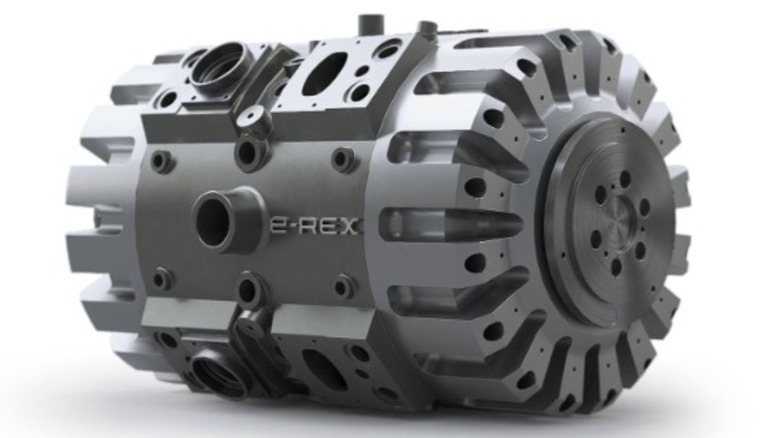
You've seen plenty of weird engines on Jalopnik, from Trojan's weird two-stroke, four-cylinder cube with wishbone-shaped connecting rods to the Napier Deltic triangle-18 diesel, but never have you ever been confronted with a one-stroke engine. Technically, you still won't even after reading about the INNengine e-Rex, but we'll get to that momentarily.
The INNengine company, based in Granada, Spain has created two adorably tiny, strange little engines: the e-Rex and the Rex-B. Inside the e-Rex, you'll find a situation not unlike the aforementioned Napier Deltic in that it has twice the pistons (eight) as cylinders (four). These pistons move toward each other to create compression and, as they move away from each other, reveal ports in the cylinder walls for intake and exhaust. If this sounds suspiciously similar to a two-stroke engine, yes, don't get ahead of me.
Each set of pistons sits on a spinning disk shaped sort of like a Tilt-A-Whirl's undulating floor. Car and Driver legend and quantam-brained engineer Csaba Csere calls this thing a thrust plate, so I will, too, though "axial cams" is apparently also acceptable. While the e-Rex uses two of these plates for two sets of pistons, the Rex-B uses a single plate and a single set of four pistons in four cylinders with fixed heads.
Now, about INNengine's patented "1Stroke" technology. This engine isn't a one-stroke engine. It tackles combustion and exhaust in one stroke, then intake and compression in another stroke. For the math-inclined among us, you'll notice that adds up to two strokes. The reason INNengine calls this two-stroke engine a one-stroke, or "1Stroke," is that the company wants to distance this design from the traditional stigma of dirty two-strokes that burn oil along with the fuel, which the e-Rex and Rex-B don't.
I'm putting out no vibrations
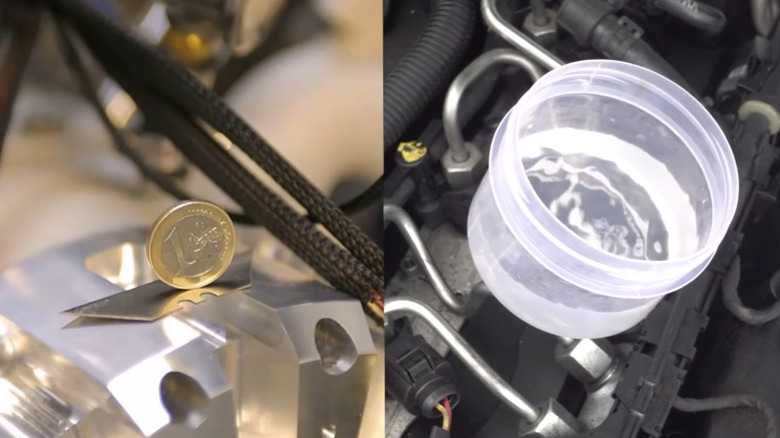
The cool thing about using opposing pistons in the e-Rex is that the engine should be quite well balanced. INNengine even did a coin test like it was a Rolls-Royce V12, and the coin barely moved, while a cup of water the team placed on a normal car engine and it shook like a T-Rex was approaching.
And the two thrust plates can move out of phase with each other to change where the pistons are in relation to each other. In other words, it can change compression ratios on the fly without the complexity of the failure-prone Nissan variable compression engine.
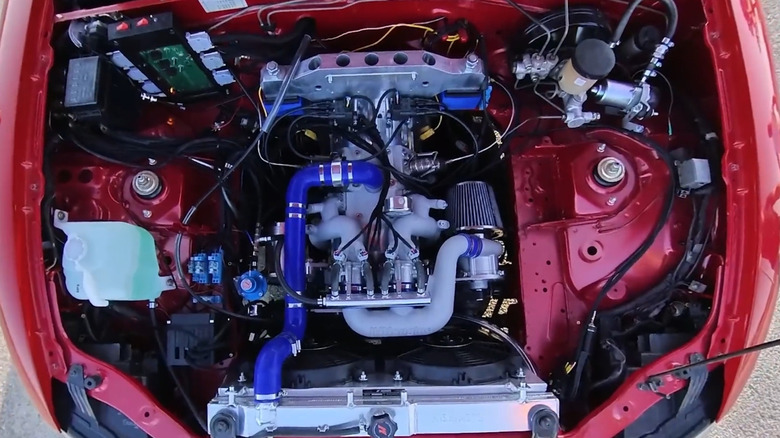
At 500 cubic centimeters, with a weight of 85 pounds, this engine is minuscule (the company is working on a 700cc version), but INNengine claims it makes 120 horsepower on atmospheric pressure. For testing purposes, INNengine stuck an e-Rex in a Mazda Miata. It sounds pretty neat:
If you read through the comments, you'll see plenty of people writing that there's clearly a supercharger there, so saying that the e-Rex is making 120 hp purely through natural aspiration is bunk. Well, not necessarily. This is a two-stroke, after all, so that supercharger is likely there for scavenging. It's the same concept as Detroit Diesel 71-series bus and truck engines, whose scavenging blowers also add zero power.
Scavenging is where two-stroke engines bring in fresh air for a new combustion event and expel exhaust from the last one. Where a blower/supercharger comes in handy is that it helps fill the cylinders with new air to push out spent gases and prevent them from sticking around for another combustion cycle. It's not compressing the air in the chamber to increase cylinder pressure, it's allowing the engine to simply breathe.
Let's cut down on those moving parts, too
Engineers love reducing contraptions down to as few parts as possible, and INNengine does away with traditional four-stroke engines complex valve trains and even the downsides of direct injection. Yes, this is a direct-injection engine, but with no valves, there's no buildup of deposits, as happens in traditional crank-and-rods engines with direct injection. And unlike in a two-stroke, there's no exhaust port lid or cover to close after the intake, since piston movement is what takes care of opening and closing the ports.
Though INNengine popped an e-Rex into a Miata for testing, the company envisions it more as part of a range-extending system where it would essentially be a battery charger. According to the company, emissions and efficiency are on par with four-stroke engines, yet with the power density of a two-stroke. Also, its variable compression allows for varying states of tune to accommodate different fuels.
Now, what about this "1Stroke" issue? If the e-Rex were a real one-stroke engine, it would need to make power whenever the piston travels from top dead center to bottom dead center and vice versa. To put it in traditional engine terms, a one-stroke would make power for every 180 degrees of crankshaft rotation, going through suck, squeeze, bang, blow essentially all at once.
Could some clever designer figure out how to create a second combustion chamber with a plug underneath a piston to drive it back up to top dead center? Sure, that's how AMPERe's prototype one-stroke engines work, but that's not what's going on with the INNengine. Calling the e-Rex a one-stroke is a pragmatic choice, similar to how some racing series refer to Mazda's "1.3-liter" rotary engine as a 2.6-liter.