

Chevy's Original V8 Story Starts In 1917, Not The 1950s
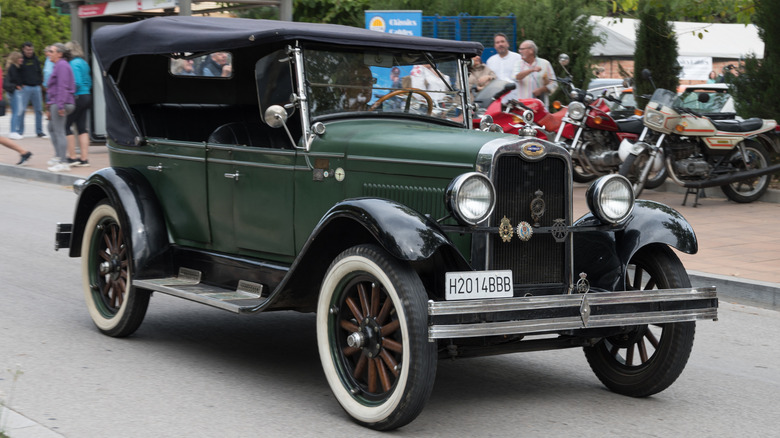
When enthusiasts talk about Chevrolet V8's history, the conversation almost always starts in 1955 with the small block, which had some powerful iterations over the years. That's understandable. The 265-cubic-inch V8 reshaped Chevrolet's image and went on to become one of the most influential engines ever built. But it wasn't Chevrolet's first attempt at eight-cylinder power.
That story actually begins nearly four decades earlier, in 1917. Chevrolet's first V8 powered the long-wheelbase Model D. At the time, the company's bread-and-butter car was the four-cylinder Chevrolet 490, a lightweight, affordable machine aimed squarely at the mass market. The Model D was something entirely different. It rode on a 120-inch wheelbase and weighed roughly 3,200 pounds, as opposed to the 490, which had a 102-inch wheelbase and was 1,820 pounds. The Model D also carried a price tag more than twice that of the 490, at $1,500 — nearly $38,000 today — rather than $660.
Advanced engineering came at a high cost
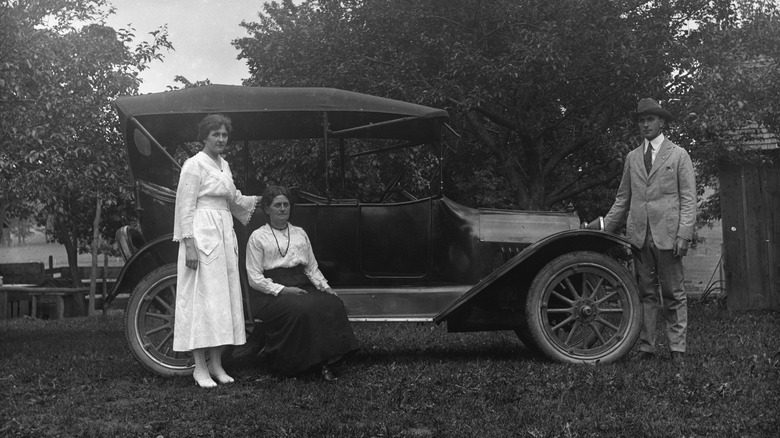
Under the hood was a 288-cubic-inch V8 running a standard liquid cooling system, with a bore and stroke of 3.375 and 4 inches, respectively. It used a single-plane 180-degree crankshaft, which was standard in the V8s of that era, and also gave them a rather distinctive sound. In a departure from other early V8s, though, the fork-and-blade arrangement of the connecting rods was ditched for paired ones. That layout was possible because the two-cylinder banks were slightly offset.
The valve train, however, was what really set the engine apart. While most contemporary V8s relied on side-valve layouts, Chevrolet's engine used overhead valves actuated by a central camshaft and pushrods. Even the block construction was unusual, using a two-piece iron casting split vertically down the crankshaft centerline, as opposed to having a cast-aluminum crankcase with separate cast-iron blocks for each cylinder bank.
The rocker covers weren't oil-tight like the ones in other engines, and the pushrods weren't covered completely. Owners were expected to lubricate the system manually, aided by an oil can mounted on the firewall. Instead of a conventional bell housing, the three-speed transmission was bolted at the back to a bracket, leaving much of the clutch exposed for cooling.
Output figures have been listed as ranging from the mid-30-horsepower range to about 55 hp at roughly 2,700 rpm. Compression hovered around 4.75:1, appropriate for the low-octane fuel of the time. Performance was smooth and competitive, but the design's complexity and cost worked against it.
Why Chevrolet walked away from its first V8
Production totals tell the story. Chevrolet built just 3,500 or so Model D cars from 1917 to 1919. By mid-1918, Chevrolet was no longer an independent automaker. It had joined the General Motors family, with brands that already occupied the premium end of the market.
Within that structure, there was no longer a clear role for a high-priced Chevrolet V8. As a result, the Model D V8 was quietly phased out, and Chevrolet returned its focus to four-cylinder engines, later followed by the well-known sixes that carried the "Valve in Head" advertising slogan. The change in direction was a good thing at the time, because if the company hadn't proven itself valuable, it would have likely joined the long list of brands killed by GM over the years.
Chevrolet wouldn't offer another V8 for 36 years. When the small block finally arrived in 1955, it carried forward the same basic overhead-valve architecture first seen in the Model D, but executed with thin-wall casting techniques, lower cost, and a clear eye toward mass production. In hindsight, the 1917 V8 looks less like a footnote and more like a preview.