

5 Three-Wheeled Motorcycles That Are Cheaper Than A Harley-Davidson
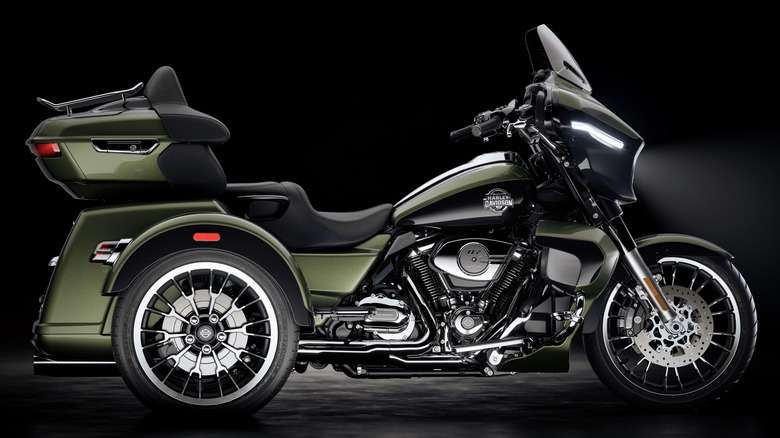
Three-wheeled motorcycles — also known as trikes — can offer the same wind-in-your-face thrills as the two-wheeled variety, but on a more stable platform. As a result, they can unlock the excitement for people who aren't confident trying to balance hundreds of pounds of motorcycle between their legs, whether for physical reasons or just lack of experience. Trikes can be more comfortable, offer more storage solutions, and some people think trikes are safer than motorcycles (in certain driving situations). But all those benefits can come at a price — one that's often higher than for a typical entry-level motorcycle.
Let's look at the Harley-Davidson lineup, for example. Harley-Davidson's weirdest side hustles saw a number of different three-wheel vehicles go into at least limited production, but the company didn't start building three-wheelers for everyday riders until the launch of the 2009 Tri Glide Ultra Classic. Today, the brand keeps a trio of trikes on its roster, with prices ranging from $36,799 for the Road Glide 3 up to $54,999 for the CVO Street Glide Limited. At that point, you could purchase cars like the Ford Mustang GT Premium, Subaru WRX, VW Golf R, Honda Civic Type R, or even a Cadillac CT4-V and still have change.
That sets a fairly high ceiling when we're looking for three-wheelers that are cheaper than a Harley-Davidson. And keep in mind, we're not only looking at new rides; some surprising used trikes can be found in the same online classifieds as other motorcycles.
Can-Am Canyon
Also known for its two-wheel motorcycles, ATVs and side-by-sides, Can-Am comes to the trike party from a completely different direction than Harley. The Can-Am On-Road models — which Can-Am says are classified as three-wheel motorcycles by the National Highway Traffic Safety Administration (NHTSA) — have two wheels up front and one in the back in what's called a tadpole configuration; the Harley-Davidson three-wheelers are the other way around. The key differences are that the former setup generally has a more car-like driving experience, and more room for a second rider, while the latter still feels more like you're riding a traditional motorcycle.
With that out of the way, let's turn to today's real topic: pricing. The brand's cheapest trike for 2026 is the Can-Am Ryker at $9,699, and while this is indeed a pretty basic machine — highlights are limited to items like fender-mounted front LED lighting, a glove box, and dual USB ports — it also (very slightly) undercuts the lowest-cost Harley two-wheeler. What's maybe more relevant here is that all the Can-Am trikes are priced below all of the Harley-Davidson three-wheelers.
That includes the Can-Am Canyon that we got our hands on in 2025. The Canyon brings tons of adventure flavor to the table, helping satisfy your appetite for off-road action with a semi-active suspension, four drive modes, anti-slip foot pegs, and the brand's XPS tires that are designed in-house specifically for Can-Am three-wheelers — all for an MSRP of $25,999. Moreover, you can move up to the top trim level, the $32,499 Canyon Redrock, flaunting an upgraded suspension plus another, custom drive mode, seating for two, and aluminum cargo cases, and save thousands compared to buying the least-expensive Harley trike.
Polaris Slingshot
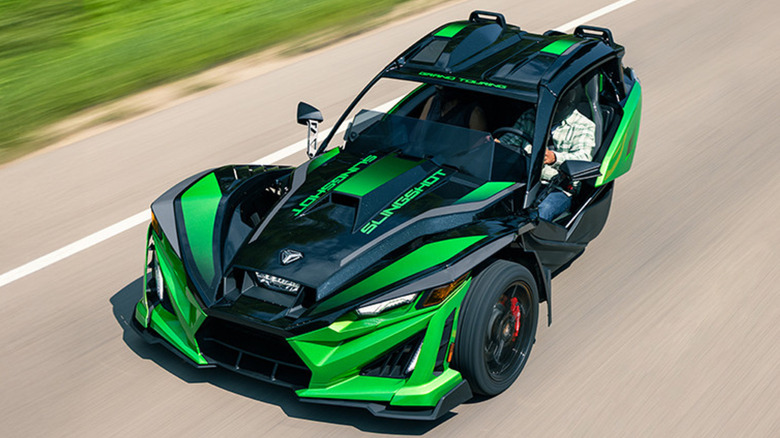
The Polaris Slingshot perhaps pushes the boundaries for what's considered a three-wheel motorcycle. After all, these bikes have steering wheels, not handlebars, traditional foot pedals instead of hand controls, and offer what can be generously called a roof. It's car enough to have earned a Roush edition, too. Yet here's what Polaris says: "The classification of the Polaris Slingshot is state-dependent. The most common classifications are motorcycle, which requires a motorcycle endorsement or license, and autocycle, which only requires a state driver's license."
As for what Jalopnik says, well, Logan Carter found the whole experience so unpleasant it set off his fitness tracker's stress monitor. Of course, he also admitted he wasn't part of the Slingshot's target audience, many members of which have had a very different response.
The vehicles themselves? The 2026 Slingshot family leads off with the S trim that has a starting price of $24,999 — $10,000 below the entry cost for the Harley-Davidson trikes — and peaks with the $41,999 Slingshot Grand Touring. Roll up to your local Polaris dealership with that sort of budget, and you can ride out with a SlingShade roof, two side-by-side heated/cooled seats, a Rockford-Fosgate sound system, and a rearview camera, all packed into a flingable fun machine with a 204-horsepower engine and a curb weight of about 1,800 pounds. Even better, you can get it with a manual transmission for maximum driver engagement. The same amount in your bank account will still leave you more than $10,000 shy of the MSRP of the highest-priced Harley-Davidson three-wheel motorcycle.
Yamaha Niken
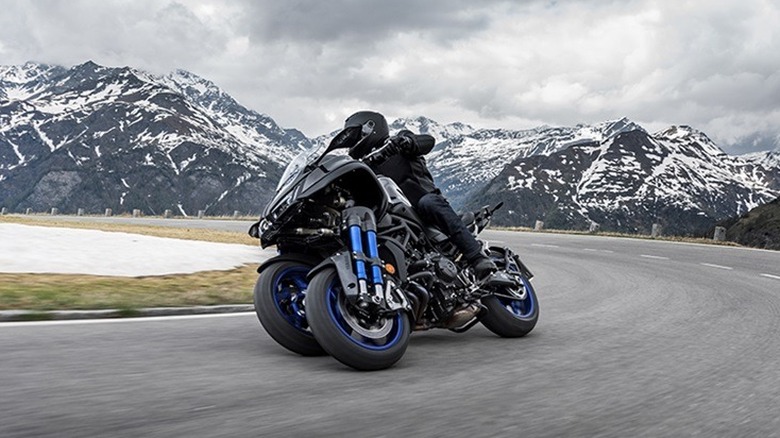
Regardless of how you feel about the Slingshot's motorcycle credentials, you aren't likely to mistake the Yamaha Niken for anything else. Nor may you ever see one in the wild, since they sold in such limited numbers. Yamaha first sold the Niken in the United States for the 2019 model year, only on its website, and it was pulled from the U.S. market only a few years later. The usual explanation is the Niken's unusual appearance, though it's got nothing on the ugliest cars our readers still love.
Named after the Japanese word for "two swords," the motorcycle lives up to that billing with its Leaning Multi-Wheel chassis. It rides with two traditional-style 15-inch front wheels, each mounted on its own fork but able to lean in unison for cutting through corners with enhanced handling. Yamaha, however, stressed that the real-world results would still feel like a traditional setup when riders got behind the handlebars — note that the single rear wheel was a 17-incher.
Price-wise, the Niken had an MSRP of $15,999 when it premiered, which translates to approximately $21,000 today — again representing a massive bargain versus the three-wheelers from Harley-Davidson. Further, despite their rarity, they're not exactly collector's items. A recent-ish listing on CycleTrader had a single example at $13,990. In Europe, where they were a bit more common, Nikens can be found more often in the 6,000 to 8,000-Euro range (equivalent to roughly $7,000 to $9,300).
Ural Gear Up
Do you like your three-wheeled motorcycles served up with a heaping helping of irony? In that case, you might be interested in a Ural Gear Up. It's an updated version of the Ural sidecar motorcycles originally built by the Soviet Union to fight the fascists in World War II. It has now become a favorite of the same country's modern fascist-in-chief, Vladimir Putin, who even surprised an Alaskan Ural owner with a free bike after Russian journalists discovered he was riding one of their older models.
Needless to say, there were a lot of twists and turns in Ural's history, but today it's a private company, headquartered in Washington state and right in the midst of another turning point. Ural announced it would stop production of its legacy models for export markets at the end of 2025 to focus on a fresh project, the Ural Neo. To be clear, though, when this story was written, there were still new 2025 Urals at dealerships for riders who want a unique approach to shared motorcycle adventures — and aren't worried about seeming to support the Russian war machine.
The most popular setup is the Gear Up Standard that starts at about $22,000 — well under the starting point for Harley trikes, remember. This gets you onto a 41-hp motorcycle with a design created in the 1940s as a clone of the BMW R71, paired with a robust sidecar that, in turn, has its own front bumper, front LED fog lights, auxiliary power outlet, and reinforced floor protection. A sidecar tonneau cover is also standard for when you're riding solo.
Rewaco
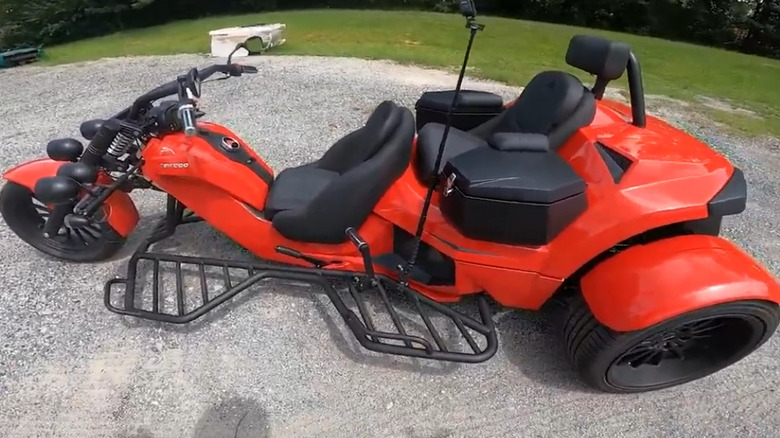
At this stage, you've probably noticed that while our choices are all three-wheeled motorcycles, none really looks like a rival to the Harley-Davidson trikes. For that, you can shop the rides from Rewaco. In business in Germany since 1990, Rewaco takes the Harley formula of having two rear wheels and one up front, and then expands on it — like to the point where Rewaco's trikes can exceed 12 feet in length. To put that into context, it's more than 3 feet longer than the Harley Street Glide 3.
The extra length gives you plenty of space for a passenger — and on some Rewaco trikes, multiple passengers – along with the ability to carry more cargo. Motivation comes from your choice of 1.5-liter four-cylinder engines sourced from Mitsubishi, with the naturally aspirated motor good for 110 hp and the turbo unit ready to serve up 140 hp.
The mill helps the Rewaco RF1 GT, with an MSRP of $49,900 that's well within the range for Harley-Davidson three-wheelers, move from 0-60 in a brisk 5.9 seconds and keep on rolling right up to a top speed of 110 mph. At the same time, you can enjoy standard upscale details like heated seats, an adaptive chassis, a rearview camera, and bright accents. An Apple CarPlay/Android Auto infotainment system backed by a 6.1-inch screen and a (separate) 180-watt Bluetooth sound system are among the options — giving you an advantage over GM's four-wheel transportation, for instance, since the General will eventually drop that connectivity from every model, not just EVs.