

Look At The Goofy Wings On Bugatti's Prototype Veyrons
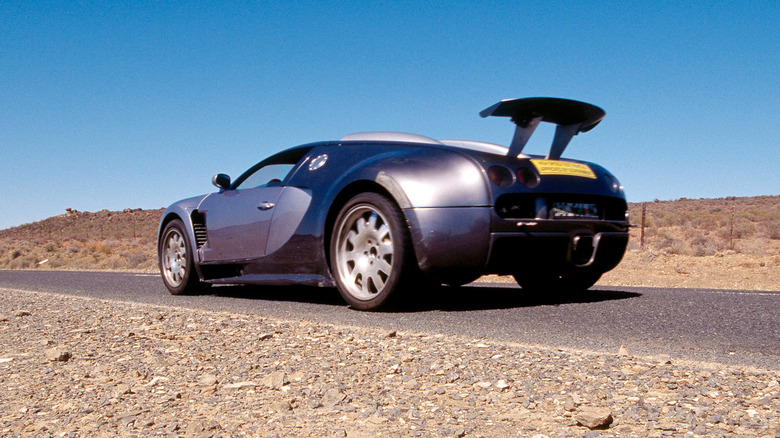
As you may already know, especially if you read my opus from a couple months ago, Bugatti is busy celebrating the 20th anniversary of the Veyron. Yes, the first concepts were shown in 1999, and the car's long development was very public, but the first production Veyron delivery was in April 2006, so Bugatti has been working its way up to that milestone with a bunch of different event showcases and press releases celebrating the Veyron. Among its many innovations and boundary-pushing engineering benchmarks, the Veyron was one of the first cars with advanced active aerodynamics, particularly its complex hydraulically-actuated rear wing.
This latest release isn't about the wing, and in fact it doesn't even mention it, being more of a general story about the Veyron's development from the eyes of Loris Bicocchi, Bugatti's then high-speed expert. But the attached photos of prototypes undergoing dynamic testing made me laugh because of how goofy the rear wings look in some of them, with the cobbled-together prototypes being a far cry from the beautifully machined arms of the final thing.
One of the industry's first airbrakes
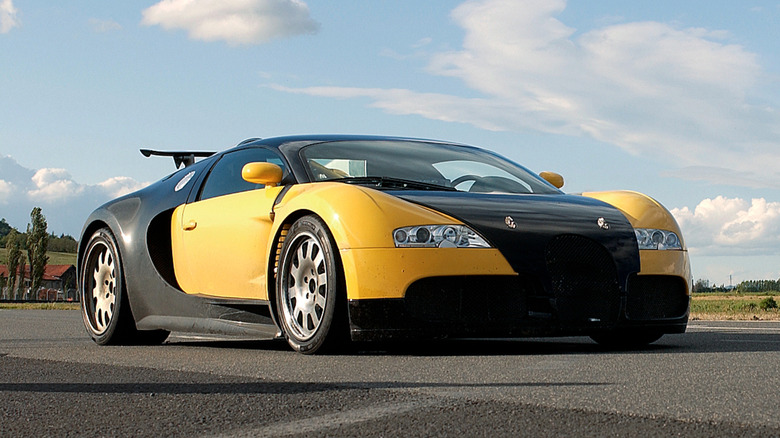
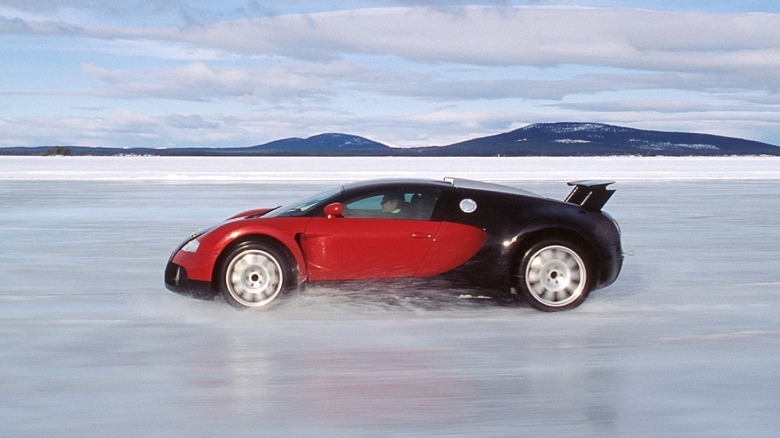
For these earlier builds, it seems like Bugatti found some generic aftermarket wing and attached it to hastily made metal stands that were stuck onto the rear deck. The wing seems to be even taller than the production one will get in handling mode, and the shape and width just don't look right. In some of the other photos, like the one below, the prototype seems to have a closer approximation to the final thing, but with coverings over the complex metal arms and their hydraulic hoses. As development continued, the shape and size of the wing evolved to be a simpler, sleeker profile.
 Bugatti
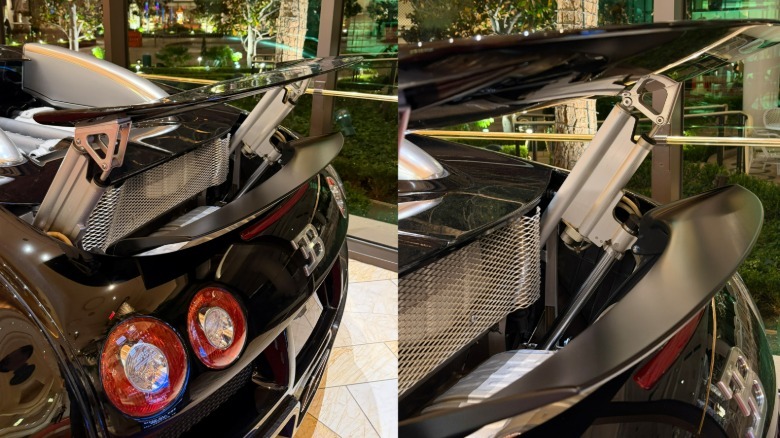
The production Veyron's wing was mighty impressive, especially for the time but even now. In regular driving the wing lays flush with the rear deck, but at 112 mph the car enters handling mode, where the suspension lowers, flaps in the front end open, and the rear wing deploys at a 14-degree angle. When the main wing extends, a secondary spoiler also slides out, sitting just on top of the rear bodywork with a 24-degree angle. In this setting the wing provides 770 pounds of downforce. If you hit the brakes at above 124 mph, the upper wing flips up to a 55-degree angle (and the lower one goes to 27) in less than 0.4 second, acting as an air brake that increases deceleration force by an additional 0.6 g, to a total of 2 g. To reach the Veyron's 253-mph top speed, you have to insert a second key into a special slot next to the driver's seat; do so and the car hunkers down even more, the front flaps close, and the rear wing and spoiler are retracted to become just a lip spoiler at a 3-degree angle.
 Daniel Golson / Jalopnik
Another thing you may have noticed in these photos are the large vents just behind the front wheel arches. These vents, which were likely for extracting heat from the brakes, went through a few different iterations over the years. At some point during the development, Bugatti determined they weren't actually necessary, so production Veyrons got smooth fenders and doors with no vent. (There is a small vent at the very front of the side skirts, though.) Otherwise, the production Veyron ended up looking identical to these early prototypes, which themselves were extremely close to the original concept.