

Here's What Using The Wrong Spark Plugs Can Do To Your Engine
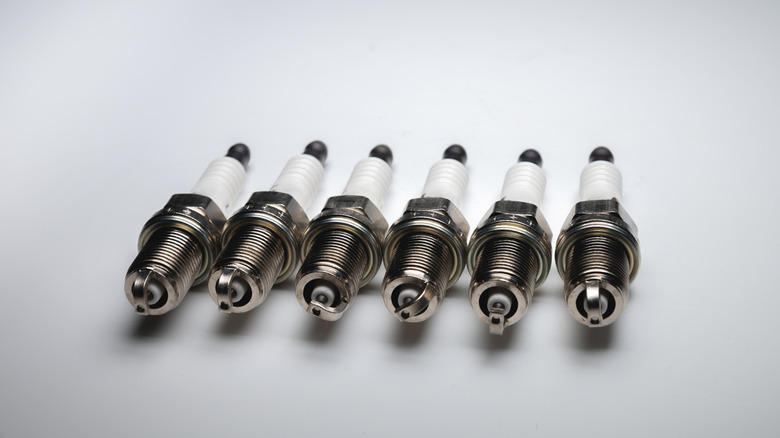
All spark plugs may look the same to the untrained eye. Unfortunately, nothing could be further from the truth. For starters, spark plugs come in many types that are mainly differentiated by the exotic metals utilized on the tips of the center and ground electrodes. That's why you'll commonly hear car enthusiasts referring to copper, platinum, or iridium plugs when talking about their engines. In this regard, using the wrong kind of plug, like swapping copper plugs for an engine that requires iridium, will lead to performance issues, misfires, poor fuel economy, and a plug that degrades more quickly than usual.
And that's just the tip of the iceberg. As it turns out, spark plugs come in many sizes, too, and they have threads to compensate for the reach, diameter, and pitch of the firing end. This is important, since the diameter of the firing end should perfectly match the threads in the cylinder head. Using the wrong kind or forcing it to screw into the hole will surely strip or cross-thread the cylinder head, damaging it severely.
As you can tell by now, using the wrong spark plugs can lead to minor issues or bigger problems later on. However, there's also such a thing as a spark plug heat range, and not adhering to it could have dire consequences for your car's engine.
Spark plugs come in hot or cold variants

You may be surprised that spark plugs come in hot or cold varieties, and it doesn't have to do with how warm or cool they feel if you touch them. There are pros and cons to hotter or colder plugs, but modern engines are designed to have the correct heat range of spark plugs from the factory.
Spark plugs produce the necessary jolt of energy for the engine to produce power, but their role also has to do with how it pulls away heat from the combustion chamber. Thus, the heat range of a spark plug has to do with how effectively it disperses heat during operation.
Cold plugs have a higher heat dispersal rate, while hot plugs disperse heat more slowly. Cold spark plugs have shorter insulators and are applied to high-performance motors, engines that can scream to higher rpms, or motors with higher operating temperatures. Meanwhile, hot plugs have longer insulators and are typically found in low-compression engines for passenger cars and crossovers. Hot spark plugs have tips that remain hotter to help burn carbon deposits.
Using the wrong heat range is bad for your engine

Engines with higher compression ratios typically need cold spark plugs since they run hotter than lower compression motors. Installing hot plugs into a cold engine could lead to harmful pre-ignition, due to too much heat inside the chamber. Moreover, intense heat could overheat the motor or wear out the electrodes of the plug prematurely.
On the other hand, forcing a hot engine to run with cold spark plugs could lead to annoying misfires, early fouling of the spark plug tips, and excess carbon deposits. In some cases, the engine could stall or not start at all. A persistently misfiring engine is bad news for the transmission and drivetrain, and it could lead to early wear and thousands in potential repair bills.
You can avoid the hassle and eliminate the guessing game by referring to your car's owner's manual or service booklet before buying a new set of spark plugs. In most cases, the heat range of a plug is determined by the number in the product code. A lower number typically means a colder plug, while a higher number refers to hotter spark plugs. Lastly, be aware that the market is riddled with counterfeit or fake spark plugs, so it's best to be vigilant and purchase only from reputable auto stores and online shops.